. 2012 Jan;78(2):363-70.
doi: 10.1128/AEM.06333-11. Epub 2011 Nov 11.

Isolation of bacteria capable of growth with 2-methylisoborneol and geosmin as the sole carbon and energy sources

Affiliations

Isolation of bacteria capable of growth with 2-methylisoborneol and geosmin as the sole carbon and energy sources

Lior Guttman et al. Appl Environ Microbiol. 2012 Jan.

Abstract

Using a relatively simple enrichment technique, geosmin and 2-methylisoborneol (MIB)-biodegrading bacteria were isolated from a digestion basin in an aquaculture unit. Comparison of 16S rRNA gene sequences affiliated one of the three isolates with the Gram-positive genus Rhodococcus, while the other two isolates were found to be closely related to the Gram-negative family Comamonadaceae (Variovorax and Comamonas). Growth rates and geosmin and MIB removal rates by the isolates were determined under aerated and nonaerated conditions in mineral medium containing either of the two compounds as the sole carbon and energy source. All isolates exhibited their fastest growth under aerobic conditions, with generation times ranging from 3.1 to 5.7 h, compared to generation times of up to 19.1 h in the nonaerated flasks. Incubation of the isolates with additional carbon sources caused a significant increase in their growth rates, while removal rates of geosmin and MIB were significantly lower than those for incubation with only geosmin or MIB. By fluorescence in situ hybridization, members of the genera Rhodococcus and Comamonas were detected in geosmin- and MIB-enriched sludge from the digestion basin.


Figures
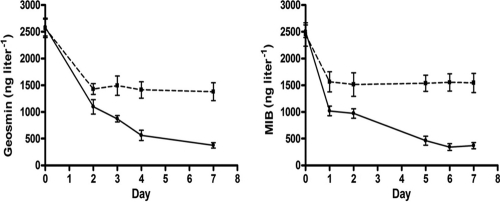
Fig 1
Fig 1
Geosmin (left) and MIB (right) biodegradation under nonaerated conditions in mineral media containing crude (●) and sterilized (■) sludge obtained from a digestion basin. Rates represent mean values (n = 3).
Fig 2
Fig 2
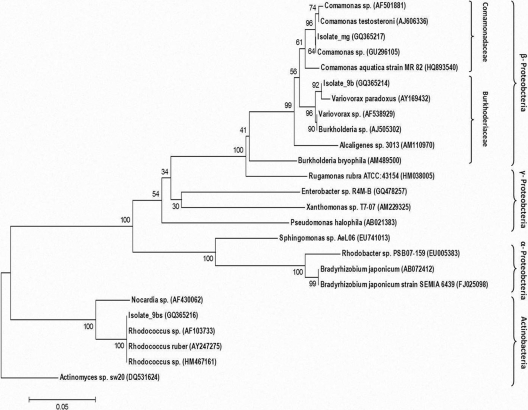
Phylogenetic tree analysis of 16S rRNA gene sequences of three bacterial isolates found capable of geosmin and MIB biodegradation. Bacteria isolated in the current study are noted with their GenBank accession number. Numbers on branches represent bootstrap tests of phylogeny (500 replicates) using the neighbor-joining with maximum likelihood analysis tool.
Fig 3
Fig 3
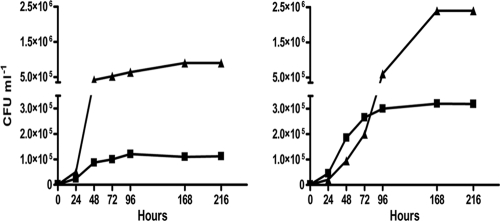
Growth of the Rhodococcus sp.-like isolate (expressed as CFU ml−1) during incubation in mineral medium under aerobic conditions with geosmin (left) and MIB (right). Initial geosmin and MIB concentrations were 2.5 μg liter−1 (■) and 2.5 mg liter−1 (▲).
Fig 4
Fig 4
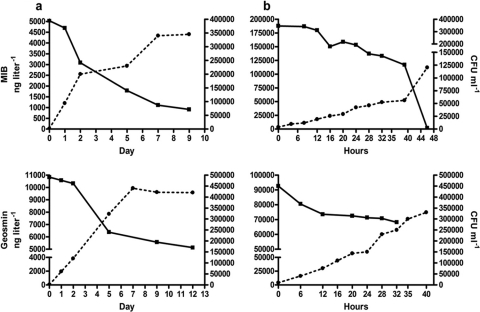
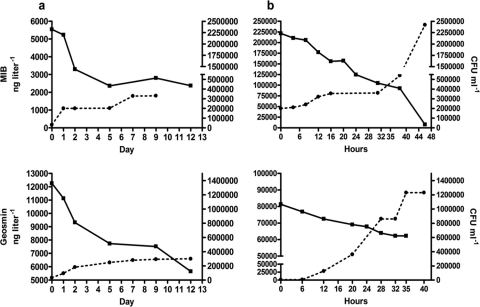
MIB (top) and geosmin (bottom) degradation (■) during growth (●) of a Variovorax paradoxus-like isolate in mineral media containing MIB or geosmin as the sole carbon source under nonaerated (a) and aerated (b) conditions. Rates are mean values of duplicate analyses. Net loss is depicted relative to abiotic control treatments. Differences between the duplicate determinations did not exceed 10%. Note the use of different time scales for the aerated and nonaerated treatments.
Fig 5
Fig 5
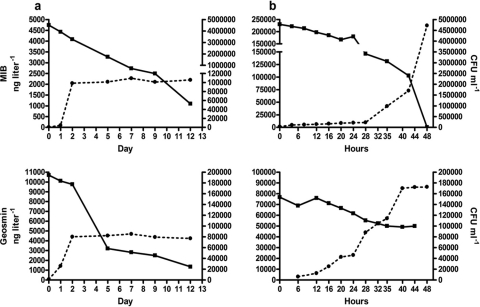
MIB (top) and geosmin (bottom) degradation (■) during growth (●) of Rhodococcus sp.-like isolate in mineral media containing MIB or geosmin as the sole carbon source under nonaerated (a) and aerated (b) conditions. Rates are mean values of duplicate analyses. Net loss is depicted relative to abiotic control treatments. Differences between the duplicate determinations did not exceed 10%. Note the use of different time scales for the aerated and nonaerated treatments.
Fig 6
Fig 6
MIB (top) and geosmin (bottom) degradation (■) during growth (●) of the Comamonas sp.-like isolate in mineral media containing MIB or geosmin as the sole carbon source under nonaerated (a) and aerated (b) conditions. Rates are mean values of duplicate analyses. Net loss is depicted relative to abiotic control treatments. Differences between the duplicate determinations did not exceed 10%. Note the use of different time scales for the aerated and nonaerated treatments.
Fig 7
Fig 7
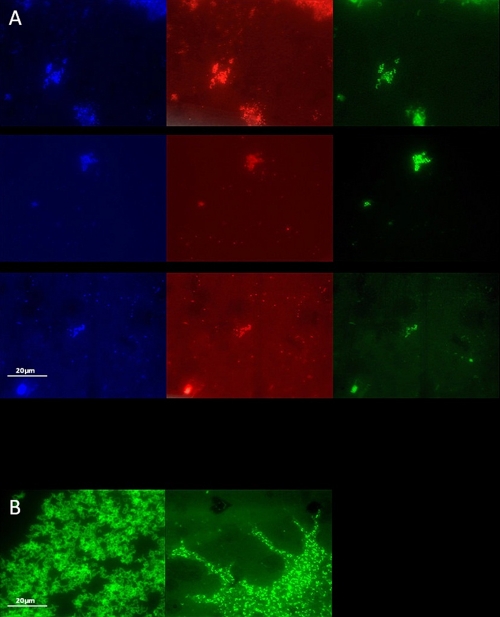
FISH analysis of sludge bacteria with DAPI (blue), EUB338 (red) and the targeting probes (green) HGCr69A (top panels), RHCOC3 (middle panels), and COM1424 (bottom panels) (A) and the Rhodococcus sp.-like isolate with the 16S rRNA targeting probe RHCOC3 (left) and the Comamonas sp.-like isolate with the 16S rRNA targeting probe COM1424 probe (right) (B).

References

    1. Altschul SF, et al. 1997. Gapped BLAST and PSI-BLAST: a new generation of protein database search programs. Nucleic Acids Res. 25:3389–3402 - PMC - PubMed
    1. Amann R, et al. 1990. Combination of 16S rRNA-targeted oligonucleotide probes with flow cytometry for analyzing mixed microbial populations. Appl. Environ. Microbiol. 56:1919–1925 - PMC - PubMed
    1. Amann R, Ludwig W, Schleifer KH. 1995. Phylogenetic identification and in situ detection of individual microbial cells without cultivation. Microbiol. Rev. 59:143–169 - PMC - PubMed
    1. Amann R, et al. 1996. rRNA-targeted oligonucleotide probes for the identification of genuine and former pseudomonads. Syst. Appl. Microbiol. 19:501–509
    1. American Public Health Association 1992. Standard methods for the examination of water and wastewater, 18th ed. American Public Health Association, Washington, DC

MeSH terms

Associated data

LinkOut - more resources