


doi: 10.1016/j.ddmod.2011.07.002.
A Neurobiological Model of Insomnia
Affiliations
- PMID: 22081772
- PMCID: PMC3212043
- DOI: 10.1016/j.ddmod.2011.07.002
Item in Clipboard
A Neurobiological Model of Insomnia
Drug Discov Today Dis Models.
2011 Winter.
Abstract
Insomnia is a common clinical condition resulting in significant costs and morbidity. Previous models of insomnia focusing on psychological and behavioral processes are useful clinically, but lack neurobiological specificity. We propose an insomnia model based on basic and clinical neuroscience findings, and hypothesize that insomnia results from persistent activity in wake-promoting neural structures during NREM sleep. The simultaneous occurrence of sleeping and waking neural activity helps to explain clinical phenomenology and treatment effects in insomnia.
Figures

This simplified circuit diagram outlines key neural structures and physiological processes that regulate sleep in humans. See text for details. Solid arrows indicate direct anatomic or physiologic pathways. Dotted arrows indicate indirect pathways. VLPO = Ventrolateral preoptic area. LHA = Lateral hypothalamus/perifornical area. LC = locus coeruleus. LDT = Laterodorsal pontine tegmentum. PPT = Pedunculopontine tegmentum. TMN = Tuberomamillary nucleus.
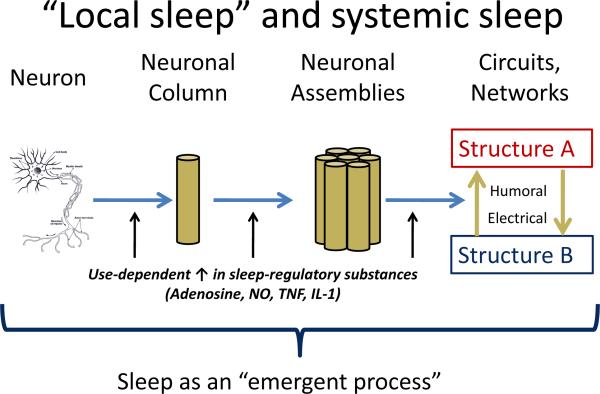
The concept of local sleep proposes that sleep-like activity is an inherent property of neurons and neural assemblies, mediated by the use-dependent accumulation of various sleep-regulatory substances. The occurrence of sleep behavior in the whole organisms depends on the proportion of neuronal assemblies in the sleep-like state, which can then influence central sleep regulatory structures. See text for details. Adapted from [23].

This figure depicts an overview of the Neurobiological Model of Insomnia with regard to existing conceptualizations of sleep-wake regulation. Panel A presents a simplified model of the bi-stable “sleep switch” proposed by Saper and others. Panel B presents a model of insomnia based on the work of Cano et al., using a rat model of transient insomnia. In this conceptualization, the “sleep switch” is seen as unstable, with frequent transitions between sleep and wakefulness. Panel C presents a model of insomnia informed by the “local sleep” conceptualization, and consistent with our proposed model. In this model, different brain regions may simultaneously show sleep-like and wake-like activity. Refer to Figure 4 and the text for further details.

This figure depicts the Neurobiological Model of Insomnia in greater detail with regard to specific neural circuits and processes. The three panels present our conceptualization of normal sleep wake function (A), sleep-wake function in untreated insomnia (B), and the effects of treatment on sleep-wake function in insomnia (C). Within each panel, we depict specific brain systems (right column of boxes) which generate—and are in turn influenced by—a set of physiological processes (left column of boxes) to regulate overall sleep-wake function (far right box). (A) In the “normal” condition, neural circuits and structures that regulate sleep and wakefulness generate appropriate psychophysiological arousal, circadian rhythms, and homeostatic sleep drive. These structures include cortico-limbic circuits that regulate cognitive and emotional arousal, and the default mode network that may regulate self-awareness; hypothalamic centers (including the sleep-active median and ventrolateral preoptic areas and wake-promoting lateral hypothalamic hypocretin neurons) that control the “switching” between sleep and wakefulness; and brainstem-hypothalamic arousal centers (e.g., posterior hypothalamus, locus coeruleus, raphe nuclei, cholinergic brainstem nuclei) that in turn innervate cortico-limbic systems. The specific brain systems and physiological processes have extensive feedback interactions among themselves, and with each other. In insomnia (B), we hypothesize activation (pink boxes) of cortico-limbic and brainstem-hypothalamic centers and a relative increase in psychophysiolgical arousal. In addition, insomnia may also be characterized by impaired function (blue boxes) of circadian and homeostatic function. Increased arousal, coupled with reduced circadian and homeostatic sleep drive, may result in the sleep and waking features of insomnia. Deficient function of the sleep-wake “switch” (hatched green box) could also contribute to increased wakefulness in insomnia. Treatment effects in insomnia are shown in (C). Cognitive-behavioral treatments for insomnia may specifically target the dysregulated processes that characterize insomnia, whereas pharmacologic treatment may directly affect brain centers including cognitive-affective circuits and hypothalamic-brainstem arousal centers. Diagonally-filled boxes indicate changes anticipated with treatment. See text for details.

18F-fluoro-deoxyglucose was injected in 18 primary insomnia and 18 good sleeper subjects after they had been in NREM sleep for 10 minutes. Following 20 minutes of glucose uptake, subjects were awakened for 3-D PET scans. The amount of NREM sleep during the uptake period did not differ between the two groups. Using SPM-2, regions with greater relative glucose during the uptake period in insomnia patients were identified. The pseudo-color map shows a map of voxel-by-voxel t-values. Insomnia patients had greater relative glucose metabolism in broad regions of the dorsolateral and parietal cortex and the precuneus.
References
-
- Lichstein KL, et al. Insomnia: Epidemiology and risk factors. In: Kryger MH, Roth T, Dement WC, editors. Principles and Practices of Sleep Medicine. Elsevier; 2011. pp. 827–837.
-
- Roth T, et al. Prevalence and perceived health associated with insomnia based on DSM-IV-TR; International Statistical Classification of Diseases and Related Health Problems, Tenth Revision; and Research Diagnostic Criteria/International Classification of Sleep Disorders, Second Edition criteria: results from the America Insomnia Survey. Biol.Psychiatry. 2011;69:592–600. - PubMed
-
- Morin CM, et al. The natural history of insomnia: a population-based 3-year longitudinal study. Archives of Internal Medicine. 2009;169:447–453. - PubMed
-
- Edinger JD, Means MK. Overview of insomnia: Definitions, epidemiology, differential diagnosis, and assessment. In: Kryger MH, Roth T, Dement WC, editors. Principles and practice of sleep medicine. fourth edition Saunders; 2005. pp. 702–713.
-
- Perlis M, et al. Models of insomnia. In: Kryger MH, Roth T, Dement WC, editors. Principles and Practices of Sleep Medicine. Elsevier; 2011. pp. 850–865.
Grants and funding
LinkOut - more resources
Full Text Sources
Other Literature Sources