


Human Papillomaviruses, p16INK4a and Akt expression in basal cell carcinoma
- PMID: 22082146
- PMCID: PMC3271997
- DOI: 10.1186/1756-9966-30-108
Human Papillomaviruses, p16INK4a and Akt expression in basal cell carcinoma
Abstract
Background: The pathogenic role of beta-HPVs in non melanoma skin cancer (NMSC), is not still completely understood, and literature data indicate that they might be at least cofactors in the development of certain cutaneous squamous cell carcinomas. However, only few reports contain data on basal cell carcinoma (BCC). The HPVs interact with many cellular proteins altering their function or the expression levels, like the p16INK4a and Akt. Our study aimed to determine the presence of different beta -HPV types and the expression of p16INK4a and Akt in BCC, the commonest NMSC, in the normal appearing perilesional skin and in forehead swab of 37 immunocompetent patients.
Methods: The expression of p16INK4a and Akt, by immunohistochemistry, and the HPV DNA, by nested PCR, were investigated in each sample.
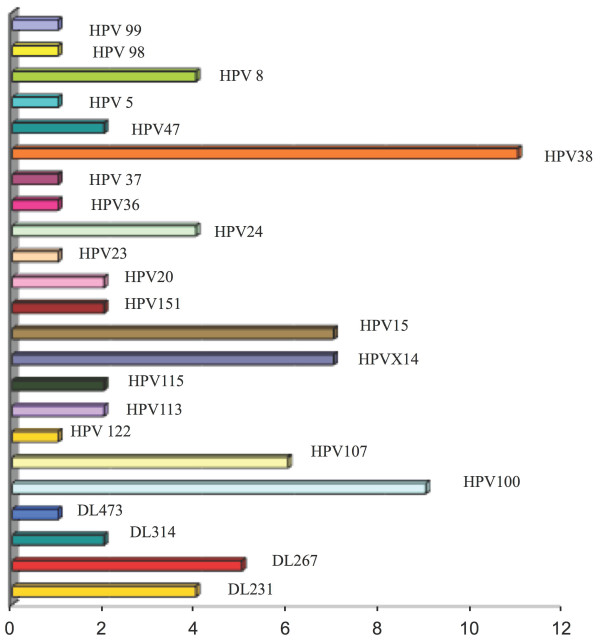
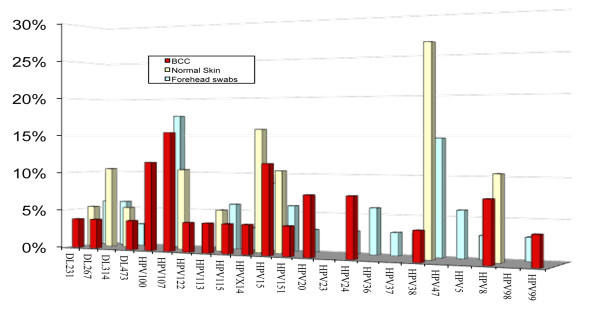
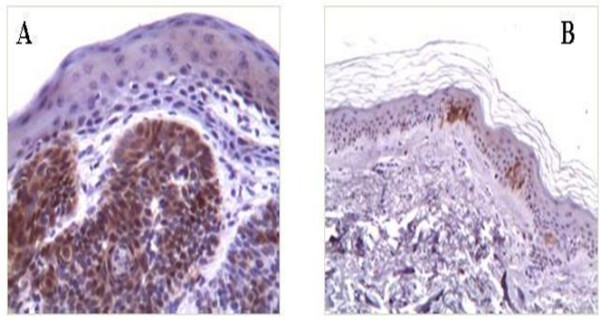
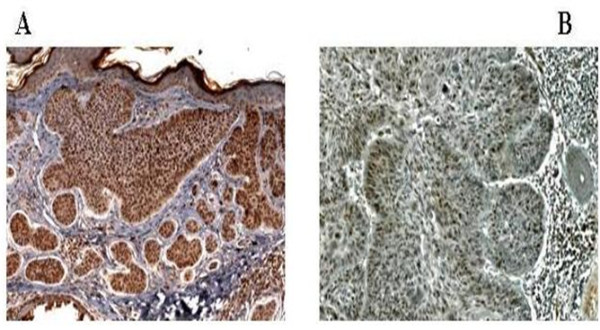
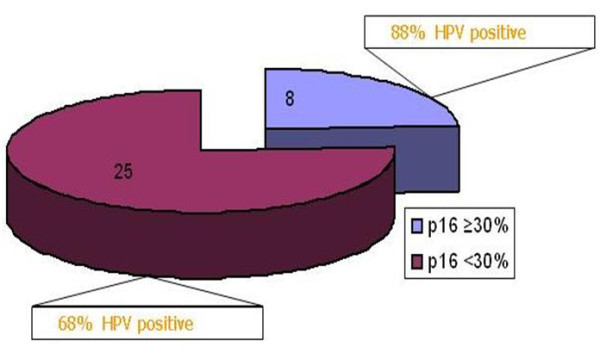
Results: No correspondence of HPV types between BCC and swab samples was found, whereas a correspondence between perilesional skin and BCC was ascertained in the 16,7% of the patients. In BCC, 16 different types of beta HPV were found and the most frequent types were HPV107 (15,4%), HPV100 (11,5%) and HPV15 (11,5%) all belonging to the beta HPV species 2. Immunohistochemistry detected significant p16INK4a expression in almost all tumor samples (94,3%) with the highest percentages (> 30%) of positive cells detected in 8 cases. A statistically significant (p = 0,012) increase of beta HPV presence was detected in p16INK4a strongly positive samples, in particular of species 2. pAkt expression was detected in all tumor samples with only 2 cases showing rare positive cells, whereas Akt2 expression was found in 14 out of 35 BCC (40%); in particular in HPV positive samples over-expressing p16INK4a.
Conclusions: Our data show that p16INK4a and pAkt are over-expressed in BCC and that the high expression of p16INK4a and of Akt2 isoform is often associated with the presence of beta-HPV species 2 (i.e. HPV 15). The association of these viruses with the up-regulation of p16INK4a and Akt/PI3K pathway suggests that in a subtype of BCC these viruses may exert a role in the carcinogenesis or in other, still undefined, biological property of these tumors. If this particular type of BCC reflects a different biology it will remain undisclosed until further studies on a larger number of samples will be performed.
Figures
References
Publication types
MeSH terms
Substances
LinkOut - more resources
Full Text Sources
Medical
Miscellaneous
