


Solitary fibrous tumors and hemangiopericytomas of the meninges: overlapping pathological features and common prognostic factors suggest the same spectrum of tumors
- PMID: 22082190
- PMCID: PMC8057625
- DOI: 10.1111/j.1750-3639.2011.00552.x
Solitary fibrous tumors and hemangiopericytomas of the meninges: overlapping pathological features and common prognostic factors suggest the same spectrum of tumors
Abstract
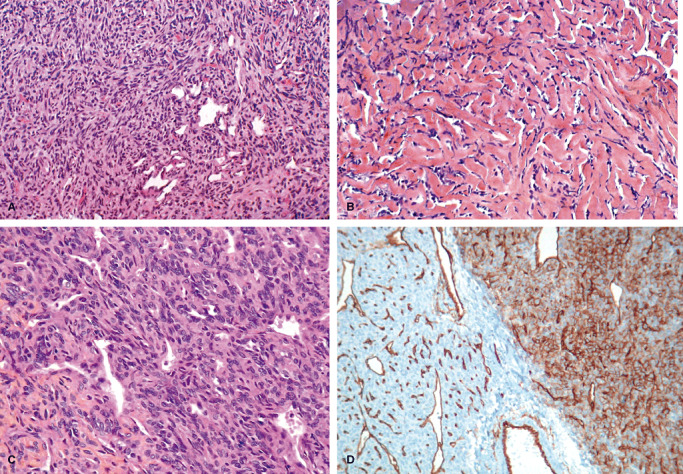
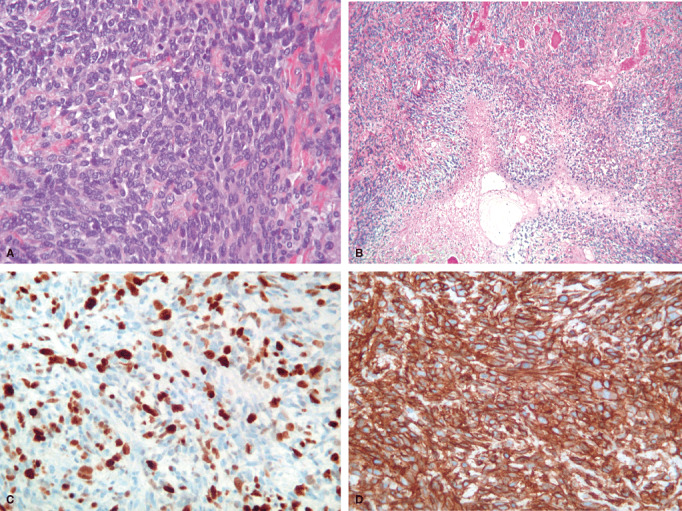
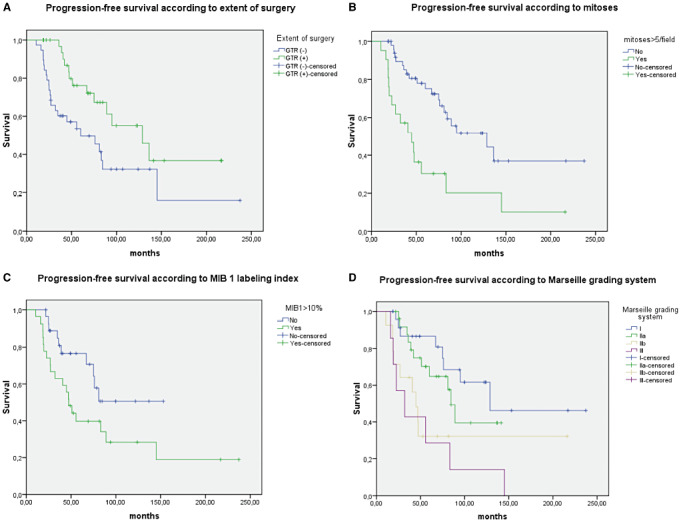
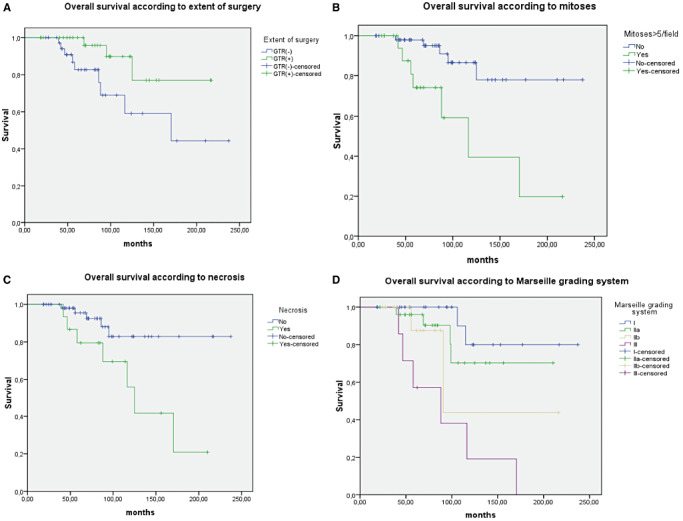
Meningeal solitary fibrous tumors (SFTs) and hemangiopericytomas (HPCs) are distinct entities in the World Health Organization (WHO) classification of central nervous system (CNS) tumors while they belong to the same spectrum of tumors in other locations. Well-defined histological prognostic factors are also lacking for these tumors. In order to clarify the relationship between SFT and HPC and to find histological and immunohistochemical prognostic factors, we carried out a retrospective study in 89 patients. The following histological parameters were recorded: hypercellularity, collagenic areas, cytonuclear atypias, necrosis, mitotic count per 10 high-power fields, vasculo-nervous adherences defined by engulfment of vessel or nerve by the tumor, brain infiltration. We found overlapping histological and immunohistochemical features between SFT and HPC. The most relevant histological prognostic factors in the whole cohort for both progression-free survival (PFS) and overall survival (OS) in univariate analysis were hypercellularity, high mitotic count (>5 per 10 high-power fields) and necrosis. On the basis of these results, we propose a new grading scheme for these tumors which was of pronostic value for both PFS and OS in uni- and multivariate analysis. As extent of surgery was also a prognostic factor for both PFS and OS in univariate analysis, we propose that management of SFT/HPC might be based both on quality of removal and histological grade.
© 2011 The Authors; Brain Pathology © 2011 International Society of Neuropathology.
Figures
References
-
- Alston SR, Francel PC, Jane JA Jr (1997) Solitary fibrous tumor of the spinal cord. Am J Surg Pathol 21:477–483. - PubMed
-
- Ambrosini‐Spaltro A, Eusebi V (2010) Meningeal hemangiopericytomas and hemangiopericytoma/solitary fibrous tumors of extracranial soft tissues: a comparison. Virchows Arch 456:343–354. - PubMed
-
- Bikmaz K, Cosar M, Kurtkaya‐Yapicier O, Iplikcioglu AC, Gokduman CA (2005) Recurrent solitary fibrous tumour in the cerebellopontine angle. J Clin Neurosci 12:829–832. - PubMed
-
- Bisceglia M, Dimitri L, Giannatempo G, Carotenuto V, Bianco M, Monte V et al (2011) Solitary fibrous tumor of the central nervous system: report of an additional 5 cases with comprehensive literature review. Int J Surg Pathol 19:476–486. - PubMed
-
- Bisceglia M, Galliani C, Giannatempo G, Lauriola W, Bianco M, D'Angelo V et al (2011) Solitary fibrous tumor of the central nervous system: a 15‐year literature survey of 220 cases. Adv Anat Pathol 18:356–392. - PubMed
Publication types
MeSH terms
LinkOut - more resources
Full Text Sources
Other Literature Sources
Research Materials
