


Development and validation of educational materials for food allergy
- PMID: 22082955
- PMCID: PMC3307837
- DOI: 10.1016/j.jpeds.2011.09.056
Development and validation of educational materials for food allergy
Abstract
Objective: To develop and validate a food allergy educational program.
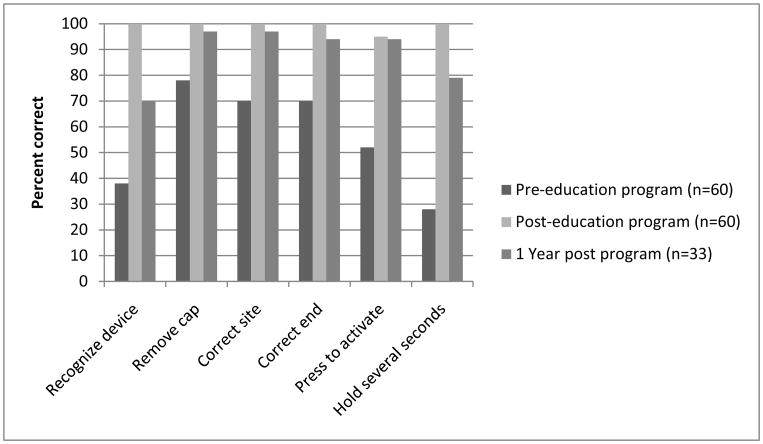
Study design: Materials developed through focus groups and parental and expert review were submitted to 60 parents of newly referred children with a prior food allergy diagnosis and an epinephrine autoinjector. The main outcome was correct demonstration of an autoinjector.
Results: The correct number of autoinjector activation steps increased from 3.4 to 5.95 (of 6) after training (P < .001) and was 5.47 at 1 year (P < .05). The mean score for comfort with using the autoinjector (7-point Likert scale) before the curriculum was 4.63 (somewhat comfortable) and increased to 6.23 after the intervention (P < .05) and remained elevated at 1 year (6.03). Knowledge tests (maximum 15) increased from a mean score of 9.2 to 12.4 (P < .001) at the initial visit and remained at 12.7 at 1 year. The annualized rate of allergic reactions fell from 1.77 (historical) the year prior, to 0.42 (P < .001) after the program. On a 7-point Likert scale, all satisfaction categories remained above a favorable mean score of 6: straight-forward, organized, interesting, relevant, and recommend to others.
Conclusions: This food allergy educational curriculum for parents, now available online at no cost, showed high levels of satisfaction and efficacy.
Copyright © 2012 Mosby, Inc. All rights reserved.
Conflict of interest statement
The authors declare no conflicts of interest.
Figures
Comment in
-
Spreading the word on food allergy education: lessons from childhood asthma.J Pediatr. 2012 Apr;160(4):540-1. doi: 10.1016/j.jpeds.2011.11.035. Epub 2011 Dec 20. J Pediatr. 2012. PMID: 22192814 No abstract available.
References
-
- Branum AM, Lukacs SL. Food allergy among children in the United States. Pediatrics. 2009;124:1549–55. - PubMed
-
- Sicherer SH. Epidemiology of food allergy. J Allergy Clin Immunol. 2011;127:594–602. - PubMed
-
- Gupta RS, Springston EE, Warrier MR, Smith B, Kumar R, Pongracic J, et al. The Prevalence, Severity, and Distribution of Childhood Food Allergy in the United States. Pediatrics. 2011;128:e9–17. - PubMed
-
- Bock SA, Munoz-Furlong A, Sampson HA. Further fatalities caused by anaphylactic reactions to food, 2001–2006. J Allergy Clin Immunol. 2007;119:1016–8. - PubMed
Publication types
MeSH terms
Substances
Grants and funding
LinkOut - more resources
Full Text Sources
Medical
