


Comparison of aortic and carotid arterial stiffness parameters in patients with verified coronary artery disease
- PMID: 22083664
- PMCID: PMC6652332
- DOI: 10.1002/clc.20999
Comparison of aortic and carotid arterial stiffness parameters in patients with verified coronary artery disease
Abstract
Background: Arterial stiffness parameters are commonly used to determine the development of atherosclerotic disease. The independent predictive value of aortic stiffness has been demonstrated for coronary events.
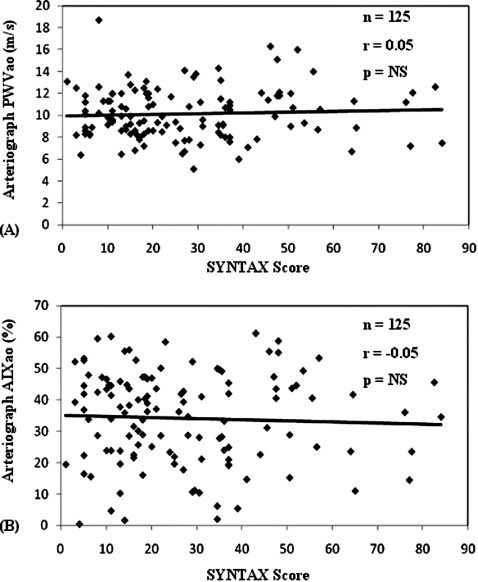
Hypothesis: The aim of our study was to compare regional and local arterial functional parameters measured by 2 different noninvasive methods in patients with verified coronary artery disease (CAD). We also compared and contrasted these stiffness parameters to the coronary SYNTAX score in patients who had undergone coronary angiography.
Methods: In this study, 125 CAD patients were involved, and similar noninvasive measurements were performed on 125 healthy subjects. The regional velocity of the aortic pulse wave (PWVao) was measured by a novel oscillometric device, and the common carotid artery was studied by a Doppler echo-tracking system to determine the local carotid pulse wave velocity (PWVcar). The augmentation index (AIx), which varies proportionately with the resistance of the small arteries, was recorded simultaneously.
Results: In the CAD group, the PWVao and aortic augmentation index (Alxao) values increased significantly (10.1 ± 2.3 m/sec and 34.2% ± 14.6%) compared to the control group (9.6 ± 1.5 m/sec and 30.9% ± 12%; P < 0.05). We observed similar significant increases in the local stiffness parameters (PWVcar and carotid augmentation index [Alxcar]) in patients with verified CAD. Further, we found a strong correlation for PWV and AIx values that were measured with the Arteriograph and those obtained using the echo-tracking method (r = 0.57, P < 0.001 for PWV; and r = 0.65, P < 0.001 for AIx values).
Conclusions: Our results indicate that local and regional arterial stiffness parameters provide similar information on impaired arterial stiffening in patients with verified CAD.
© 2011 Wiley Periodicals, Inc.
Figures
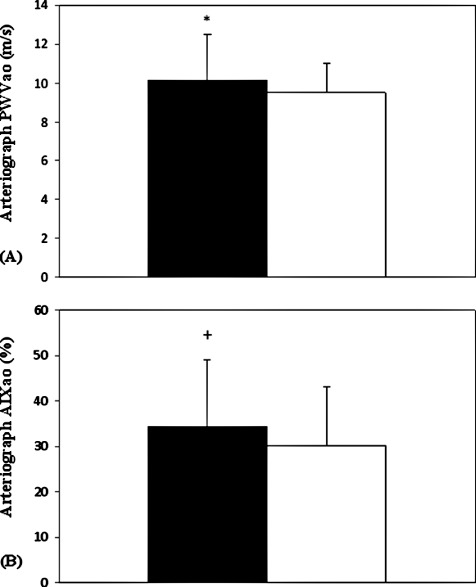
 = CAD group (n = 125).
  = control group (n = 125). *
P < 0.05; +P = 0.05.
= control group (n = 125). *
P < 0.05; +P = 0.05.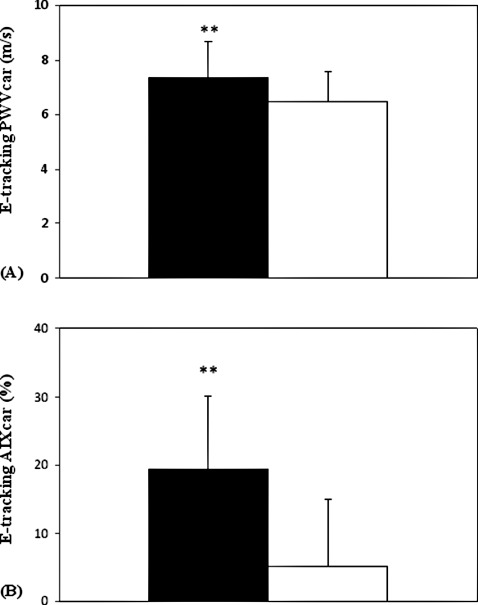 = CAD group (n = 35). = control group (n = 35). **
P < 0.01.
= CAD group (n = 35). = control group (n = 35). **
P < 0.01.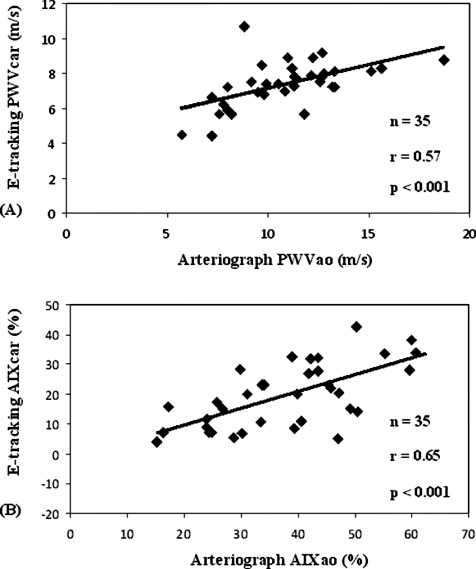
References
-
- Laurent S, Cockcroft J, Van Bortel L, et al. Expert consensus document on arterial stiffness: methodological issues and clinical applications. Eur Heart J. 2006;27:2588–2605. - PubMed
-
- Boutouyrie P, Tropeano AI, Asmar R, et al. Aortic stiffness is an independent predictor of primary coronary events in hypertensive patients: a longitudinal study. Hypertension. 2002;39:10–15. - PubMed
-
- Laurent S, Boutouyrie P, Asmar R, et al. Aortic stiffness is an independent predictor of all‐cause and cardiovascular mortality in hypertensive patients. Hypertension. 2001;37:1236–1241. - PubMed
-
- Cruickshank K, Riste L, Anderson SG, et al. Aortic pulse‐wave velocity and its relationship to mortality in diabetes and glucose intolerance: an integrated index of vascular function? Circulation. 2002;106:2085–2090. - PubMed
-
- Blacher J, London G, Safar B, et al. Influence of age and end‐stage renal disease on the stiffness of carotid wall material in hypertension. J Hypertens. 1999;17:237–244. - PubMed
Publication types
MeSH terms
LinkOut - more resources
Full Text Sources
Medical
Miscellaneous
