Review
. 2011 Dec 27;366(1584):3508-20.
doi: 10.1098/rstb.2011.0124.

Nutrient limitations alter cell division control and chromosome segregation through growth-related kinases and phosphatases

Affiliations
Review

Nutrient limitations alter cell division control and chromosome segregation through growth-related kinases and phosphatases

Mitsuhiro Yanagida et al. Philos Trans R Soc Lond B Biol Sci. .

Abstract

In dividing fission yeast Schizosaccharomyces pombe cells, the balance between Wee1 kinase and Cdc25 phosphatase which control the cyclin-dependent kinase (CDK) at the G2-M transition determines the rod-shaped cell length. Under nitrogen source starvation or glucose limitation, however, cell size determination is considerably modulated, and cell size shortening occurs for wild-type cells. For several mutants of kinases or phosphatases, including CDK, target of rapamycin complex (TORC) 1 and 2, stress-responsive mitogen-activated protein kinase (MAPK) Sty1/Spc1, MAPK kinase Wis1, calcium- and calmodulin-dependent protein kinase kinase-like Ssp1, and type 2A and 2A-related phosphatases inhibitor Sds23, this cell shortening does not normally occur. In tor1 and ssp1 mutants, cell elongation is observed. Sds23 that binds to and inhibits 2A and 2A-related phosphatases is synergistic with Ssp1 in the cell size determination and survival under low glucose and nitrogen source. Tor2 (TORC1) is required for growth, whereas Tor1 (TORC2) is needed for determining division size according to different nutrient conditions. Surprisingly, in growth-diminished tor2 mutant or rapamycin-treated cells, the requirement of separase/Cut1-securin/Cut2 essential for chromosome segregation is greatly alleviated. By contrast, defects of tor1 with secruin/cut2 or overproduction of Cut1 are additive. While Tor1 and Tor2 are opposite in their apparent functions, both may actually coordinate cell division with growth in response to the changes in nutrients.


Figures
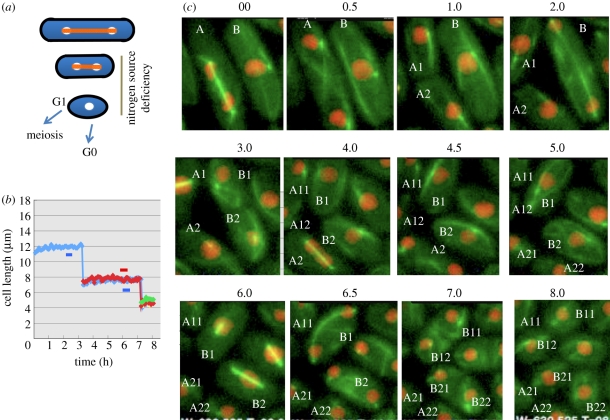
Figure 1.
Figure 1.
Nitrogen source deficiency-induced cell size shortening of wild-type. (a) Schizosaccharomyces pombe wild-type cells under the absence of nitrogen source (NH4Cl) divide twice and arrest at a temporal G1 phase followed by meiosis or the entry into quiescent G0 phase dependent on the presence or absence of mating. The orange bar represents the spindle. (b) Cell length is shortened dramatically during two divisions after transfer (time 0) from the complete EMM2 to the NH4Cl-deficient EMM2 medium. (c) Light micrographs of time course changes of the two cells in the complete medium (time 00 h) shifted to the nitrogen-deficient medium for 8.0 h. The first division produced daughter cells A1, A2 and B1, B2 cells. The second division produced A11, A12, A21, A22 and B11, B12, B21, B22 cells. Red, histone H2A; green, tubulin and the Sid4 SPB protein (see text).
Figure 2.
Figure 2.
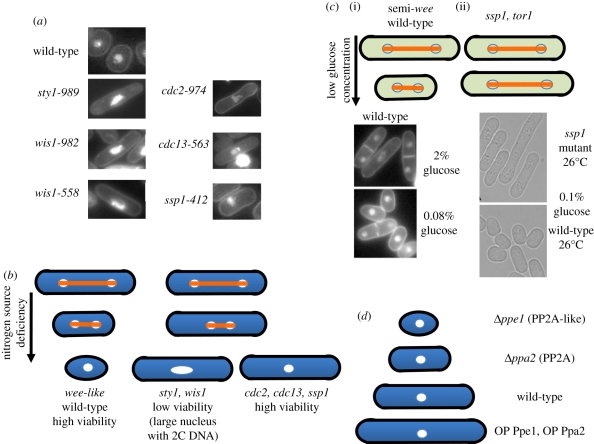
Genes required for cell size shortening under limited nitrogen or glucose. (a) In the absence of nitrogen source, mutant cells sty1-989, wis1-982, -558, cdc2-974, cdc13-563 and ssp1-412 remained rod-shaped at 26°C, the permissive temperature. (b) Schematic of mutants that fail to shorten cell size upon the transfer to the culture deficient of the nitrogen source. (c) Length of dividing wild-type cells is shortened in EMM2 medium containing low (0.1%) glucose instead of standard 2% glucose concentration. Mutant ssp1-412 is elongated in 0.1% glucose at 26°C rather than the shortening in wild-type. A similar result is obtained for tor1 mutant cells at the semi-permissive temperature. (a,b) Based on Sajiki et al. [13]; (c) based on Hanyu et al. [21]. (d) The phosphatase deletion mutant Δppe1 or Δppa2 results in the production of small, round or short semi-wee cells, respectively. By contrast, overproduction of Ppe1 or Ppa2 causes the semi-cdc25 elongation phenotype [22,23].
Figure 3.
Figure 3.
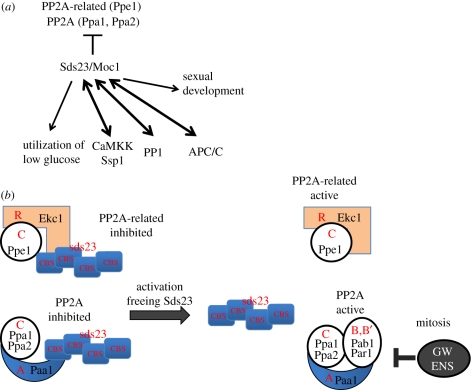
Diverse roles of Sds23. (a) High-copy plasmid carrying the sds23+ gene suppresses the mutations of ssp1, protein phosphatase PP1 and APC/cyclosome [21,46,51]. Sds23/Moc1 is required for the utilization of low glucose and sexual development. (b) Sds23 stably associates with PP2A-related Ppe1–Ekc1 and PP2A phosphatases (see text). C, R: catalytic and regulatory subunits of PP2A-related phosphatase. C, A, B: catalytic, regulatory A and B subunits of PP2A. The phosphatase free from Sds23 seems to be active [21]. GW and ENS represent greatwall kinase and alpha-endosulphine, respectively (see text).
Figure 4.
Figure 4.
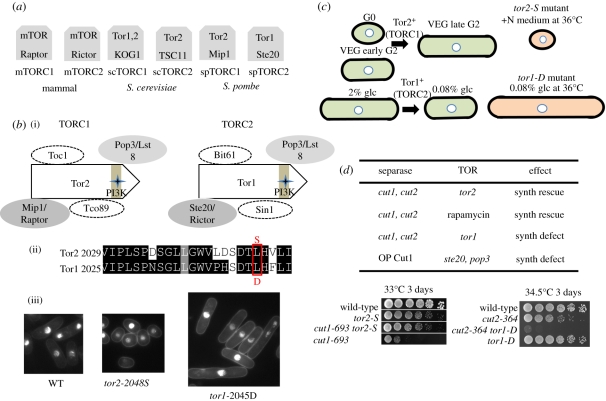
Functional relationship of TORCs with securin and separase. (a) Two TORCs exist in mammals, Saccharomyces cerevisiae and Schizosaccharomyces pombe. Mammalian TOR is the sole catalytic subunit in mammals, while budding and fission yeasts have two distinct catalytic subunits. (b)(i) The subunit constituents of TORC1 and 2 in S. pombe. The crosses indicate the mutation sites of tor1-D and tor2-S in the PI3K domain of Tor1 and Tor2. (b)(ii) The mutated residues are indicated in red colour in the conserved amino acid sequences in the PI3K domain. (b)(iii) DAPI-stained micrographs of wild-type, tor2-S and tor1-D cultured at 36°C for 6 h. (c) Schematic of the role of Tor2 and Tor1 in cell size determination (see text). glc, glucose. (d) Synthetic rescue or defect observed in the pair of mutations in securin/cut2, separase/cut1 or overproduction (OP) of Cut1 and mutations of tor1, tor2, regulatory subunits (ste20 and pop3) or the addition of rapamycin. See text. Two examples of the spot test at the semi-permissive temperature, showing the (left) synthetic rescue and (right) defect, are shown (see text).

References

    1. Mitchison J. 1971. The biology of the cell cycle. London, UK: Cambridge University Press.
    1. Mitchison J. M. 1957. The growth of single cells. I. Schizosaccharomyces pombe. Exp. Cell Res. 13, 244–26210.1016/0014-4827(57)90005-8 (doi:10.1016/0014-4827(57)90005-8) - DOI - DOI - PubMed
    1. Nurse P., Thuriaux P., Nasmyth K. 1976. Genetic control of the cell division cycle in the fission yeast Schizosaccharomyces pombe. Mol. Gen. Genet. 146, 167–17810.1007/BF00268085 (doi:10.1007/BF00268085) - DOI - DOI - PubMed
    1. Thuriaux P., Nurse P., Carter B. 1978. Mutants altered in the control co-ordinating cell division with cell growth in the fission yeast Schizosaccharomyces pombe. Mol. Gen. Genet. 161, 215–22010.1007/BF00274190 (doi:10.1007/BF00274190) - DOI - DOI - PubMed
    1. Nurse P., Thuriaux P. 1980. Regulatory genes controlling mitosis in the fission yeast Schizosaccharomyces pombe. Genetics 96, 627–637 - PMC - PubMed

Publication types