


Levels of Circulating MMCN-151, a Degradation Product of Mimecan, Reflect Pathological Extracellular Matrix Remodeling in Apolipoprotein E Knockout Mice
- PMID: 22084568
- PMCID: PMC3201086
- DOI: 10.4137/BMI.S7777
Levels of Circulating MMCN-151, a Degradation Product of Mimecan, Reflect Pathological Extracellular Matrix Remodeling in Apolipoprotein E Knockout Mice
Abstract
Aim: Arterial extracellular matrix (ECM) remodeling by matrix metalloproteinases (MMPs) is one of the major hallmarks of atherosclerosis. Mimecan, also known as osteoglycin has been implicated in the integrity of the ECM. This study assessed the validity of an enzyme-linked immunosorbent assay (ELISA) developed to measure a specific MMP12-derived fragment of mimecan, MMCN-151, in apolipoprotein-E knockout (ApoE-KO) mice.
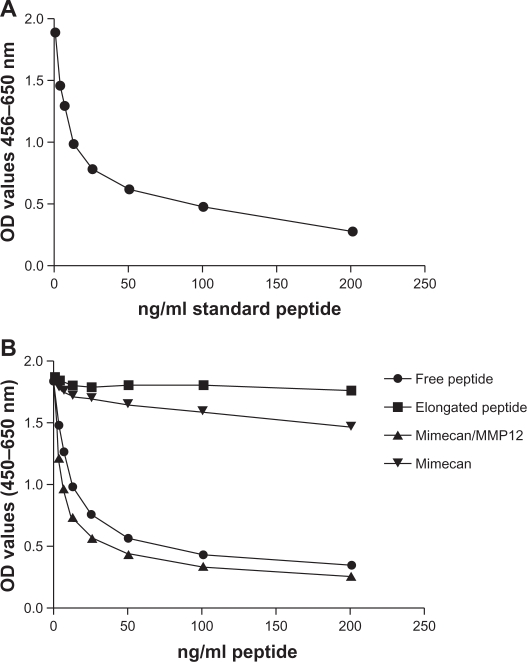
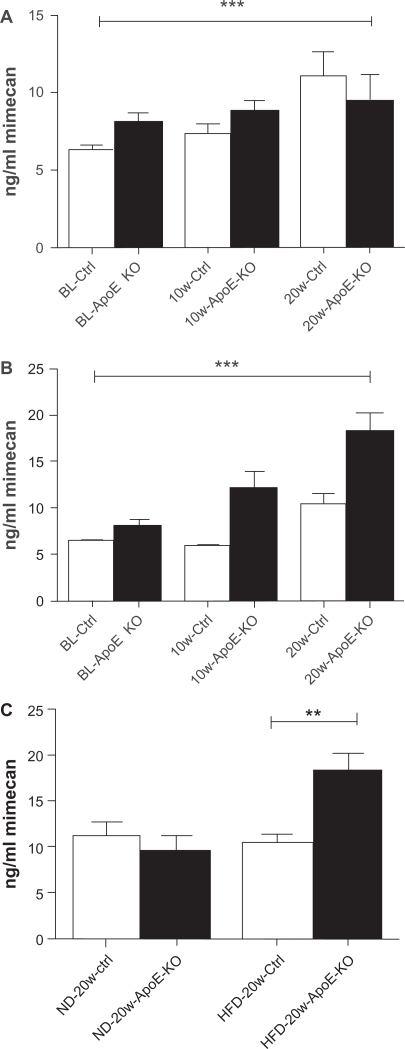
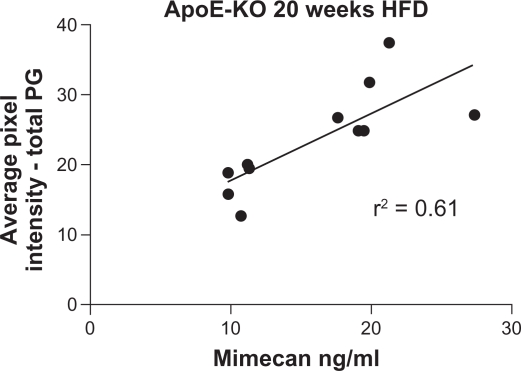
Methods and results: A mouse monoclonal antibody raised against MMCN-151 was used to develop a competitive ELISA. The assay was validated using samples from 20 ApoE-KO and 20 wild type [C57 BL/6] male mice fed a normal or high-fat diet (HFD) for up to 20 weeks. The technical reliability of the assay was established with intra-assay variability <2% and inter-assay variability <10%. The lowest limit of quantification of MMCN-151 was 0.5 ng/ml. ApoE-KO mice fed a HFD for 20 weeks had four-fold increased circulating levels of MMCN-151 compared to baseline, whereas MMCN-151 levels in control mice on HFD increased two-fold compared with baseline. After 10 weeks of a HFD, a significant difference in MMCN-151 levels was observed between ApoE-KO and control mice (P = 0.005) and became more significant at 20 weeks (P = 0.002).
Conclusions: The newly developed assay is a reliable detector of MMCN-151 levels which ultimately may be useful indicators of arterial remodeling in patients affected by atherosclerotic disease.
Keywords: MMCN-151; atherosclerosis; biomarker; extracellular matrix; matrix metalloproteinases; mimecan; proteoglycans.
Figures
References
-
- American Heart Association . Heart Disease and Stroke Statistics—2007 Update. Dallas, Texas: American Heart Association; 2007. http://wwwamericanheart.org/downloadable/heart/1166712318459HS_StatsInsi....
-
- Kragel AH, Reddy SG, Wittes JT, Roberts WC. Morphometric analysis of the composition of atherosclerotic plaques in the four major epicardial coronary arteries in acute myocardial infarction and in sudden coronary death. Circulation. 1989 Dec;80(6):1747–56. - PubMed
-
- Wagner WD. Proteoglycan structure and function as related to atherosclerosis. Ann NY Acad Sci. 1985;454:52–68. - PubMed
-
- McCullagh KG, Duance VC, Bishop KA. The distribution of collagen types I, III and V (AB) in normal and atherosclerotic human aorta. J Pathol. 1980 Jan;130(1):45–55. - PubMed
-
- Shekhonin BV, Domogatsky SP, Muzykantov VR, Idelson GL, Rukosuev VS. Distribution of type I, III, IV and V collagen in normal and atherosclerotic human arterial wall: immunomorphological characteristics. Coll Relat Res. 1985 Sep;5(4):355–68. - PubMed
LinkOut - more resources
Full Text Sources
Other Literature Sources
Research Materials
Miscellaneous
