


doi: 10.1155/2011/529648.
Epub 2011 Feb 24.
Heat shock proteins in association with heat tolerance in grasses
Affiliations
- PMID: 22084689
- PMCID: PMC3200123
- DOI: 10.1155/2011/529648
Item in Clipboard
Heat shock proteins in association with heat tolerance in grasses
Int J Proteomics.
2011.
Abstract
The grass family Poaceae includes annual species cultivated as major grain crops and perennial species cultivated as forage or turf grasses. Heat stress is a primary factor limiting growth and productivity of cool-season grass species and is becoming a more significant problem in the context of global warming. Plants have developed various mechanisms in heat-stress adaptation, including changes in protein metabolism such as the induction of heat shock proteins (HSPs). This paper summarizes the structure and function of major HSPs, recent research progress on the association of HSPs with grass tolerance to heat stress, and incorporation of HSPs in heat-tolerant grass breeding.
Figures
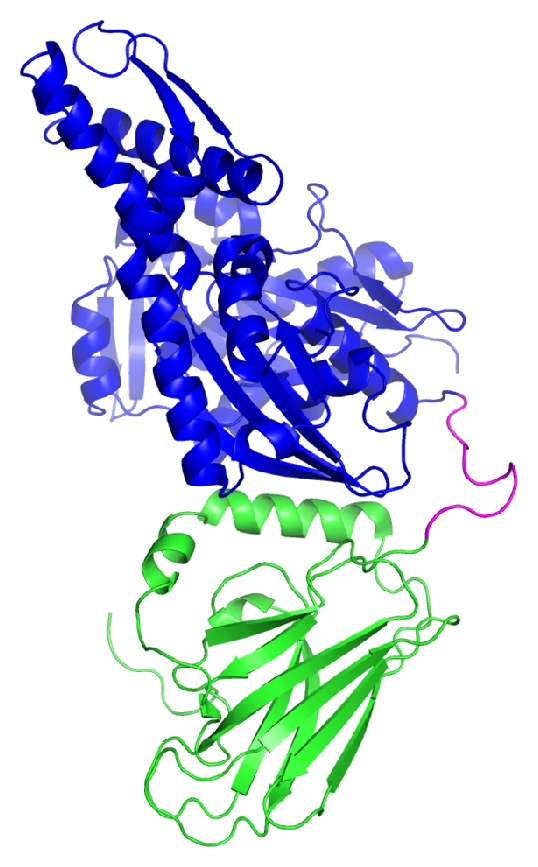
Crystal structure of bovine HSC70. The crystal structure of bovine HSC70 reported by Jiang et al. is shown as ribbon representations (PDB ID: 1YUW) [37]. The N-terminal ATPase domain, interdomain linker, and C-terminal substrate-binding domain are colored in blue, magenta, and green, respectively.
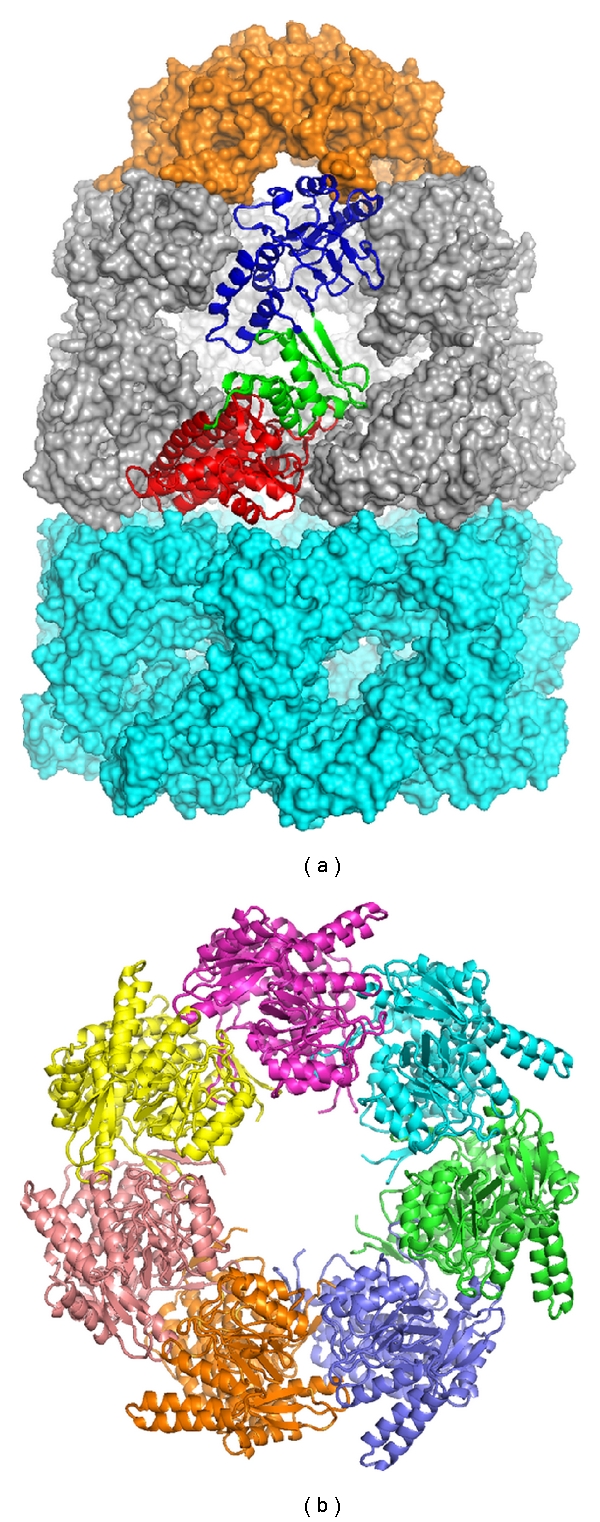
Crystal structure of E. coli GroEL and GroES complex. (a) The overall structure of GroEL/GroES complex reported by Xu et al. (PDB ID: 1AON) [42]. The GroES molecule is represented by orange surface. One GroEL monomer in the GroEL top (cis) ring is displayed as ribbon, with the apical, intermediate, and equatorial domains colored in blue, green, and red, respectively. The rest of the top (cis) ring and the entire bottom (trans) ring are shown as grey and cyan surface representations, respectively. (b) Ribbon representation of the GroEL heptameric bottom (trans) ring. Each GroEL monomers is shown in a different color.
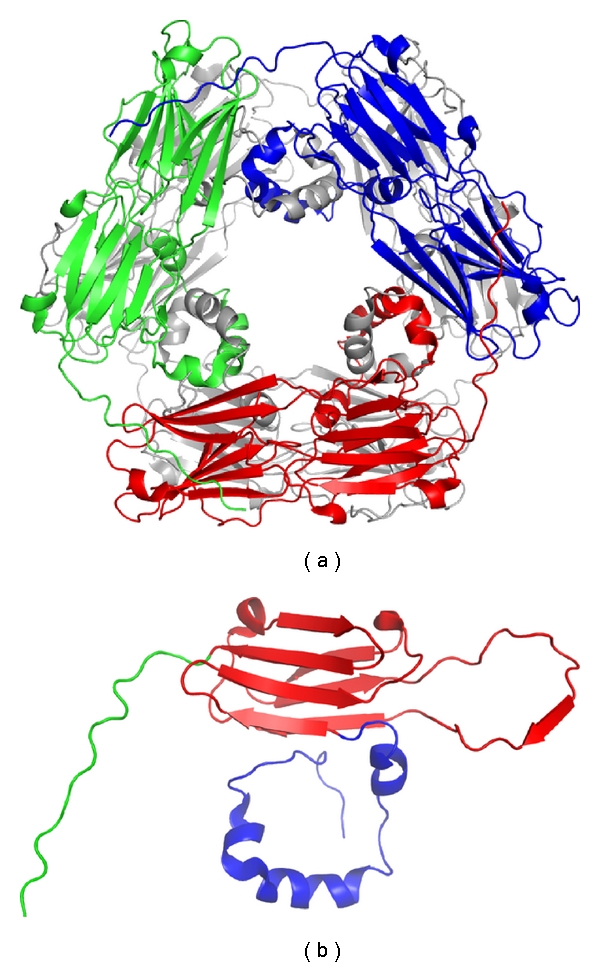
Crystal structure of wheat HSP16.9. (a) The ribbon structure of wheat HSP16.9 reported by Van Montfort et al. (PDB ID: 1GME) [43]. Wheat HSP16.9 is a homo-dodecameric protein consisting of two disk-like layers. The three HSP16.9 dimers in the upper disk are colored in green, blue and red, respectively. The lower disk is colored in gray. (b) The ribbon structure of wheat HSP16.9 monomer. The N-terminal region, α-crystallin domain and C-terminal tail are colored in blue, red, and green, respectively.
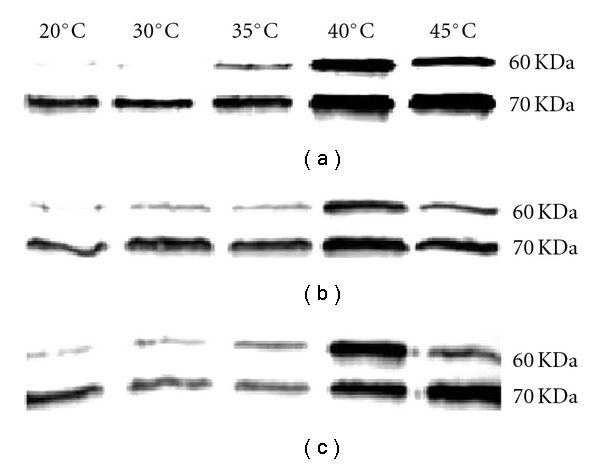
Immunoblots of HSP60 and HSP70 of Agrostis scabra (a), creeping bentgrass (A. stolonifera) cv. Penncross (b) and cv. L-93 (c) after 3 d of five different temperatures. Equal amounts of protein (18 μg) were loaded in each lane (from [44]).
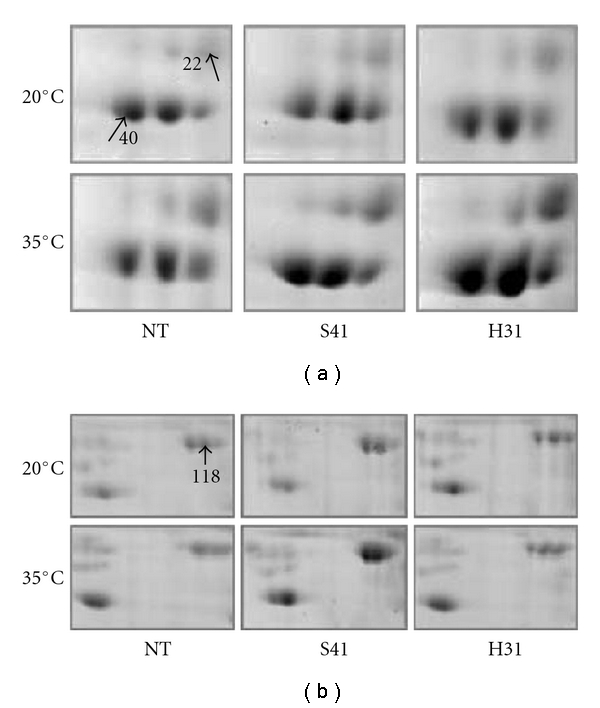
Differential expression of a plastid Hsp90 (no. 22) and a chloroplast Hsp70 (no. 40) proteins in the shoots (a) and an endoplasmic Hsp90 homologue (no. 118) protein in the roots (b) of the nontransgenic plants (NT), SAG12-ipt line (S41), and HSP18-ipt line (H31) at 10 d of treatment at normal temperature (20°C) or heat stress (35°C) (from [45]).
References
-
- Fry J, Huang B. Applied Turfgrass Science and Physiology. Hoboken, NJ, USA: John Wiley & Sons; 2004.
-
- Porter JR. Rising temperatures are likely to reduce crop yields. Nature. 2005;436(7048):p. 174. - PubMed
-
- Sung DY, Kaplan F, Lee KJ, Guy CL. Acquired tolerance to temperature extremes. Trends in Plant Science. 2003;8(4):179–187. - PubMed
-
- Weis E, Berry JA. Plants and high temperature stress. Symposia of the Society for Experimental Biology. 1988;42:329–346. - PubMed
-
- Levitt J. Responses of Plants to Environmental Stresses. New York, NY, USA: Academic Press; 1972. (Physiological Ecology).
LinkOut - more resources
Full Text Sources