


A Systematic Review and Meta-Analysis of Front-line Anthracycline-Based Chemotherapy Regimens for Peripheral T-Cell Lymphoma
- PMID: 22084700
- PMCID: PMC3197255
- DOI: 10.5402/2011/623924
A Systematic Review and Meta-Analysis of Front-line Anthracycline-Based Chemotherapy Regimens for Peripheral T-Cell Lymphoma
Abstract
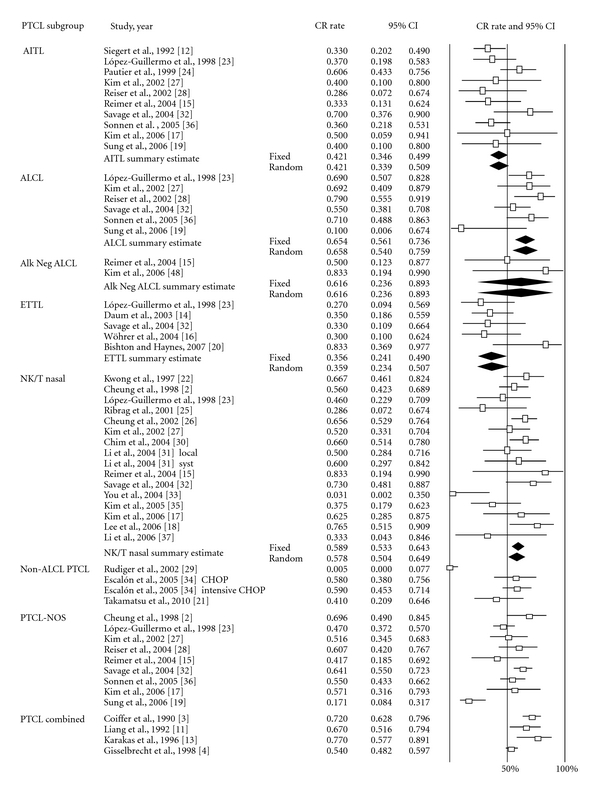
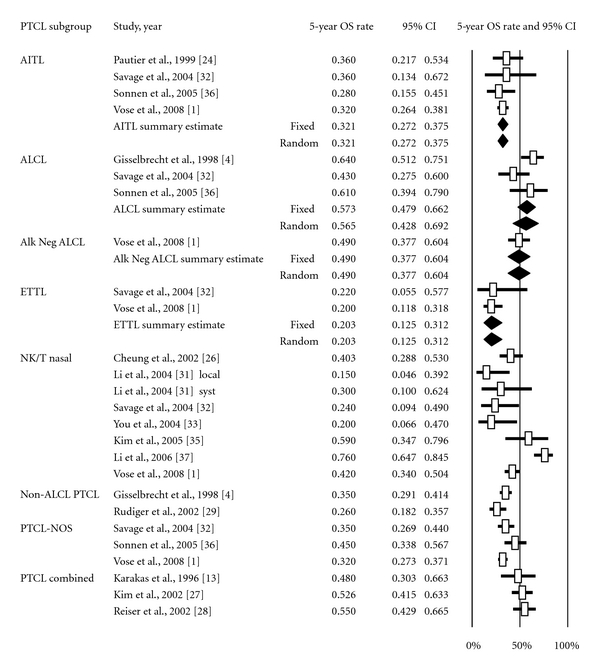
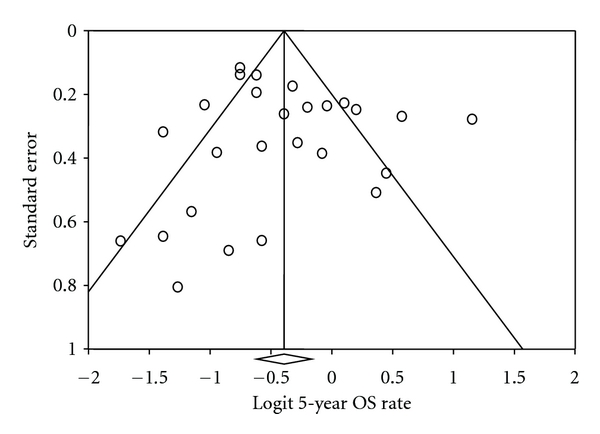
Anthracycline-based chemotherapy remains standard treatment for peripheral T-cell lymphoma (PTCL) although its benefits have been questioned. We performed systematic literature review and meta-analyses examining the complete response (CR) and overall survival (OS) rates for patients with PTCL. The CR rate for PTCL patients ranged from 35.9% (95% CI 23.4-50.7%) for enteropathy-type T-cell lymphoma (ETTL) to 65.8% (95% CI 54.0-75.9%) for anaplastic large cell lymphoma (ALCL). The 5-year OS was 38.5% (95% CI 35.5-41.6%) for all PTCL patients and ranged from 20.3% (95% CI 12.5-31.2%) for ETTL to 56.5% (95% CI 42.8-69.2%) for ALCL. These data suggest that there is marked heterogeneity across PTCL subtypes in the benefits of anthracycline-based chemotherapy. While anthracyclines produce CR in half of PTCL patients, this yields reasonable 5-year OS for patients with ALCL but not for those with PTCL-NOS or ETTL. Novel agents and regimens are needed to improve outcomes for these patients.
Figures
References
-
- Vose JM, Armitage J, Weisenburger D. International peripheral T-cell and natural killer/T-cell lymphoma study: pathology findings and clinical outcomes. Journal of Clinical Oncology. 2008;26(25):4124–4130. - PubMed
-
- Cheung MMC, Chan JKC, Lau WH, et al. Primary non-Hodgkin’s lymphoma of the nose and nasopharynx: clinical features, tumor immunophenotype, and treatment outcome in 113 patients. Journal of Clinical Oncology. 1998;16(1):70–77. - PubMed
-
- Coiffier B, Brousse N, Peuchmaur M, et al. Peripheral T-cell lymphomas have a worse prognosis than B-cell lymphomas: a prospective study of 361 immunophenotyped patients treated with the LNH-84 regimen. The GELA (Groupe d’Etude des Lymphomes Agressives) Annals of Oncology. 1990;1(1):45–50. - PubMed
-
- Gisselbrecht C, Gaulard P, Lepage E, et al. Prognostic significance of T-cell phenotype in aggressive non-Hodgkin’s lymphomas. Blood. 1998;92(1):76–82. - PubMed
-
- Savage KJ. Prognosis and primary therapy in peripheral T-cell lymphomas. Hematology. 2008:280–288. - PubMed
LinkOut - more resources
Full Text Sources
Molecular Biology Databases
