


Frameless linac-based stereotactic radiosurgery (SRS) for brain metastases: analysis of patient repositioning using a mask fixation system and clinical outcomes
- PMID: 22085700
- PMCID: PMC3253058
- DOI: 10.1186/1748-717X-6-158
Frameless linac-based stereotactic radiosurgery (SRS) for brain metastases: analysis of patient repositioning using a mask fixation system and clinical outcomes
Abstract
Purpose: To assess the accuracy of patient repositioning and clinical outcomes of frameless stereotactic radiosurgery (SRS) for brain metastases using a stereotactic mask fixation system.
Patients and methods: One hundred two patients treated consecutively with frameless SRS as primary treatment at University of Rome Sapienza Sant'Andrea Hospital between October 2008 and April 2010 and followed prospectively were involved in the study. A commercial stereotactic mask fixation system (BrainLab) was used for patient immobilization. A computerized tomography (CT) scan obtained immediately before SRS was used to evaluate the accuracy of patient repositioning in the mask by comparing the isocenter position to the isocenter position established in the planning CT. Deviations of isocenter coordinates in each direction and 3D displacement were calculated. Overall survival, brain control, and local control were estimated using the Kaplan-Meier method calculated from the time of SRS.
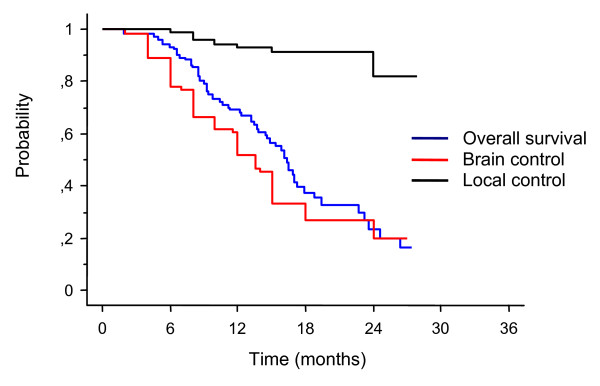
Results: The mean measured isocenter displacements were 0.12 mm (SD 0.35 mm) in the lateral direction, 0.2 mm (SD 0.4 mm) in the anteroposterior, and 0.4 mm (SD 0.6 mm) in craniocaudal direction. The maximum displacement of 2.1 mm was seen in craniocaudal direction. The mean 3D displacement was 0.5 mm (SD 0.7 mm), being maximum 2.9 mm. The median survival was 15.5 months, and 1-year and 2-year survival rates were 58% and 24%, respectively. Nine patients recurred locally after SRS, with 1-year and 2-year local control rates of 91% and 82%, respectively. Stable extracranial disease (P = 0.001) and KPS > 70 (P = 0.01) were independent predictors of survival.
Conclusions: Frameless SRS is an effective treatment in the management of patients with brain metastases. The presented non-invasive mask-based fixation stereotactic system is associated with a high degree of patient repositioning accuracy; however, a careful evaluation is essential since occasional errors up to 3 mm may occur.
Figures
References
-
- Pirzkall A, Debus J, Lohr F, Fuss M, Rhein B, Engenhart-Cabillic R, Wannenmacher M. Radiosurgery alone or in combination with whole-brain radiotherapy for brain metastases. J Clin Oncol. 1998;16:3563–3569. - PubMed
-
- Andrews DW, Scott CB, Sperduto PW, Flanders AE, Gaspar LE, Schell MC, Werner-Wasik M, Demas W, Ryu J, Bahary JP, Souhami L, Rotman M, Mehta MP, Curran WJ Jr. Whole brain radiation therapy with or without stereotactic radiosurgery boost for patients with one to three brain metastases: phase III results of the RTOG 9508 randomised trial. Lancet. 2004;363:1665–1672. doi: 10.1016/S0140-6736(04)16250-8. - DOI - PubMed
-
- Manon R, O'Neill A, Knisely J, Werner-Wasik M, Lazarus HM, Wagner H, Gilbert M, Mehta M. Eastern Cooperative Oncology Group. Phase II trial of radiosurgery for one to three newly diagnosed brain metastases from renal cell carcinoma, melanoma, and sarcoma: an Eastern Cooperative Oncology Group study (E 6397) J Clin Oncol. 2005;23:8870–8876. doi: 10.1200/JCO.2005.01.8747. - DOI - PubMed
-
- Aoyama H, Shirato H, Tago M, Nakagawa K, Toyoda T, Hatano K, Kenjyo M, Oya N, Hirota S, Shioura H, Kunieda E, Inomata T, Hayakawa K, Katoh N, Kobashi G. Stereotactic radiosurgery plus whole-brain radiation therapy vs stereotactic radiosurgery alone for treatment of brain metastases: a randomized controlled trial. JAMA. 2006;295:2483–2491. doi: 10.1001/jama.295.21.2483. - DOI - PubMed
-
- Kocher M, Soffietti R, Abacioglu U, Villà S, Fauchon F, Baumert BG, Fariselli L, Tzuk-Shina T, Kortmann RD, Carrie C, Hassel MB, Kouri M, Valeinis E, van den Berge D, Collette S, Collette L, Mueller RP. Adjuvant whole-brain radiotherapy versus observation after radiosurgery or surgical resection of one to three cerebral metastases: results of the EORTC 22952-26001 study. J Clin Oncol. 2011;29:134–141. doi: 10.1200/JCO.2010.30.1655. - DOI - PMC - PubMed
MeSH terms
LinkOut - more resources
Full Text Sources
Medical
Miscellaneous
