Review
. 2012 Jan;108(1):75-85.
doi: 10.1038/hdy.2011.100. Epub 2011 Nov 16.

Characterising chromosome rearrangements: recent technical advances in molecular cytogenetics

Affiliations
Review

Characterising chromosome rearrangements: recent technical advances in molecular cytogenetics

S Le Scouarnec et al. Heredity (Edinb). 2012 Jan.

Abstract

Genomic rearrangements can result in losses, amplifications, translocations and inversions of DNA fragments thereby modifying genome architecture, and potentially having clinical consequences. Many genomic disorders caused by structural variation have initially been uncovered by early cytogenetic methods. The last decade has seen significant progression in molecular cytogenetic techniques, allowing rapid and precise detection of structural rearrangements on a whole-genome scale. The high resolution attainable with these recently developed techniques has also uncovered the role of structural variants in normal genetic variation alongside single-nucleotide polymorphisms (SNPs). We describe how array-based comparative genomic hybridisation, SNP arrays, array painting and next-generation sequencing analytical methods (read depth, read pair and split read) allow the extensive characterisation of chromosome rearrangements in human genomes.


Figures

Figure 1
Figure 1
Overview of ‘cytogenetics' oligonucleotide arrays workflow. White boxes: sample preparation stage, grey boxes: microarray stage. Different methods are available for array-CGH labelling (enzymatic, restriction digestion, Universal Linkage System) and can require a fragmentation step (dashed line box). Hybridisation mixtures contain blocking agents and DNA enriched for repetitive sequences (for example, Cot-1 DNA) to block nonspecific hybridisation and reduce background signal. Hybridisation times vary according to platform and array format. For further details on protocols see the commercial vendors' website. Available catalogue arrays are listed in Supplementary Table S1. Cy5, cyanine-5; Cy3, cyanine-3; gDNA, genomic DNA; OGT, Oxford Gene Technology; WGA, whole-genome amplification.
Figure 2
Figure 2
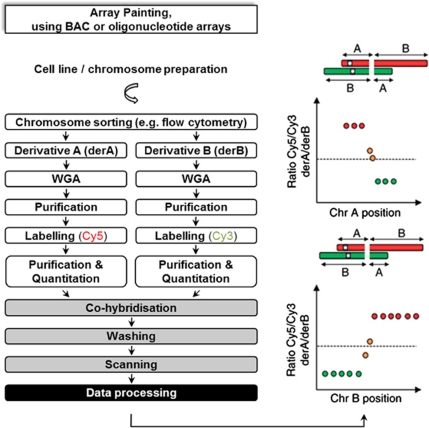
Overview of array painting workflow. White boxes: sample preparation stage, grey boxes: microarray stage. BAC, bacterial artificial chromosome; WGA, whole-genome amplification. For further details see Gribble et al. (2009).
Figure 3
Figure 3
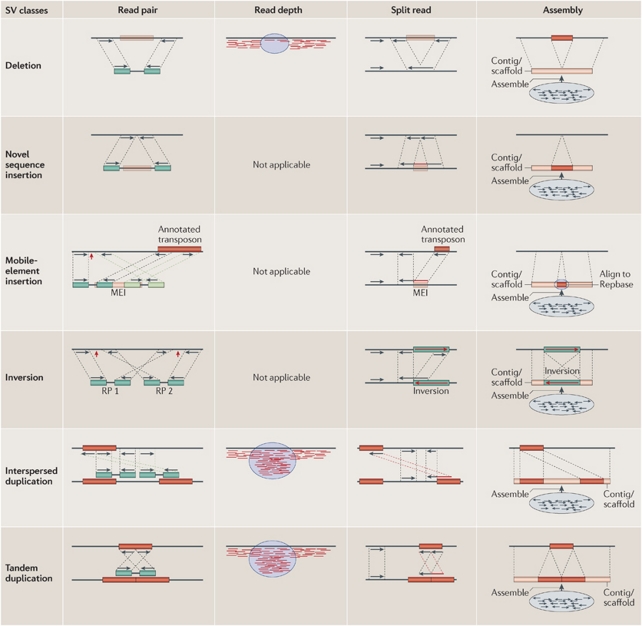
Four methods to identify SVs from NGS data. These methods are often used in combination to detect chromosomal rearrangements and characterise breakpoints (red arrows) with precision. De novo assembly methods are still challenging but have the potential to accurately and rapidly characterise all classes of rearrangements. MEI, mobile-element insertion; RP, read pair. For further details and full figure legend, see Alkan et al., 2011a. Reprinted by permission from Macmillan Publishers Ltd: Nature Reviews Genetics (Alkan et al., 2011a), copyright 2011.
Figure 4
Figure 4
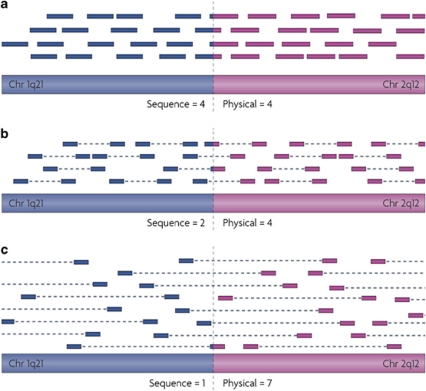
Mapping translocation breakpoints by NGS. Bars depict sequencing reads mapping to distinct chromosomes (chromosome 1 and chromosome 2) each side of the translocation breakpoint. Sequence coverage (number of times the breakpoint is covered by sequencing reads) vs physical coverage (number of times the breakpoint is covered by library fragments) are indicated. (a) Single-end sequencing. (b) Paired-end sequencing from a short-insert library (<500 bp). (c) Paired-end sequencing from a large-insert library (>1 kb), increasing physical coverage at the breakpoint site and likelihood of characterising the translocation. Reads spanning the translocation breakpoint are called ‘split reads' and can identify breakpoints at basepair resolution. Higher depth of sequence coverage (using short-insert libraries) and longer read lengths theoretically generates more informative split reads. Reprinted by permission from Macmillan Publishers Ltd: Nature Reviews Genetics (Meyerson et al., 2010), copyright 2010.
Figure 5
Figure 5
Genomic landscape of rearrangements in a pancreatic cancer patient. NGS identified various types of inter- and intra-chromosomal rearrangements scattered across the whole genome as shown by this circos plot. Inner ring represents copy-number status and outer ring shows chromosome ideograms. Reprinted by permission from Macmillan Publishers Ltd: Nature (Campbell et al., 2010), copyright 2010.

References

    1. Abel HJ, Duncavage EJ, Becker N, Armstrong JR, Magrini VJ, Pfeifer JD. SLOPE: a quick and accurate method for locating non-SNP structural variation from targeted next-generation sequence data. Bioinformatics. 2010;26:2684–2688. - PubMed
    1. Abyzov A, Gerstein M. AGE: defining breakpoints of genomic structural variants at single-nucleotide resolution, through optimal alignments with gap excision. Bioinformatics. 2011;27:595–603. - PMC - PubMed
    1. Alkan C, Coe BP, Eichler EE. Genome structural variation discovery and genotyping. Nat Rev Genet. 2011a;12:363–376. - PMC - PubMed
    1. Alkan C, Kidd JM, Marques-Bonet T, Aksay G, Antonacci F, Hormozdiari F, et al. Personalized copy number and segmental duplication maps using next-generation sequencing. Nat Genet. 2009;41:1061–1067. - PMC - PubMed
    1. Alkan C, Sajjadian S, Eichler EE. Limitations of next-generation genome sequence assembly. Nat Methods. 2011b;8:61–65. - PMC - PubMed

Publication types