


Acute leukemia incidence and patient survival among children and adults in the United States, 2001-2007
- PMID: 22086414
- PMCID: PMC3251235
- DOI: 10.1182/blood-2011-04-347872
Acute leukemia incidence and patient survival among children and adults in the United States, 2001-2007
Abstract
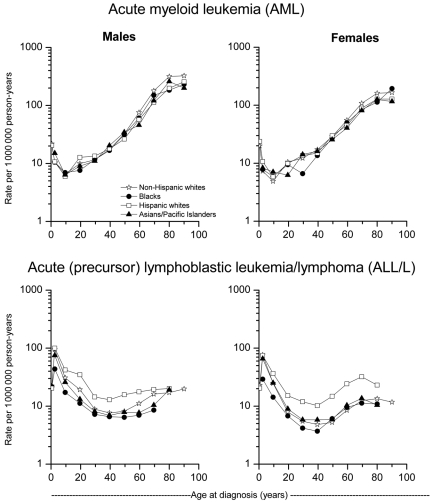
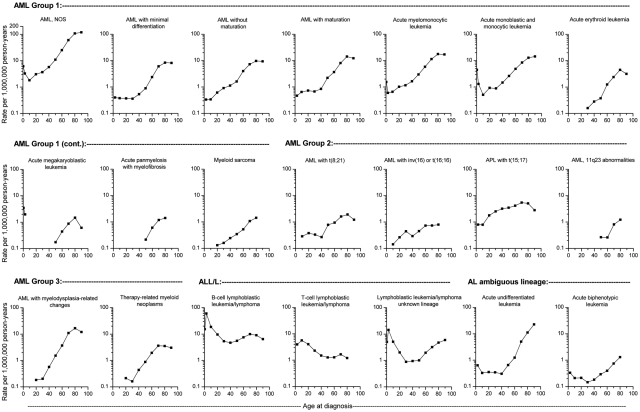
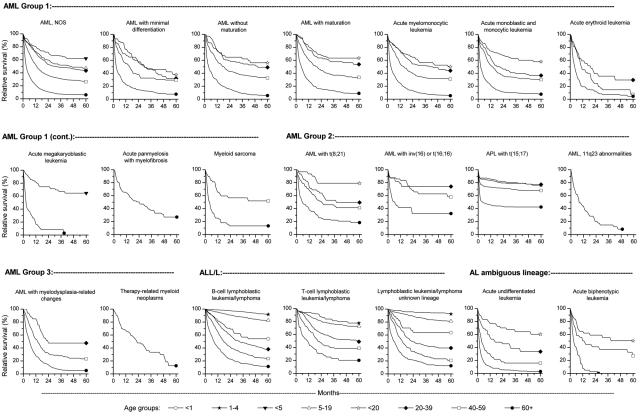
Since 2001, the World Health Organization classification for hematopoietic and lymphoid neoplasms has provided a framework for defining acute leukemia (AL) subtypes, although few population-based studies have assessed incidence patterns and patient survival accordingly. We assessed AL incidence rates (IRs), IR ratios (IRRs), and relative survival in the United States (2001-2007) in one of the first population-based, comprehensive assessments. Most subtypes of acute myeloid leukemia (AML) and acute lymphoblastic leukemia/lymphoma (ALL/L) predominated among males, from twice higher incidence of T-cell ALL/L among males than among females (IRR = 2.20) to nearly equal IRs of acute promyelocytic leukemia (APL; IRR = 1.08). Compared with non-Hispanic whites, Hispanics had significantly higher incidence of B-cell ALL/L (IRR = 1.64) and APL (IRR = 1.28); blacks had lower IRs of nearly all AL subtypes. All ALL/L but only some AML subtypes were associated with a bimodal age pattern. Among AML subtypes, survival was highest for APL and AML with inv(16). B-cell ALL/L had more favorable survival than T-cell ALL/L among the young; the converse occurred at older ages. Limitations of cancer registry data must be acknowledged, but the distinct AL incidence and survival patterns based on the World Health Organization classification support biologic diversity that should facilitate etiologic discovery, prognostication, and treatment advances.
Figures
References
-
- Jemal A, Siegel R, Xu J, Ward E. Cancer statistics, 2010. CA Cancer J Clin. 2010;60(5):277–300. - PubMed
-
- Linet MS, Devesa SS, Morgan GJ. The leukemias. In: Schottenfeld D, Fraumeni JF Jr, editors. Cancer Epidemiology and Prevention. 3rd ed. New York, NY: Oxford University Press; 2006. pp. 841–871.
-
- Jaffe ES, Harris NL, Stein H, Vardiman JW. World Health Organization Classification of Tumours. Pathology and Genetics of Haematopoietic and Lymphoid Tissues. Lyon, France: IARC Press; 2001.
-
- Swerdlow SH, Campo E, Harris NL, et al. WHO Classification of Tumours of Haematopoietic and Lymphoid Tissues (4th ed) Lyon, France: International Agency for Research on Cancer; 2008.
-
- Sant M, Allemani C, Tereanu C, et al. Incidence of hematologic malignancies in Europe by morphologic subtype: results of the HAEMACARE project. Blood. 2010;116(19):3724–3734. - PubMed
Publication types
MeSH terms
Grants and funding
LinkOut - more resources
Full Text Sources
Other Literature Sources
Medical
