


Genetic Basis of Children's Interstitial Lung Disease
- PMID: 22087432
- PMCID: PMC3207222
- DOI: 10.1089/ped.2009.0024
Genetic Basis of Children's Interstitial Lung Disease
Abstract
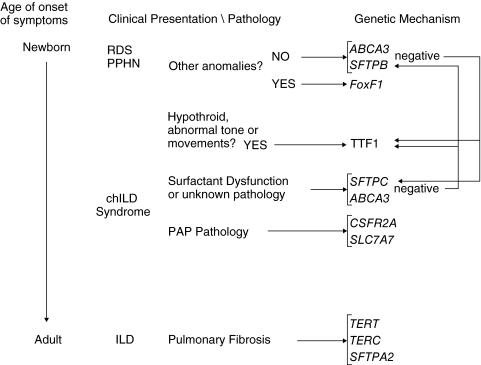
Specific genetic causes for children's interstitial lung disease (chILD) have been identified within the past decade. These include deletions of or mutations in genes encoding proteins important in surfactant production and function (SP-B, SP-C, and ABCA3), surfactant catabolism (GM-CSF receptor), as well as transcription factors important for surfactant production (TTF1) or lung development (Fox F1), with heterozygous deletions or loss-of-function mutations of the latter resulting in alveolar capillary dysplasia (ACD) with misalignment of the pulmonary veins. Familial pulmonary fibrosis in adults may result from mutations in genes encoding components of telomerase and SP-A2. While not yet reported in children, the expression of these genes in alveolar type II epithelial cells supports a key role for the disruption of normal homeostasis in this cell type in the pathogenesis of interstitial lung disease. The identification of specific genetic causes for chILD now allows for the possibility of non-invasive diagnosis, and provides insight into basic cellular mechanisms that may allow the development of novel therapies.
Figures
References
-
- Dinwiddie R. Sharief N. Crawford O. Idiopathic interstitial pneumonitis in children: a national survey in the United Kingdom and Ireland. Pediatr Pulmonol. 2002;34:23–29. - PubMed
-
- Fan LL. Langston C. Chronic interstitial lung disease in children. Pediatr Pulmonol. 1993;16:184–196. - PubMed
-
- Goerke J. Pulmonary surfactant: functions and molecular composition. Biochim Biophys Acta. 1998;1408:79–89. - PubMed
-
- Farrell PM. Avery ME. Hyaline membrane disease. Am Rev Respir Dis. 1975;111:657–688. - PubMed
-
- Weaver TE. Na CL. Stahlman M. Biogenesis of lamellar bodies, lysosome-related organelles involved in storage and secretion of pulmonary surfactant. Semin Cell Dev Biol. 2002;13:263–270. - PubMed
LinkOut - more resources
Full Text Sources
Miscellaneous
