


Epidermal growth factor receptor and K-Ras in non-small cell lung cancer-molecular pathways involved and targeted therapies
- PMID: 22087435
- PMCID: PMC3215775
- DOI: 10.5306/wjco.v2.i11.367
Epidermal growth factor receptor and K-Ras in non-small cell lung cancer-molecular pathways involved and targeted therapies
Abstract
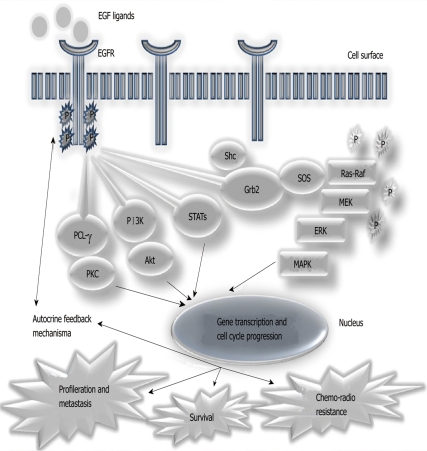
Lung cancer is currently the leading cause of cancer death in Western nations. Non-small cell lung cancer (NSCLC) represents 80% of all lung cancers, and adenocarcinoma is the predominant histological type. Despite the intensive research carried out on this field and therapeutic advances, the overall prognosis of these patients remains unsatisfactory, with a 5-year overall survival rate of less than 15%. Nowadays, pharmacogenetics and pharmacogenomics represent the key to successful treatment. Recent studies suggest the existence of two distinct molecular pathways in the carcinogenesis of lung adenocarcinoma: one associated with smoking and activation of the K-Ras oncogene and the other not associated with smoking and activation of the epidermal growth factor receptor (EGFR). The K-ras mutation is mainly responsible for primary resistance to new molecules which inhibit tyrosine kinase EGFR (erlotinib and gefitinib) and most of the EGFR mutations are responsible for increased tumor sensitivity to these drugs. This article aims to conduct a systematic review of the literature regarding the molecular pathways involving the EGFR, K-Ras and EGFR targeted therapies in NSCLC tumor behavior.
Keywords: Epidermal growth factor receptor; K-Ras; Non-small-cell lung carcinoma; Pharmacogenomics; p21ras proto-oncogene proteins.
Figures
References
-
- Schrump D, Giaccone G, Kelsey K, Marks L. Non Small Cell Lung Cancer. In: DeVita V, Lawrence T, Rosenberg S, Weinberg R, DePinho R, et al., editors. DeVita, Hellman, and Rosenberg’s Cancer: principles and practice of oncology. 8th ed. Philadelphia: Lippincott Williams and Wilkins; 2008. pp. 896–939.
-
- Jemal A, Bray F, Center MM, Ferlay J, Ward E, Forman D. Global cancer statistics. CA Cancer J Clin. 2011;61:69–90. - PubMed
-
- Alberg AJ, Brock MV, Samet JM. Epidemiology of lung cancer: looking to the future. J Clin Oncol. 2005;23:3175–3185. - PubMed
-
- Herbst RS, Bajorin DF, Bleiberg H, Blum D, Hao D, Johnson BE, Ozols RF, Demetri GD, Ganz PA, Kris MG, et al. Clinical Cancer Advances 2005: major research advances in cancer treatment, prevention, and screening--a report from the American Society of Clinical Oncology. J Clin Oncol. 2006;24:190–205. - PubMed
-
- Jemal A, Siegel R, Ward E, Hao Y, Xu J, Murray T, Thun MJ. Cancer statistics, 2008. CA Cancer J Clin. 2008;58:71–96. - PubMed
LinkOut - more resources
Full Text Sources
Other Literature Sources
Research Materials
Miscellaneous
