


Does the Framingham Stroke Risk Profile predict white-matter changes in late-life depression?
- PMID: 22088779
- PMCID: PMC3448558
- DOI: 10.1017/S1041610211002183
Does the Framingham Stroke Risk Profile predict white-matter changes in late-life depression?
Abstract
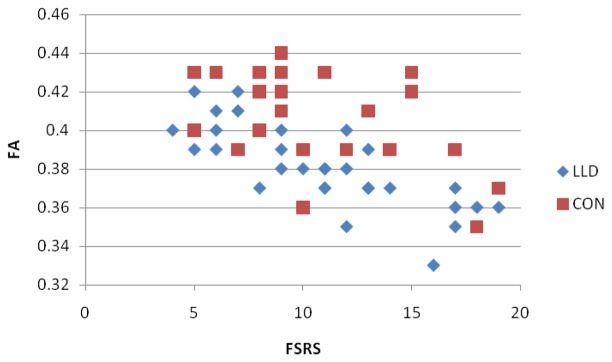
Background: Cardiovascular risk factors and diseases are important etiological factors in depression, particularly late-life depression. Brain changes associated with vascular disease and depression can be detected using magnetic resonance imaging. Using diffusion tensor imaging (DTI), we investigated whether the Framingham Stroke Risk Profile (FSRP), a well-validated risk prediction algorithm, is associated with changes in white-matter connectivity. We hypothesized that depressed participants would show reduced white-matter integrity with higher FSRP, and non-depressed controls (matched for mean vascular risk) would show minimal co-variance with white-matter changes.
Methods: Thirty-six participants with major depression (age 71.8 ± 7.7 years, mean FSRP 10.3 ± 7.6) and 25 controls (age 71.8 ± 7.3 years, mean FSRP 10.1 ± 7.7) were clinically interviewed and examined, followed by 60-direction DTI on a 3.0 Tesla scanner. Image analysis was performed using FSL tools (www.fmrib.ox.ac.uk/fsl) to assess the correlation between FSRP and fractional anisotropy (FA). Voxelwise statistical analysis of the FA data was carried out using Tract Based Spatial Statistics. The significance threshold for correlations was set at p < 0.05 using threshold-free cluster-enhancement. Partial correlation analysis investigated significant correlations in each group.
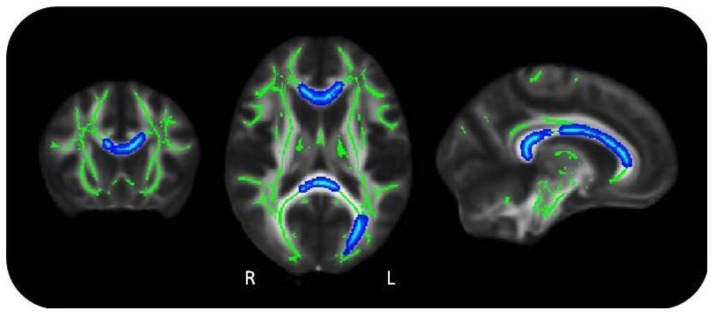
Results: Participants in the depressed group showed highly significant correlations between FSRP and FA within the body of corpus callosum (r = -0.520, p = 0.002), genu of corpus callosum (r = -0.468, p = 0.005), splenium of corpus callosum (r = -0.536, p = 0.001), and cortico-spinal tract (r = -0.473, p = 0.005). In controls, there was only one significant correlation in the body of corpus callosum (r = -0.473, p = 0.023).
Conclusions: FSRP is associated with impairment in white-matter integrity in participants with depression; these results suggest support for the vascular depression hypothesis.
Conflict of interest statement
None
Figures
References
-
- Alexopoulos GS, Meyers BS, Young RC, Campbell S, Silbersweig D, Charlson M. ‘Vascular depression’ hypothesis. Archives of General Psychiatry. 1997;54(10):915–922. - PubMed
-
- Andersson JLR, Jenkinson M, Smith S. Non-linear optimisation. FMRIB technical report TR07JA1. 2007a. from www.fmrib.ox.ac.uk/analysis/techrep.
-
- Andersson JLR, Jenkinson M, Smith S. Non-linear registration, aka Spatial normalisation. FMRIB technical report TR07JA2. 2007b. from www.fmrib.ox.ac.uk/analysis/techrep.
-
- Buckner RL. Memory and executive function in aging and AD: multiple factors that cause decline and reserve factors that compensate. Neuron. 2004;44(1):195–208. - PubMed
-
- Chen CS, Chen CC, Kuo YT, Chiang IC, Ko CH, Lin HF. Carotid intima-media thickness in late-onset major depressive disorder. International Journal of Geriatric Psychiatry. 2006;21(1):36–42. - PubMed
