


Analysis of 4999 online physician ratings indicates that most patients give physicians a favorable rating
- PMID: 22088924
- PMCID: PMC3222200
- DOI: 10.2196/jmir.1960
Analysis of 4999 online physician ratings indicates that most patients give physicians a favorable rating
Abstract
Background: Many online physician-rating sites provide patients with information about physicians and allow patients to rate physicians. Understanding what information is available is important given that patients may use this information to choose a physician.
Objectives: The goals of this study were to (1) determine the most frequently visited physician-rating websites with user-generated content, (2) evaluate the available information on these websites, and (3) analyze 4999 individual online ratings of physicians.
Methods: On October 1, 2010, using Google Trends we identified the 10 most frequently visited online physician-rating sites with user-generated content. We then studied each site to evaluate the available information (eg, board certification, years in practice), the types of rating scales (eg, 1-5, 1-4, 1-100), and dimensions of care (eg, recommend to a friend, waiting room time) used to rate physicians. We analyzed data from 4999 selected physician ratings without identifiers to assess how physicians are rated online.
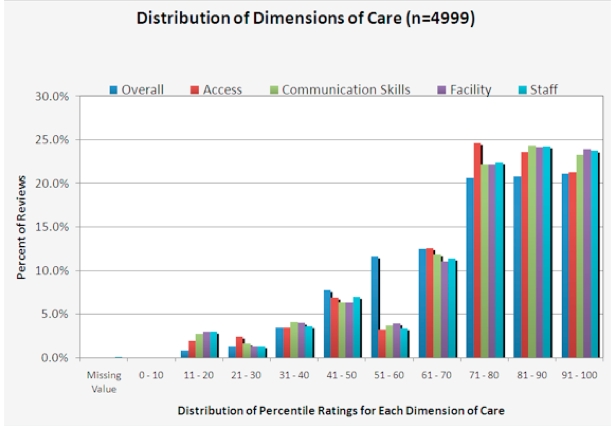
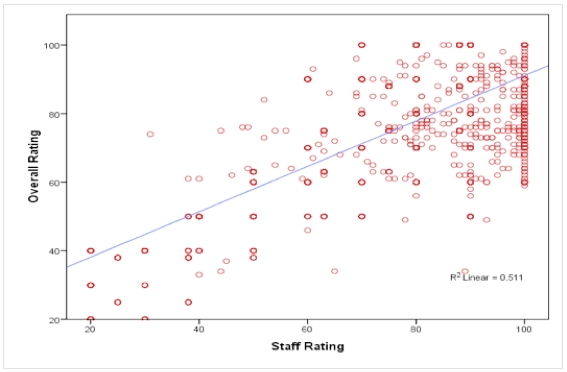
Results: The 10 most commonly visited websites with user-generated content were HealthGrades.com, Vitals.com, Yelp.com, YP.com, RevolutionHealth.com, RateMD.com, Angieslist.com, Checkbook.org, Kudzu.com, and ZocDoc.com. A total of 35 different dimensions of care were rated by patients in the websites, with a median of 4.5 (mean 4.9, SD 2.8, range 1-9) questions per site. Depending on the scale used for each physician-rating website, the average rating was 77 out of 100 for sites using a 100-point scale (SD 11, median 76, range 33-100), 3.84 out of 5 (77%) for sites using a 5-point scale (SD 0.98, median 4, range 1-5), and 3.1 out of 4 (78%) for sites using a 4-point scale (SD 0.72, median 3, range 1-4). The percentage of reviews rated ≥75 on a 100-point scale was 61.5% (246/400), ≥4 on a 5-point scale was 57.74% (2078/3599), and ≥3 on a 4-point scale was 74.0% (740/1000). The patient's single overall rating of the physician correlated with the other dimensions of care that were rated by patients for the same physician (Pearson correlation, r = .73, P < .001).
Conclusions: Most patients give physicians a favorable rating on online physician-rating sites. A single overall rating to evaluate physicians may be sufficient to assess a patient's opinion of the physician. The optimal content and rating method that is useful to patients when visiting online physician-rating sites deserves further study. Conducting a qualitative analysis to compare the quantitative ratings would help validate the rating instruments used to evaluate physicians.
Conflict of interest statement
None declared
Figures
References
-
- Reimann S, Strech D. The representation of patient experience and satisfaction in physician rating sites. A criteria-based analysis of English- and German-language sites. BMC Health Serv Res. 2010;10:332. doi: 10.1186/1472-6963-10-332. http://www.biomedcentral.com/1472-6963/10/3321472-6963-10-332 - DOI - PMC - PubMed
-
- Taylor H. Harris Interactive. 2010. Aug 4, [2011-10-03]. Press release: "Cyberchondriacs" on the Rise? Those who go online for healthcare information continues to increase http://www.harrisinteractive.com/vault/HI-Harris-Poll-Cyberchondriacs-20....
-
- Segal J. The role of the Internet in doctor performance rating. Pain Physician. 2009;12(3):659–64. http://www.painphysicianjournal.com/linkout_vw.php?issn=1533-3159&vol=12... - PubMed
-
- Keckley PH. Deloitte Center for Health Solutions. 2011. [2011-10-02]. 2011 Survey of Health Care Consumers in the United States: Key Findings, Strategic Implications http://www.deloitte.com/assets/Dcom-UnitedStates/Local%20Assets/Document....
-
- Fox S, Purcell K. Chronic disease and the Internet. Washington, DC: Pew Internet & American Life Project; 2010. Mar 24, [2011-10-03]. http://www.pewinternet.org/~/media/Files/Reports/2010/PIP_Chronic_Diseas....
MeSH terms
LinkOut - more resources
Full Text Sources
