


Prevalence of seroconversion symptoms and relationship to set-point viral load: findings from a subtype C epidemic, 1995-2009
- PMID: 22089380
- PMCID: PMC3589587
- DOI: 10.1097/QAD.0b013e32834ed8c8
Prevalence of seroconversion symptoms and relationship to set-point viral load: findings from a subtype C epidemic, 1995-2009
Abstract
Objective: To describe symptoms, physical examination findings, and set-point viral load associated with acute HIV seroconversion in a heterosexual cohort of HIV-discordant couples in Zambia.
Design: We followed HIV serodiscordant couples in Lusaka, Zambia from 1995 to 2009 with HIV testing of negative partners and symptom inventories 3 monthly, and physical examinations annually.
Methods: We compared prevalence of self-reported or treated symptoms (malaria syndrome, chronic diarrhea, asthenia, night sweats, and oral candidiasis) and annual physical examination findings (unilateral or bilateral neck, axillary, or inguinal adenopathy; and dermatosis) in seroconverting vs. HIV-negative or HIV-positive intervals, controlling for repeated observations, age, and sex. A composite score comprised of significant symptoms and physical examination findings predictive of seroconversion vs. HIV-negative intervals was constructed. We modeled the relationship between number of symptoms and physical examination findings at seroconversion and log set-point viral load using linear regression.
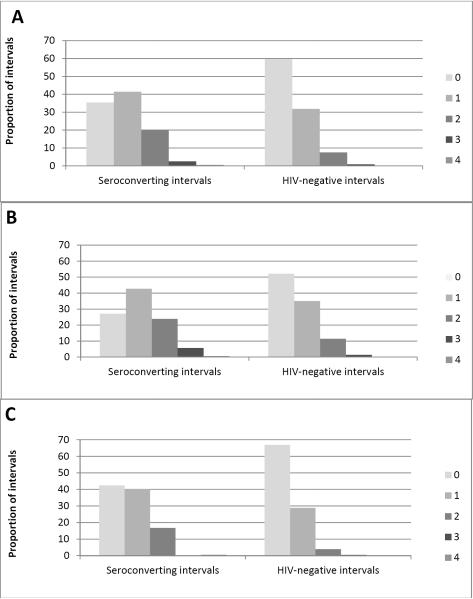
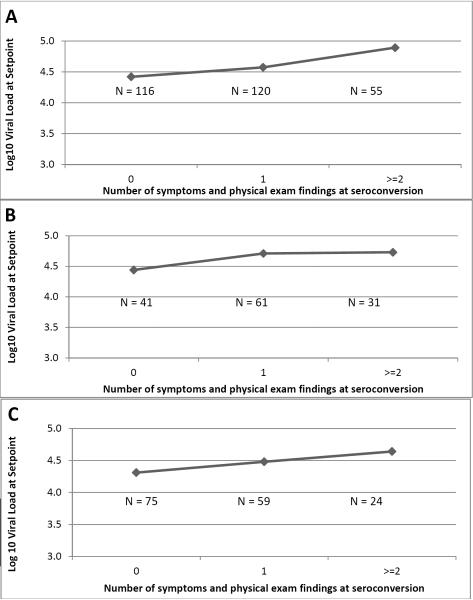
Results: Two thousand, three hundred and eighty-eight HIV-negative partners were followed for a median of 18 months; 429 seroconversions occurred. Neither symptoms nor physical examination findings were reported for most seroconverters. Seroconversion was significantly associated with malaria syndrome among nondiarrheic patients [adjusted odds ratio (aOR) = 4.0], night sweats (aOR = 1.4), and bilateral axillary (aOR = 1.6), inguinal (aOR = 2.2), and neck (aOR = 2.2) adenopathy relative to HIV-negative intervals. Median number of symptoms and findings was positively associated with set-point viral load (P < 0.001).
Conclusion: Although most acute and early infections were asymptomatic, malaria syndrome was more common and more severe during seroconversion. When present, symptoms and physical examination findings were nonspecific and associated with higher set-point viremia.
Figures
References
-
- Lifson AR, Allen S, Wolf W, Serufilira A, Kantarama G, Lindan CP. Classification of HIV infection and disease in women from Rwanda. Evaluation of the World Health Organization HIV staging system and recommended modifications. Ann Intern Med. 1995;122:262–270. - PubMed
-
- Lindan CP, Allen S, Serufilira A, Lifson AR, Van de Perre P, Chen-Rundle A. Predictors of mortality among HIV-infected women in Kigali, Rwanda. Ann Intern Med. 1992;116:320–328. - PubMed
-
- Modjarrad K, Zulu I, Karita E, Kancheya N, Funkhouser E, Allen S. Predictors of HIV Serostatus among HIV Discordant Couples in Lusaka, Zambia and Female Antenatal Clinic Attendants in Kigali, Rwanda. AIDS Res Hum Retroviruses. 2005;21:5–12. - PubMed
-
- Peters PJ, Karita E, Kayitenkore K, Meinzen-Derr J, Kim DJ, Tichacek A. HIV-infected Rwandan women have a high frequency of long-term survival. AIDS. 2007;21(Suppl 6):S31–37. - PubMed
Publication types
MeSH terms
Grants and funding
- R01 MH66767/MH/NIMH NIH HHS/United States
- R01AI40951/AI/NIAID NIH HHS/United States
- R01 HD040125/HD/NICHD NIH HHS/United States
- R01 AI051231/AI/NIAID NIH HHS/United States
- R01AI23980/AI/NIAID NIH HHS/United States
- D43TW001042/TW/FIC NIH HHS/United States
- R01 AI023980/AI/NIAID NIH HHS/United States
- R37 AI051231/AI/NIAID NIH HHS/United States
- D43 TW001042/TW/FIC NIH HHS/United States
- R01HD40125/HD/NICHD NIH HHS/United States
- P30 AI050409/AI/NIAID NIH HHS/United States
- R01 AI040951/AI/NIAID NIH HHS/United States
- R01 MH066767/MH/NIMH NIH HHS/United States
- R01AI51231/AI/NIAID NIH HHS/United States
LinkOut - more resources
Full Text Sources
Medical
