


Mitochondria in motor nerve terminals: function in health and in mutant superoxide dismutase 1 mouse models of familial ALS
- PMID: 22089637
- PMCID: PMC3237816
- DOI: 10.1007/s10863-011-9392-1
Mitochondria in motor nerve terminals: function in health and in mutant superoxide dismutase 1 mouse models of familial ALS
Abstract
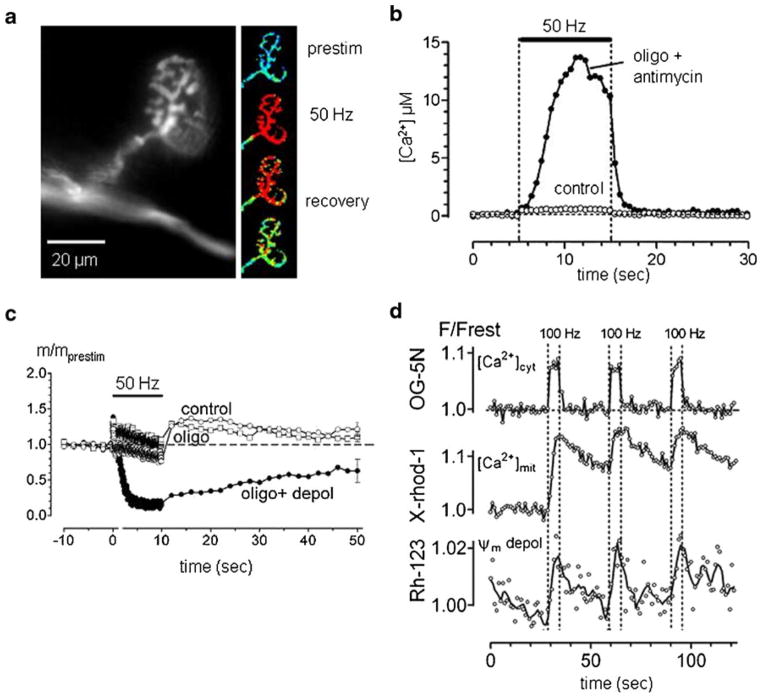
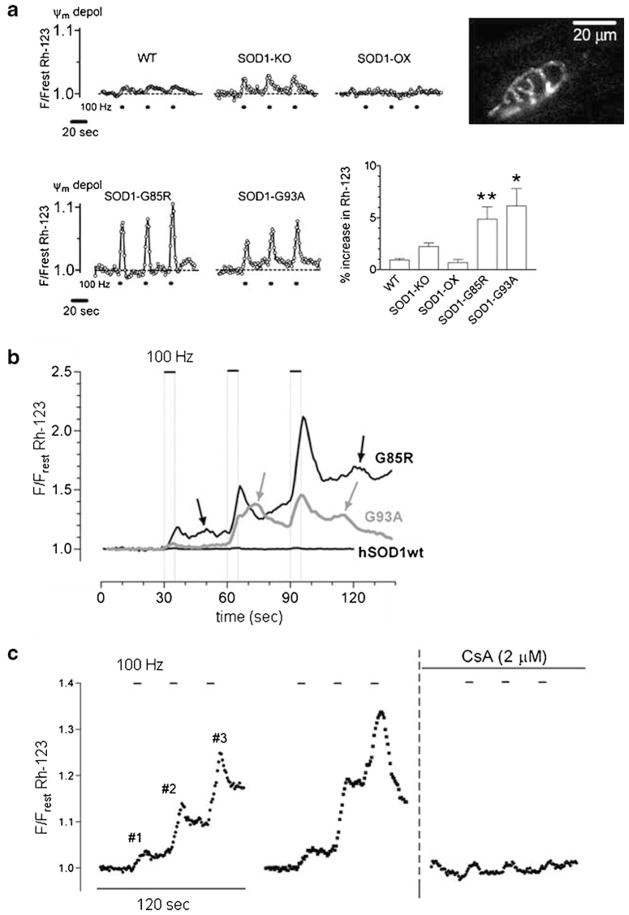
Mitochondria contribute to neuronal function not only via their ability to generate ATP, but also via their ability to buffer large Ca(2+) loads. This review summarizes evidence that mitochondrial Ca(2+) sequestration is especially important for sustaining the function of vertebrate motor nerve terminals during repetitive stimulation. Motor terminal mitochondria can sequester large amounts of Ca(2+) because they have mechanisms for limiting both the mitochondrial depolarization and the increase in matrix free [Ca(2+)] associated with Ca(2+) influx. In mice expressing mutations of human superoxide dismutase -1 (SOD1) that cause some cases of familial amyotrophic lateral sclerosis (fALS), motor terminals degenerate well before the death of motor neuron cell bodies. This review presents evidence for early and progressive mitochondrial dysfunction in motor terminals of mutant SOD1 mice (G93A, G85R). This dysfunction would impair mitochondrial ability to sequester stimulation-associated Ca(2+) loads, and thus likely contributes to the early degeneration of motor terminals.
Figures
References
-
- Bruijn LI, Becher MW, Lee MK, Anderson KL, Jemkins NA, Copeland NG, et al. Neuron. 1997;18:327–338. - PubMed
-
- Burke RE. In: Myology. 3. Engel AG, Franzini-Armstrong D, editors. McGraw-Hill; New York: 2004.
-
- Chiu AY, Zhai P, Dalcanto MC, Peters TM, Kwon YW, Prattis SM, et al. Mol Cell Neurosci. 1995;6:349–362. - PubMed
-
- Damiano M, Starkov AA, Petri S, Kipiani K, Kiaei M, Mattiazzi M, et al. J Neurochem. 2006;96:1349–1361. - PubMed
Publication types
MeSH terms
Substances
Grants and funding
LinkOut - more resources
Full Text Sources
Medical
Miscellaneous
