. 2012 Feb;63(3):1285-95.
doi: 10.1093/jxb/err355. Epub 2011 Nov 16.

A male sterility-associated cytotoxic protein ORF288 in Brassica juncea causes aborted pollen development

Affiliations

A male sterility-associated cytotoxic protein ORF288 in Brassica juncea causes aborted pollen development

Bing Jing et al. J Exp Bot. 2012 Feb.

Abstract

Cytoplasmic male sterility (CMS) is a widespread phenomenon in higher plants, and several studies have established that this maternally inherited defect is often associated with a mitochondrial mutant. Approximately 10 chimeric genes have been identified as being associated with corresponding CMS systems in the family Brassicaceae, but there is little direct evidence that these genes cause male sterility. In this study, a novel chimeric gene (named orf288) was found to be located downstream of the atp6 gene and co-transcribed with this gene in the hau CMS sterile line. Western blotting analysis showed that this predicted open reading frame (ORF) was translated in the mitochondria of male-sterile plants. Furthermore, the growth of Escherichia coli was significantly repressed in the presence of ORF288, which indicated that this protein is toxic to the E. coli host cells. To confirm further the function of orf288 in male sterility, the gene was fused to a mitochondrial-targeting pre-sequence under the control of the Arabidopsis APETALA3 promoter and introduced into Arabidopsis thaliana. Almost 80% of transgenic plants with orf288 failed to develop anthers. It was also found that the independent expression of orf288 caused male sterility in transgenic plants, even without the transit pre-sequence. Furthermore, transient expression of orf288 and green fluorescent protein (GFP) as a fused protein in A. thaliana protoplasts showed that ORF288 was able to anchor to mitochondria even without the external mitochondrial-targeting peptide. These observations provide important evidence that orf288 is responsible for the male sterility of hau CMS in Brassica juncea.


Figures
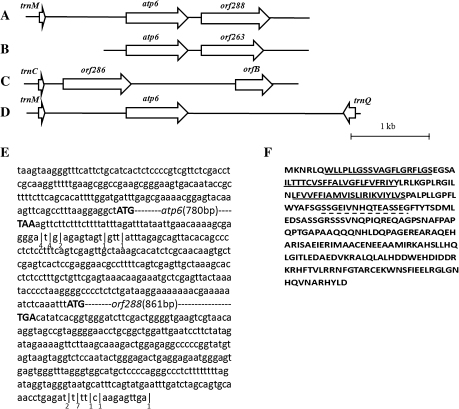
Fig. 1.
Fig. 1.
(A–D) The organization of mitochondrial genome regions associated with the orf288 gene for four different mitotypes. (A) The trnMatp6–orf288 region of the hau mitotype. (B) The atp6–orf263 region of tour CMS: orf263 is associated with this type of CMS (Landgren et al., 1996). (C) The trnC–orf286–orfB region of the nap mitotype: orf286 is an unidentified ORF in nap CMS (Handa, 2003). (D) The trnM–atp6–trnQ region of the hau CMS maintainer line. (E) Complete cDNA sequence of the atp6/orf288 transcripts of the male-sterile line. The initiation and termination codon are highlighted in bold. The different 3' ends of transcripts are indicated by vertical bars, and the number under the bar indicates the number of the ends sequenced. (F) Amino acid sequence of ORF288: the transmembrane regions are underlined, and the dotted underlining indicates that the peptide was synthesized and used for antibody production. Arrows indicate the direction of transcription.
Fig. 2.
Fig. 2.
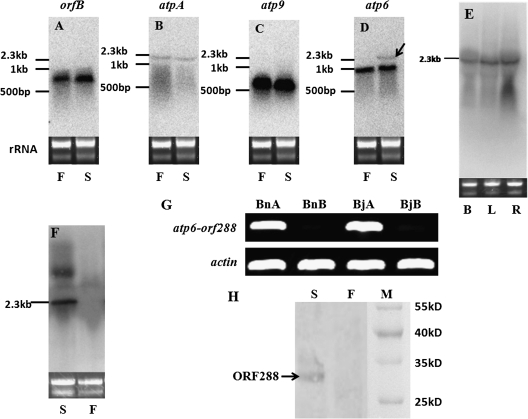
(A–D) Northern blotting analysis of total RNA from buds of the male-sterile line (S) and the maintainer line (F) for four mitochondrial probes (orfB, atpA, atp9, and atp6). The atp6 gene showed polymorphic band patterns of RNA transcripts (indicated by the black arrow). (E) Total RNA from the floral buds (B), leaf (L), and roots (R) of the hau CMS sterile line in Brassica juncea was blotted with the orf288 probe. (F) The total RNA from the male-sterile line (S) and the maintainer line (F) of hau CMS in Brassica napus was detected using the orf288 probe. (G) RT-PCR to demonstrate the expression of the atp6–orf288 region in the hau mitotype, but not in its maintainer line. BnA, the male-sterile line in Brassica napus; BnB, the maintainer line in Brassica napus; BjA, the male-sterile line in Brassica juncea; BjB, the maintainer line in Brassica juncea. (H) Identification of ORF288 unique to the sterile line of hau CMS. Mitochondrial proteins were extracted from etiolated seedlings of male-sterile (S) and maintainer (F) lines and then were separated by 12% SDS–PAGE. The protein blots were then probed with an antibody to ORF288. The specific band (lane S) for ORF288 is indicated with an arrow. A pre-stained marker (M) was used for the detection of the transfer process and an evaluation of the molecular mass of the detected protein.
Fig. 3.
Fig. 3.
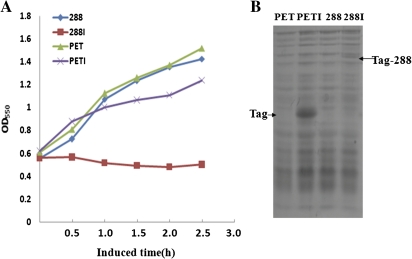
(A) The effect of orf288 expression on the growth of E. coli cells in liquid cultures with or without IPTG. IPTG was added when the cell growth reached OD550=0.6. The expression vector PET32a was set as a control. 288, orf288-containing vector not induced by IPTG, 288I, induced with IPTG; PET, the control expression vector not induced by IPTG; PETI, the control expression vector induced by IPTG. (B) The expressed recombinant protein. Tag, the tag peptide in pet32a; Tag-288, the fusion peptide of tag and ORF288. (This figure is available in colour at JXB online.)
Fig. 4.
Fig. 4.
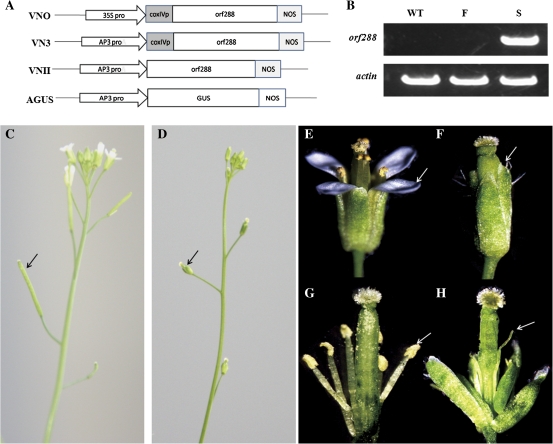
(A) Schematic illustration of constructs used to transform Arabidopsis. The mitochondrial-targeting pre-sequence is the N-terminal 57 amino acids of the coxIV gene in yeast (grey boxes). ORFs are indicated by open boxes. Arrows indicate the CaMV35S or the promoter of the Arabidopsis AP3 gene. The fragments were cloned to the expression sites of pCAMBIA2300 (constructs: VN3, VNO, and VNII). and the AP3 promoter fragment used was inserted into pBI101 as a control. The direction of transcription is from left to right. (B) Expression analysis of orf288 in transgenic plants with the VN3 construct. The transgenic plants showed male sterility (S) and full fertility (F). Wild buds (WT) were used as a control. (C–H) Phenotype analyses of male-sterile transformants with the VN3 construct. (C) Feature of a wild silique (black arrow); (D) feature of a male-sterile transgenic non-pollinated pistil (black arrow); (E) a wild flower with normal petals (white arrow); (F) a male-sterile transgenic flower without white petals; (G) wild anthers (white arrow); (H) no anther on top of a filament (white arrow).
Fig. 5.
Fig. 5.
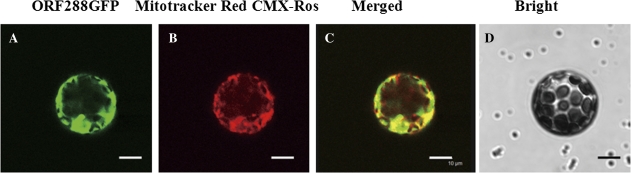
Subcellular localization of ORF288. (A) The protoplast showed a green fluorescent signal at 488 nm; (B) the same protoplast showed a red fluorescent signal (stained by Mitotracker Red CMX-Ros) at 561 nm; (C) merged image of the green and red signals; (D) bright-field image. Data are representative of the transformed protoplasts. Green fluorescent signals were examined 16 h after transformation. Scale bars=10 μm.

References

    1. Abad AR, Mehrtens BJ, Mackenzie SA. Specific expression in reproductive tissues and fate of a mitochondrial sterility-associated protein in cytoplasmic male-sterile bean. The Plant Cell. 1995;7:271–285. - PMC - PubMed
    1. Akagi H, Nakamura A, Yokozeki-Misono Y, Inagaki A, Takahashi H, Mori K, Fujimura T. Positional cloning of the rice Rf-1 gene, a restorer of BT-type cytoplasmic male sterility that encodes a mitochondria-targeting PPR protein. Theoretical and Applied Genetics. 2004;108:1449–1457. - PubMed
    1. Ashutosh Kumar P, Dinesh Kumar V, Sharma PC, Prakash S, Bhat SR. A novel orf108 co-transcribed with the atpA gene is associated with cytoplasmic male sterility in Brassica juncea carrying Moricandia arvensis cytoplasm. Plant and Cell Physiology. 2008;49:284–289. - PubMed
    1. Bellaoui M, Grelon M, Pelletier G, Budar F. The restorer Rfo gene acts post-translationally on the stability of the ORF138 Ogura CMS-associated protein in reproductive tissues of rapeseed cybrids. Plant Molecular Biology. 1999;40:893–902. - PubMed
    1. Bendtsen JD, Nielsen H, von Heijne G, Brunak S. Improved prediction of signal peptides: SignalP 3.0. Journal of Molecular Biology. 2004;340:783–795. - PubMed

Publication types

MeSH terms