


Comparing the outcomes of open surgical procedure and percutaneously peritoneal dialysis catheter (PDC) insertion using laparoscopic needle: A two month follow-up study
- PMID: 22091260
- PMCID: PMC3214349
Comparing the outcomes of open surgical procedure and percutaneously peritoneal dialysis catheter (PDC) insertion using laparoscopic needle: A two month follow-up study
Abstract
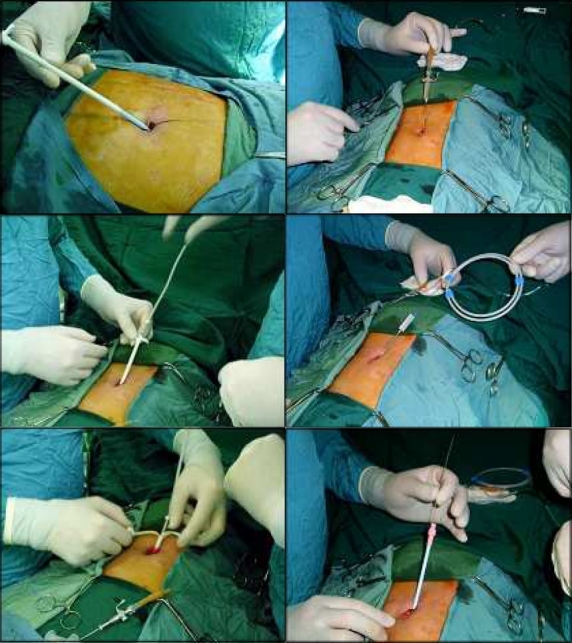
Background: This study was performed to compare the outcomes of open surgical procedure and percutaneously peritoneal dialysis catheter (PDC) insertion using laparoscopic needle.
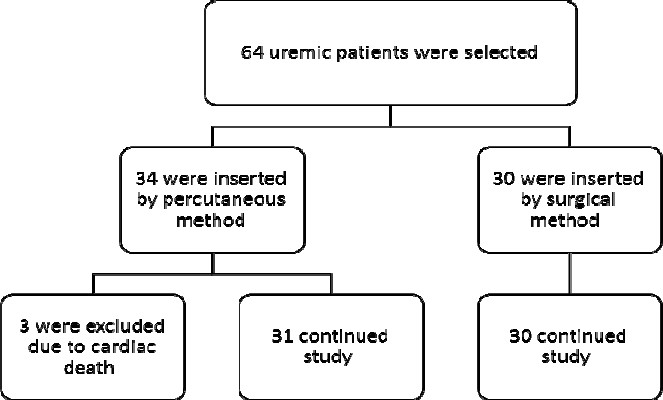
Methods: This randomized clinical trial study was conducted in the Nephrology Department in Noor Hospital, Isfahan, Iran between 2009 and 2010. 64 uremic patients were randomized into two study groups using random allocation software. Thirty four catheters were inserted percutaneously (P group) and 30 catheters were placed surgically (S group). Collected information included demographic data, body mass index, and cause of renal disease, duration of operation and length of hospitalization. Outcomes were considered as mechanical and infectious complications.
Results: There were no significant differences in age, gender, the mean of body mass index, having history of hemodialysis, diabetes mellitus, hypertension, ischemic heart disease, and length of hospitalization. Hemopenitoneom was more frequent in S group than P group (13.3% versus 3.2%; p < 0.0001). There was no significant difference between two groups in early peritonitis, early leakage, hernia, hollow viscous perforation, catheter obstruction, and malpositioning and the time of peritoneal dialysis onset. Outflow failure and the exit site infection were more frequent in S group than P group (p < 0.0001). Mean of the operative time was longer in S group than P group (27.70 ± 2.79 minutes versus 10.48 ± 1.91 minutes, p < 0.001).
Conclusions: Percutaneous catheter insertion has fewer rate of complications and is less time consuming in comparison with surgical method.
Keywords: Catheter Ablation; Laparoscopy; Needles; Peritoneal Dialysis.
Conflict of interest statement
Authors have no conflict of interests.
Figures
References
-
- Bar-Zohar D, Sagie B, Lubezky N, Blum M, Klausner J, bu-Abeid S. Laparoscopic implantation of the Tenckhoff catheter for the treatment of end-stage renal failure and congestive heart failure: experience with the pelvic fixation technique. Isr Med Assoc J. 2006;8(3):174–8. - PubMed
-
- Al-Hashemy AM, Seleem MI, Al-Ahmary AM, Bin-Mahfooz AA. A two-port laparoscopic placement of peritoneal dialysis catheter: a preliminary report. Saudi J Kidney Dis Transpl. 2004;15(2):144–8. - PubMed
-
- Schmidt SC, Pohle C, Langrehr JM, Schumacher G, Jacob D, Neuhaus P. Laparoscopic-assisted placement of peritoneal dialysis catheters: implantation technique and results. J Laparoendosc Adv Surg Tech A. 2007;17(5):596–9. - PubMed
-
- Banli O, Altun H, Oztemel A. Early start of CAPD with the Seldinger technique. Perit Dial Int. 2005;25(6):556–9. - PubMed
LinkOut - more resources
Full Text Sources