


Serum 25-hydroxyvitamin D and physical function in older adults: the Cardiovascular Health Study All Stars
- PMID: 22091492
- PMCID: PMC3228270
- DOI: 10.1111/j.1532-5415.2011.03601.x
Serum 25-hydroxyvitamin D and physical function in older adults: the Cardiovascular Health Study All Stars
Abstract
Objectives: To examine the association between 25-hydroxyvitamin D (25(OH)D) and physical function in adults of advanced age.
Design: Cross-sectional and longitudinal analysis of physical function over 3 years of follow-up in the Cardiovascular Health Study All Stars.
Setting: Forsyth County, North Carolina; Sacramento County, California; Washington County, Maryland; and Allegheny County, Pennsylvania.
Participants: Community-dwelling adults aged 77 to 100 (N = 988).
Measurements: Serum 25-hydroxyvitamin D 25(OH)D), Short Physical Performance Battery (SPPB), and grip and knee extensor strength assessed at baseline. Mobility disability (difficulty walking half a mile or up 10 steps) and activities of daily living (ADLs) disability were assessed at baseline and every 6 months over 3 years of follow-up.
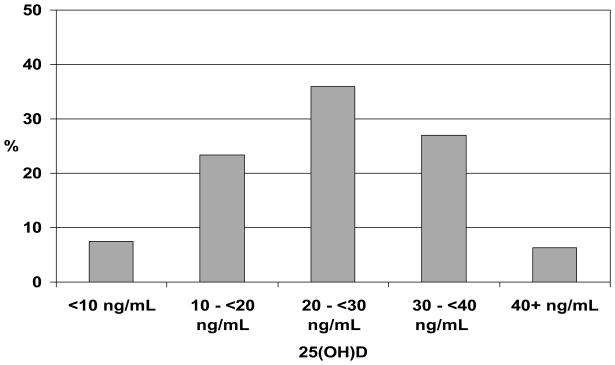
Results: Almost one-third (30.8%) of participants were deficient in 25(OH)D (<20 ng/mL). SPPB scores were lower in those with deficient 25(OH)D (mean (standard error) 6.53 (0.24)) than in those with sufficient 25(OH)D (≥30 ng/mL) (7.15 (0.25)) after adjusting for sociodemographic characteristics, season, health behaviors, and chronic conditions (P = .006). Grip strength adjusted for body size was also lower in those with deficient 25(OH)D than in those with sufficient 25(OH)D (24.7 (0.6) kg vs 26.0 (0.6) kg, P = .02). Participants with deficient 25(OH)D were more likely to have prevalent mobility (OR = 1.44, 95% confidence interval (CI)) = 0.96-2.14) and ADL disability (OR = 1.51, 95% CI = 1.01-2.25) at baseline than those with sufficient 25(OH)D. Furthermore, participants with deficient 25(OH)D were at greater risk of incident mobility disability over 3 years of follow-up (hazard ratio = 1.56, 95% CI = 1.06-2.30).
Conclusion: Vitamin D deficiency was common and was associated with poorer physical performance, lower muscle strength, and prevalent mobility and ADL disability in community-dwelling older adults. Moreover, vitamin D deficiency predicted incident mobility disability.
© 2011, Copyright the Authors Journal compilation © 2011, The American Geriatrics Society.
Conflict of interest statement
DKH, JAT, and CCD received funding from a research grant (PI: DKH) from the Investigator-Initiated Studies Program of Merck & Co., Inc., to conduct the analyses in the CHS All Stars. Merck & Co., Inc., had no role in data collection, data analysis or manuscript preparation or in the decision to submit the manuscript for publication.
Figures
References
-
- Holick MF. Vitamin D deficiency. N Engl J Med. 2007;357:266–281. - PubMed
-
- Fried LP, Guralnik JM. Disability in older adults: evidence regarding significance, etiology, and risk. J Am Geriatr Soc. 1997;45:92–100. - PubMed
-
- Lips P. Vitamin D deficiency and secondary hyperparathyroidism in the elderly: consequences for bone loss and fractures and therapeutic implications. Endocr Rev. 2001;22:477–501. - PubMed
Publication types
MeSH terms
Substances
Grants and funding
- P30 AG024827/AG/NIA NIH HHS/United States
- R01 AG024827/AG/NIA NIH HHS/United States
- K01 AG030506/AG/NIA NIH HHS/United States
- N01-HC85082/HC/NHLBI NIH HHS/United States
- N01 HC055222/HL/NHLBI NIH HHS/United States
- N01 HC085079/HL/NHLBI NIH HHS/United States
- N01-HC85081/HC/NHLBI NIH HHS/United States
- N01-HC85080/HC/NHLBI NIH HHS/United States
- N01-HC85084/HC/NHLBI NIH HHS/United States
- N01 HC035129/HC/NHLBI NIH HHS/United States
- N01-HC35129/HC/NHLBI NIH HHS/United States
- N01 HC55222/HC/NHLBI NIH HHS/United States
- UL1 TR000005/TR/NCATS NIH HHS/United States
- R01 HL075366/HL/NHLBI NIH HHS/United States
- N01 CN015103/CA/NCI NIH HHS/United States
- N01-HC85086/HC/NHLBI NIH HHS/United States
- N01-HC85079/HC/NHLBI NIH HHS/United States
- R01 AG015928/AG/NIA NIH HHS/United States
- U01 HL080295/HL/NHLBI NIH HHS/United States
- R01 AG20098/AG/NIA NIH HHS/United States
- N01-HC85083/HC/NHLBI NIH HHS/United States
- N01-HC75150/HC/NHLBI NIH HHS/United States
- N01 HC015103/HC/NHLBI NIH HHS/United States
- N01 HC085086/HL/NHLBI NIH HHS/United States
- N01-HC45133/HC/NHLBI NIH HHS/United States
- R01 AG15928/AG/NIA NIH HHS/United States
- R01 AG020098/AG/NIA NIH HHS/United States
- N01-HC85085/HC/NHLBI NIH HHS/United States
- N01 HC075150/HL/NHLBI NIH HHS/United States
- R01 AG023629/AG/NIA NIH HHS/United States
- N01 HC15103/HC/NHLBI NIH HHS/United States
- R01 AG027058/AG/NIA NIH HHS/United States
- N01 HC045133/HC/NHLBI NIH HHS/United States
