


Temporal relationship and predictive value of urinary acute kidney injury biomarkers after pediatric cardiopulmonary bypass
- PMID: 22093507
- PMCID: PMC3220882
- DOI: 10.1016/j.jacc.2011.08.017
Temporal relationship and predictive value of urinary acute kidney injury biomarkers after pediatric cardiopulmonary bypass
Abstract
Objectives: We investigated the temporal pattern and predictive value (alone and in combination) of 4 urinary biomarkers (neutrophil gelatinase-associated lipocalin [NGAL], interleukin [IL]-18, liver fatty acid-binding protein [L-FABP], and kidney injury molecule [KIM]-1) for cardiac surgery-associated acute kidney injury (AKI).
Background: Serum creatinine (S(Cr)) is a delayed marker for AKI after cardiopulmonary bypass (CPB). Rapidly detectable AKI biomarkers could allow early intervention and improve outcomes.
Methods: Data from 220 pediatric patients were analyzed. Urine samples were obtained before and at intervals after CPB initiation. AKI was defined as a ≥50% increase in S(Cr) from baseline within 48 h after CPB. The temporal pattern of biomarker elevation was established, and biomarker elevations were correlated with AKI severity and clinical outcomes. Biomarker predictive abilities were evaluated by area under the curve (AUC), net reclassification improvement, and integrated discrimination improvement.
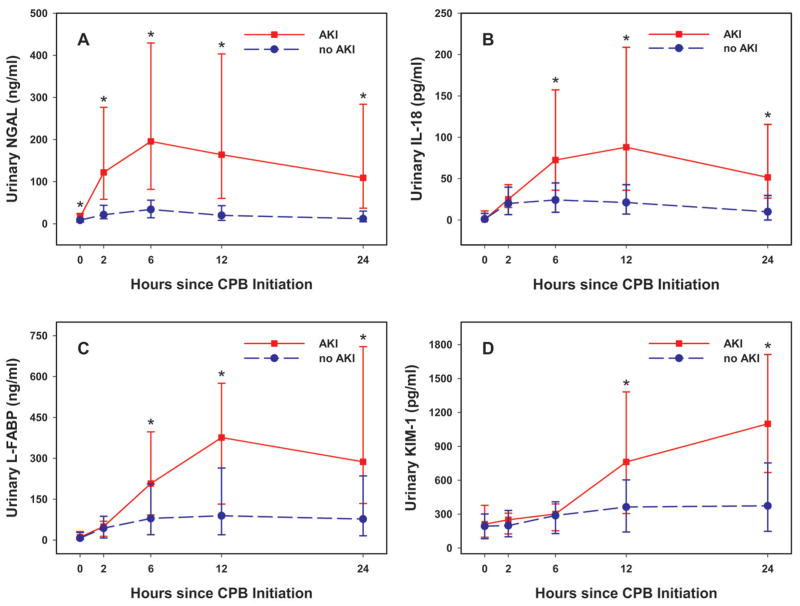
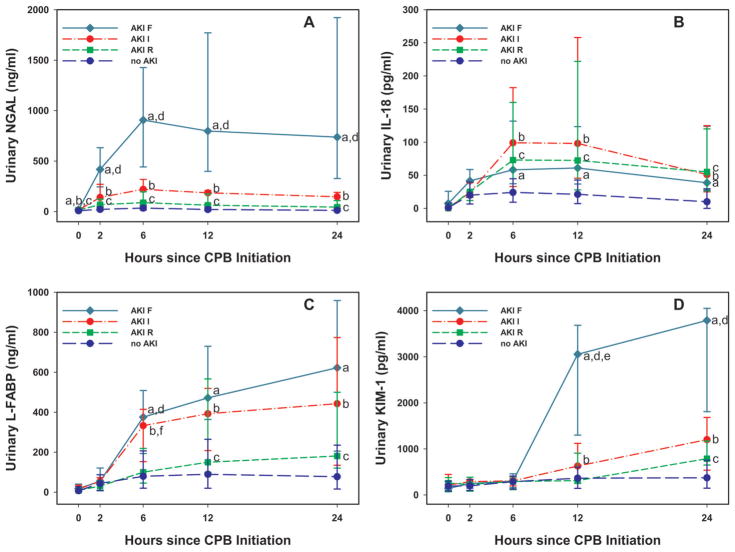
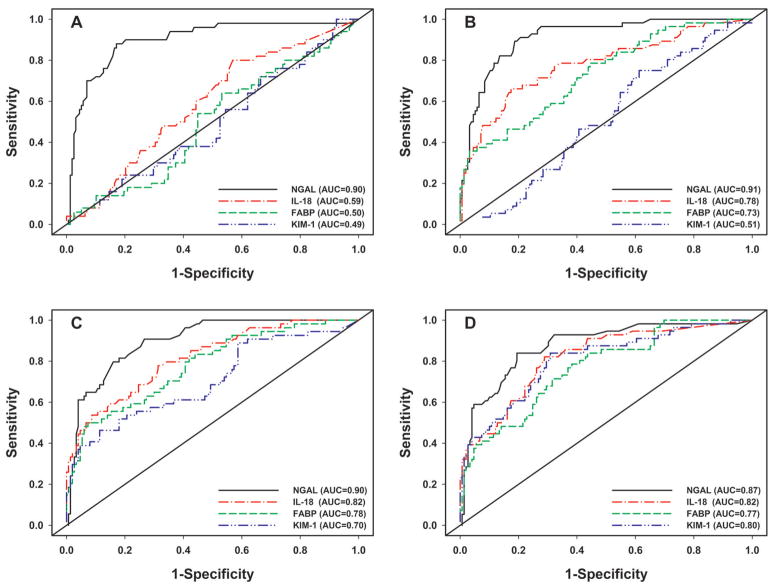
Results: AKI occurred in 27% of patients. Urine NGAL significantly increased in AKI patients at 2 h after CPB initiation. IL-18 and L-FABP increased at 6 h, and KIM-1 increased at 12 h. Biomarker elevations were correlated with AKI severity and clinical outcomes and improved AKI prediction above a clinical model. At 2 h, addition of NGAL increased the AUC from 0.74 to 0.85 (p < 0.0001). At 6 h, NGAL, IL-18, and L-FABP each improved the AUC from 0.72 to 0.91, 0.84, and 0.77, respectively (all p < 0.05). The added predictive ability of the biomarkers was supported by net reclassification improvement and integrated discrimination improvement. Biomarker combinations further improved AKI prediction.
Conclusions: Urine NGAL, IL-18, L-FABP, and KIM-1 are sequential predictive biomarkers for AKI and are correlated with disease severity and clinical outcomes after pediatric CPB. These biomarkers, particularly in combination, may help establish the timing of injury and allow earlier intervention in AKI.
Copyright © 2011 American College of Cardiology Foundation. Published by Elsevier Inc. All rights reserved.
Figures
Comment in
-
Can novel biomarkers complement best possible clinical assessment for early acute kidney injury diagnosis?J Am Coll Cardiol. 2011 Nov 22;58(22):2310-2. doi: 10.1016/j.jacc.2011.08.014. J Am Coll Cardiol. 2011. PMID: 22093508 No abstract available.
-
Acute kidney injury: Timing of biomarker increases in acute kidney injury.Nat Rev Nephrol. 2012 Jan 10;8(2):64. doi: 10.1038/nrneph.2011.210. Nat Rev Nephrol. 2012. PMID: 22231140 No abstract available.
References
-
- Lok CE, Austin PC, Wang H, Tu JV. Impact of renal insufficiency on short- and long-term outcomes after cardiac surgery. Am Heart J. 2004;148(3):430–8. - PubMed
-
- Mishra J, Dent C, Tarabishi R, Mitsnefes MM, Ma Q, Kelly C, et al. Neutrophil gelatinase-associated lipocalin (NGAL) as a biomarker for acute renal injury after cardiac surgery. Lancet. 2005;365(9466):1231–8. - PubMed
-
- Chertow GM, Levy EM, Hammermeister KE, Grover F, Daley J. Independent association between acute renal failure and mortality following cardiac surgery. Am J Med. 1998;104(4):343–8. - PubMed
-
- Lassnigg A, Schmidlin D, Mouhieddine M, Bachmann LM, Druml W, Bauer P, et al. Minimal changes of serum creatinine predict prognosis in patients after cardiothoracic surgery: a prospective cohort study. J Am Soc Nephrol. 2004;15(6):1597–605. - PubMed
-
- Zappitelli M, Bernier PL, Saczkowski RS, Tchervenkov CI, Gottesman R, Dancea A, et al. A small post-operative rise in serum creatinine predicts acute kidney injury in children undergoing cardiac surgery. Kidney Int. 2009;76(8):885–92. - PubMed
Publication types
MeSH terms
Substances
Grants and funding
LinkOut - more resources
Full Text Sources
Other Literature Sources
Miscellaneous
