


Interaction of the main components from the traditional Chinese drug pair Chaihu-Shaoyao based on rat intestinal absorption
- PMID: 22095024
- PMCID: PMC6264397
- DOI: 10.3390/molecules16119600
Interaction of the main components from the traditional Chinese drug pair Chaihu-Shaoyao based on rat intestinal absorption
Abstract
The Chaihu-Shaoyao drug pair (Bupleuri Radix and Paeoniae Radix Alba) which is a traditional Chinese drug pair, has been widely used for anti-inflammatory purposes. Saikosaponin a (SSA), saikosaponin d (SSD) and paeoniflorin are identified as the main components in the pair. The present study focused on the interaction of the main components based on investigating their intestinal absorption using a four-site perfused rat intestinal model in order to clarify the mechanism of the compatibility of Chaihu-Shaoyao. The concentrations of SSA, SSD and paeoniflorin in the intestinal perfusate were determined by LC/MS or UPLC (Ultra Performance Liquid Chromatography) methods, followed by P*(eff) (effective permeability) and 10% ABS (the percent absorption of 10 cm of intestine) calculations. The results showed that all of the three main components displayed very low permeabilities (P*(eff) < 0.4), which implied their poor absorption in the rat intestine. The absorption levels of SSA and SSD were similar in intestine and higher in ileum than those in other intestinal regions in the decreasing order: colon, jejunum and duodenum. However, there is no significant difference in the absorption of paeoniflorin in the four segments (P < 0.05). The P*(eff) values of paeoniflorin exhibited an almost 2.11-fold or 1.90-fold increase in ileum when it was co-administrated with SSA and SSD, as well as 2.42-, 2.18-fold increase in colon, respectively, whereas the absorptions of SSA and SSD were not influenced by paeoniflorin. In conclusion, SSA and SSD could promote the absorption of paeoniflorin. To some extent this might explain the nature of the compatibility mechanisms of composite formulae in TCMs.
Figures
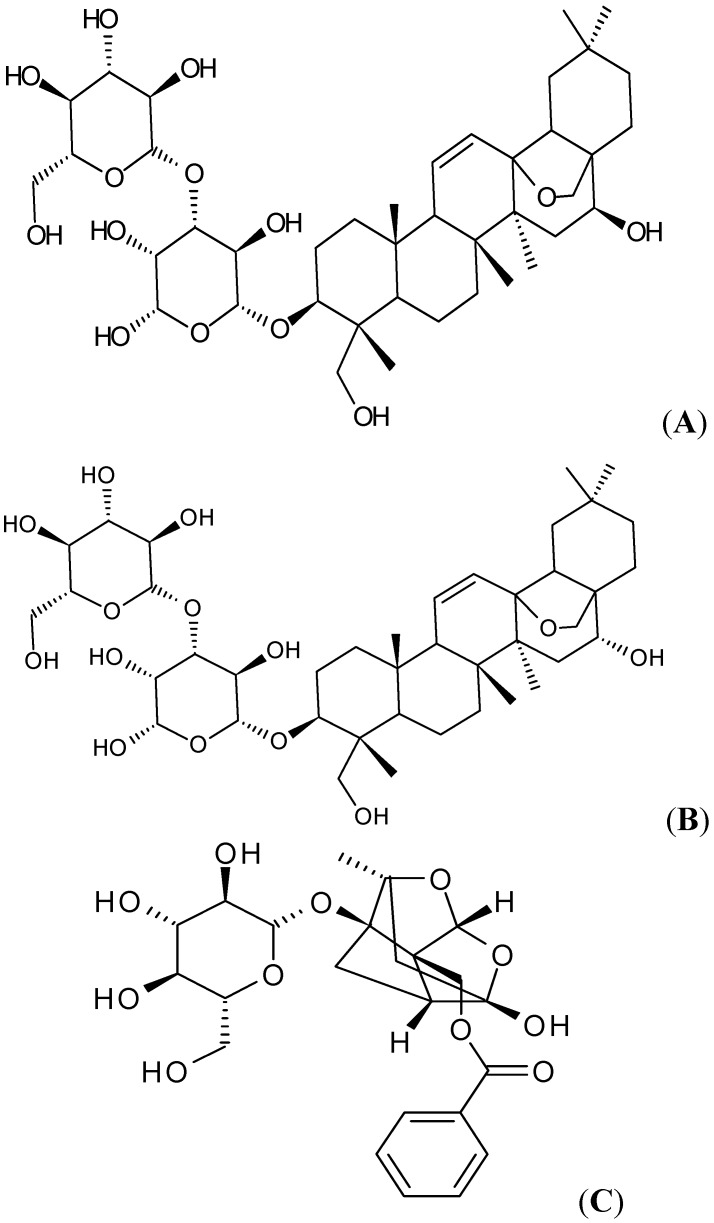
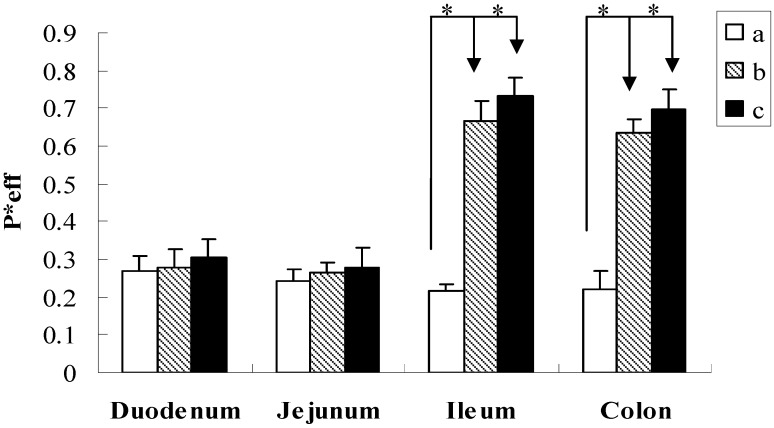
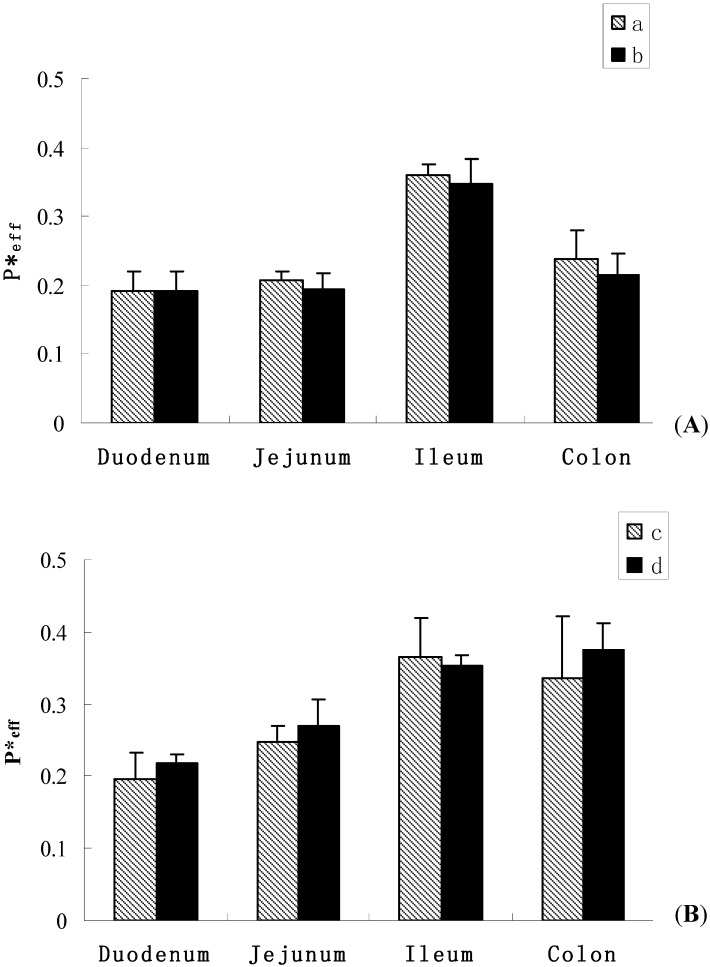
 ± s, n = 4). Figure (A) SSA; (a) alone; (b) co-administration with paeoniflorin; Figure (B) SSD; (c) alone; (d) co-administration with paeoniflorin.
References
-
- Huang X., Kong L., Li X., Chen X., Guo M., Zou H. Strategy for analysis and screening of bioactive compounds in traditional Chinese medicines. J. Chromatogr. B Anal. Technol. Biomed. Life Sci. 2004;812:71–84. - PubMed
-
- Su S.L., Yu L., Hua Y.Q., Duan J.A., Deng H.S., Tang Y.P., Lu Y., Ding A.W. Screening and analyzing the potential bioactive components from Shaofu Zhuyu decoction, using human umbilical vein endothelial cell extraction and high-performance liquid chromatography coupled with mass spectrometry. Biomed. Chromatogr. 2008;22:1385–1392. doi: 10.1002/bmc.1070. - DOI - PubMed
-
- He J.X., Akao T., Tani T. Influence of co-administered antibiotics on the pharmacokinetic fate in rats of paeoniflorin and its active metabolite paeonimetabolin-I from Shaoyao-Gancao-tang. J. Pharm. Pharmacol. 2003;55:313–321. - PubMed
-
- Yi L.T., Zhang L., Ding A.W., Xu Q., Zhu Q., Kong L.D. Orthogonal array design for antidepressant compatibility of polysaccharides from Banxia-Houpu decoction, a traditional Chinese herb prescription in the mouse models of depression. Arch. Pharm. Res. 2009;32:1417–1423. doi: 10.1007/s12272-009-2011-6. - DOI - PubMed
Publication types
MeSH terms
Substances
LinkOut - more resources
Full Text Sources
Research Materials
Miscellaneous
