. 2012 Feb;190(2):617-26.
doi: 10.1534/genetics.111.136689. Epub 2011 Nov 17.

MicroRNA transgene overexpression complements deficiency-based modifier screens in Drosophila

Affiliations

MicroRNA transgene overexpression complements deficiency-based modifier screens in Drosophila

Sébastien Szuplewski et al. Genetics. 2012 Feb.

Abstract

Dosage-sensitive modifier screening is a powerful tool for linking genes to biological processes. Use of chromosomal deletions permits sampling the effects of removing groups of genes related by position on the chromosome. Here, we explore the use of inducible microRNA transgenes as a complement to deficiency-based modifier screens. miRNAs are predicted to have hundreds of targets. miRNA overexpression provides an efficient means to reduces expression of large gene sets. A collection of transgenes was prepared to allow overexpression of 89 miRNAs or miRNA clusters. These transgenes and a set of genomic deficiencies were screened for their ability to modify the bristle phenotype of the cell-cycle regulator minus. Sixteen miRNAs were identified as dominant suppressors, while the deficiency screen uncovered four genomic regions that contain a dominant suppressor. Comparing the genes uncovered by the deletions with predicted miRNA targets uncovered a small set of candidate suppressors. Two candidates were identified as suppressors of the minus phenotype, Cullin-4 and CG5199/Cut8. Additionally, we show that Cullin-4 acts through its substrate receptor Cdt2 to suppress the minus phenotype. We suggest that inducible microRNA transgenes are a useful complement to deficiency-based modifier screens.


Figures
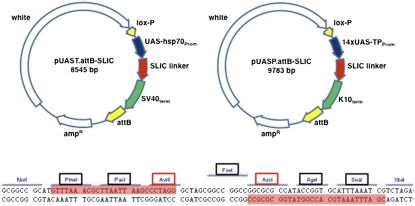
Figure 1
Figure 1
The miRNA overexpression vectors. Schematic representation of pUAST.attB-SLIC for somatic miRNA overexpression and pUASP.attB-SLIC optimized for germ line miRNA overexpression. The sequence of the SLIC linker is indicated below. All restriction sites of the SLIC linker are unique in pUAST.attB-SLIC. Unique sites for both vectors are boxed. When AvrII and AscI are used to linearize the vectors for SLIC cloning (Li and Elledge 2007), the sequences marked in red should be added to the forward (AvrII) and reverse (AscI) primers.
Figure 2
Figure 2
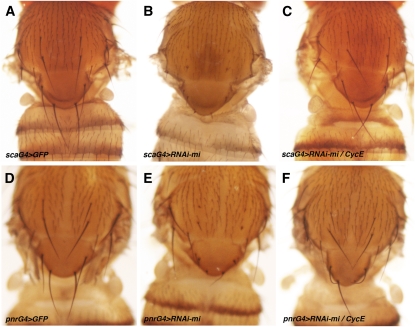
minus RNAi phenotype sensitive to CycE dosage. Images of the dorsal thorax of adult female flies of the indicated genotypes. (A) sca–GAL4/UAS–GFP, scaG4 control. (B) sca–GAL4, UAS–RNAi-mi/+ caused a size reduction of thoracic macrochaete compared to control. (C) sca–GAL4, UAS–RNAi-mi/CycEAr95: reduction of cyclin E gene dosage rescued the RNAi phenotype. (D) pnrG4 control: UAS–GFP/+; pnr–GAL4/+ (E) pnr–GAL4: UAS–RNAi-mi/+ caused a size reduction of thoracic macrochaete compared to control. (F) CycEAr95/+; pnr–GAL4, UAS–RNAi-mi/+: reduction of cyclin E rescued the phenotype.
Figure 3
Figure 3
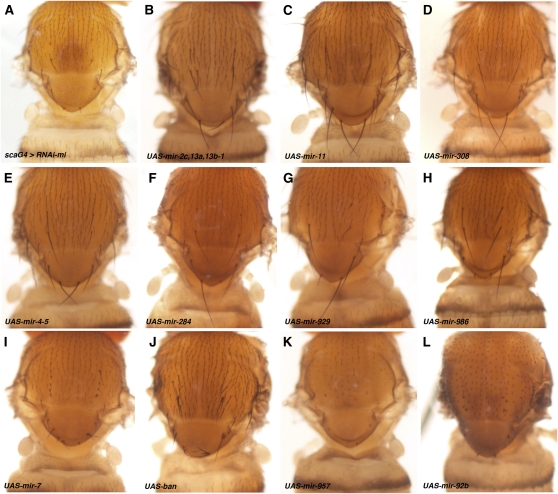
Examples of phenotypes observed in the screen. Images of the dorsal thorax of adult female flies of the indicated genotypes. (A) sca–GAL4, UAS–RNAi-mi/+ phenotype shown for comparison. (B) UAS–mir-2c,13a,13b/+; sca–GAL4, UAS–RNAi-mi/+. (C) sca–GAL4, UAS–RNAi-mi/+; UAS–mir-11/+ (note the extra macrochaete on the notum for B and C). (D) sca–GAL4, UAS–RNAi–mi/UAS–mir-308 (note the extra scutellar bristles in B–E). (E) sca–GAL4, UAS–RNAi-mi/UAS–miR-4, 5. (F) sca–GAL4, UAS–RNAi-mi/+; UAS–mir-284/+. (G) sca–GAL4, UAS–RNAi-mi/+; UAS–mir-929/+. (H) sca–GAL4, UAS–RNAi-mi/+; UAS–mir-986/+. (I and J) Absence of suppression was oberved following miR-7 or bantam overexpressison: (I) UAS–mir-7/+; sca–GAL4, UAS–RNAi-mi/+. (J) sca–GAL4, UAS–RNAi-mi/+; UAS–ban/+. (K) Absence of suppression and loss of bristles, sometimes associated with an absence of sockets, was observed following miR-957 overexpression: sca–GAL4, UAS–RNAi-mi/UAS–mir-957. (L) Enlarged shaft and bristle cells of macro- and microchaete were caused by miR-92b overexpressison. Genotype: sca–GAL4, UAS–RNAi-mi/+; UAS–mir-92b/+.
Figure 4
Figure 4
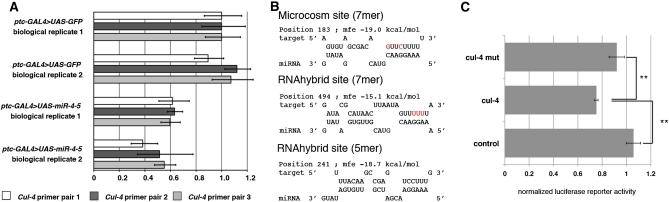
Cul-4 is a miR-5 target. (A) Cul-4 RNA levels measured using three sets of Cul-4 primer pairs. RNA was extracted from salivary glands expressing GFP (ptc-GAL4 > UAS–GFP) or miR-4-5 cluster (ptc-GAL4 > UAS–miR-4-5). Data represent mean ±SD for three technical replicates. Results of two independent experiments are shown (1 and 2). (B) Predicted miR-5 target sites in the Cul-4 3′−UTR. Minimal free energy (mfe) is calculated by RNAhybrid. Nucleotides changed to generate the target site mutant UTR are in red. The predicted RNAhybrid 5mer shown is the example with the highest mfe in this category. (C) Luciferase assays showing regulation of a Cul-4 3′-UTR reporter. Luciferase reporter activity is normalized to the Renilla transfection control and to empty miRNA overexpression vector control. Data represent mean ±SD. (**) P < 0.01 (Student's t-tests).
Figure 5
Figure 5
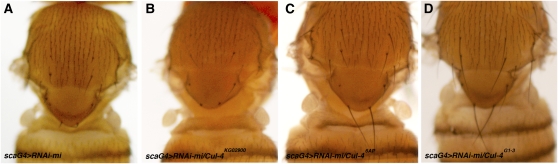
Cul-4 dosage reduction suppresses minus bristle phenotype. Images of the dorsal thorax of adult female flies of the indicated genotypes. (A) sca–GAL4, UAS–RNAi-mi/+. (B) sca–GAL4, UAS–RNAi-mi/Cul-4KG02900. (C) sca–GAL4, UAS–RNAi-mi/Cul-46AP. (D) sca–GAL4, UAS–RNAi-mi/Cul-4G1-3. The minus mutant bristle phenotype was not suppressed by the hypomorphic allele Cul-4KG02900 but was suppressed by two independent Cul-4 null alleles.
Figure 6
Figure 6
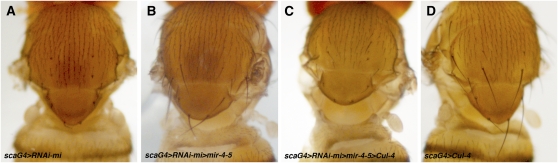
Cul-4 downregulation is responsible for the Suppressor of minus behavior caused by miR-5 overexpression. Images of the dorsal thorax of adult female flies of the indicated genotypes. (A) sca–GAL4, UAS–RNAi-mi/+, and (B) sca–GAL4, UAS–RNAi-mi/UAS–miR-4-5, show the minus RNAi phenotype and the suppressed phenotype as controls for C. (C) sca–GAL4, UAS–RNAi-mi/UAS–miR-4-5; UAS–Cul-4/+. Coexpression of Cul-4 and the miR-4-5 cluster in the sca–UAS–RNAi-mi sensitized background restored the mutant phenotype. (D) sca–GAL4/+; UAS–Cul-4/+. Expression of Cul-4 alone with sca–GAL4 caused only a slight reduction of some bristles.
Figure 7
Figure 7
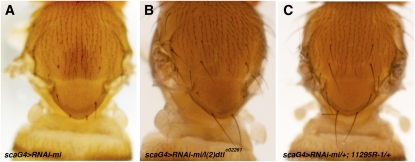
l(2)dtl dosage reduction. Images of the dorsal thorax of adult female flies of the indicated genotypes. (A) sca–GAL4, UAS–RNAi-mi/+; shows the minus RNAi phenotype as a control for the suppression shown by reduction of l(2)dtl in B. (B) sca–GAL4, UAS–RNAi-mi/ l(2)dtlc02261. (C) sca–GAL4, UAS–RNAi-mi/11295R-1 shows the effect of depleting l(2)dtl by RNAi.

References

    1. Abbas T., Dutta A., 2011. Crl4cdt2: master coordinator of cell cycle progression and genome stability. Cell Cycle 10: 241–249 - PMC - PubMed
    1. Abdelilah-Seyfried S., Chan Y. M., Zeng C., Justice N. J., Younger-Shepherd S., et al. , 2000. A gain-of-function screen for genes that affect the development of the Drosophila adult external sensory organ. Genetics 155: 733–752 - PMC - PubMed
    1. Baek D., Villen J., Shin C., Camargo F. D., Gygi S. P., et al. , 2008. The impact of microRNAs on protein output. Nature 455: 64–71 - PMC - PubMed
    1. Bartel D. P., 2009. MicroRNAs: target recognition and regulatory functions. Cell 136: 215–233 - PMC - PubMed
    1. Bischof J., Maeda R. K., Hediger M., Karch F., Basler K., 2007. An optimized transgenesis system for Drosophila using germ-line-specific Phic31 integrases. Proc. Natl. Acad. Sci. USA 104: 3312–3317 - PMC - PubMed

MeSH terms

LinkOut - more resources