


An important minority of prediabetic first-degree relatives of type 1 diabetic patients derives from seroconversion to persistent autoantibody positivity after 10 years of age
- PMID: 22095238
- PMCID: PMC3810367
- DOI: 10.1007/s00125-011-2376-1
An important minority of prediabetic first-degree relatives of type 1 diabetic patients derives from seroconversion to persistent autoantibody positivity after 10 years of age
Abstract
Aims/hypothesis: The appearance of autoantibodies (Abs) before diabetes onset has mainly been studied in young children. However, most patients develop type 1 diabetes after the age of 15 years. In first-degree relatives aged under 40 years, we investigated the frequency of seroconversion to (persistent) Ab positivity, progression to diabetes and baseline characteristics of seroconverters according to age.
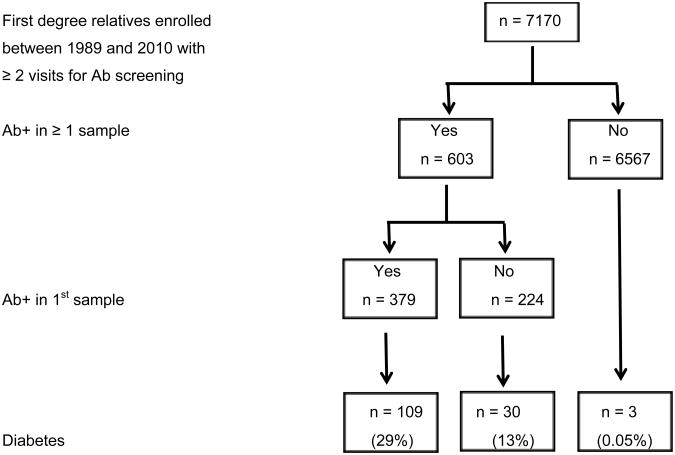
Methods: Abs against insulin (IAA), glutamate decarboxylase (GADA), insulinoma-associated protein 2 (IA-2A) and zinc transporter 8 (ZnT8A) were measured during follow-up of 7,170 first-degree relatives.
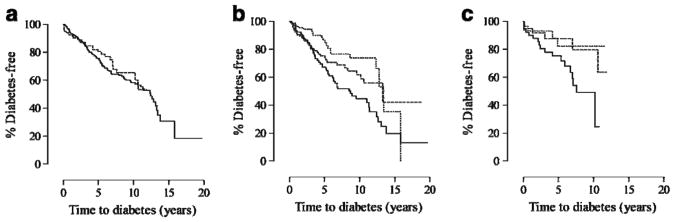
Results: We identified 379 (5.3%) relatives with positivity for IAA, GADA, IA-2A and/or ZnT8A (Ab(+)) at first sampling and 224 (3.1%) at a later time point. Most seroconversions occurred after the age of 10 years (63%). During follow-up, Abs persisted more often in relatives initially Ab(+) (76%) than in seroconverters (53%; p < 0.001). In both groups diabetes developed at a similar pace and almost exclusively with Ab persistence (136 of 139 prediabetic individuals). For both groups, progression was more rapid if Abs appeared before the age of 10 years. Baseline characteristics at seroconversion did not vary significantly according to age.
Conclusions/interpretation: Seroconversion to (persistent) Ab(+) occurs regardless of age. Although the progression rate to diabetes is higher under age 10 years, later seroconverters (up to age 40 years) have similar characteristics when compared with age-matched initially Ab(+) relatives and generate an important minority of prediabetic relatives, warranting their identification and, eventually, enrolment in prevention trials.
Conflict of interest statement
Figures
References
-
- Leslie RD, Delli Castelli M. Age-dependent influences on the origins of autoimmune diabetes: evidence and implications. Diabetes. 2004;53:3033–3040. - PubMed
-
- Pipeleers D, Ling Z. Pancreatic beta cells in insulin-dependent diabetes. Diabetes Metab Rev. 1992;8:209–227. - PubMed
-
- Gorus FK. Diabetes registries and early biological markers of insulin-dependent diabetes mellitus. Belgian Diabetes Registry. Diabetes Metab Rev. 1997;13:247–274. - PubMed
-
- Keymeulen B, Walter M, Mathieu C, et al. Four-year metabolic outcome of a randomised controlled CD3-antibody trial in recent-onset type 1 diabetic patients depends on their age and baseline residual beta cell mass. Diabetologia. 2010;53:614–623. - PubMed
Publication types
MeSH terms
Substances
Grants and funding
LinkOut - more resources
Full Text Sources
Medical
