Evidence for involvement of GNB1L in autism
- PMID: 22095694
- PMCID: PMC3270696
- DOI: 10.1002/ajmg.b.32002
Evidence for involvement of GNB1L in autism
Abstract
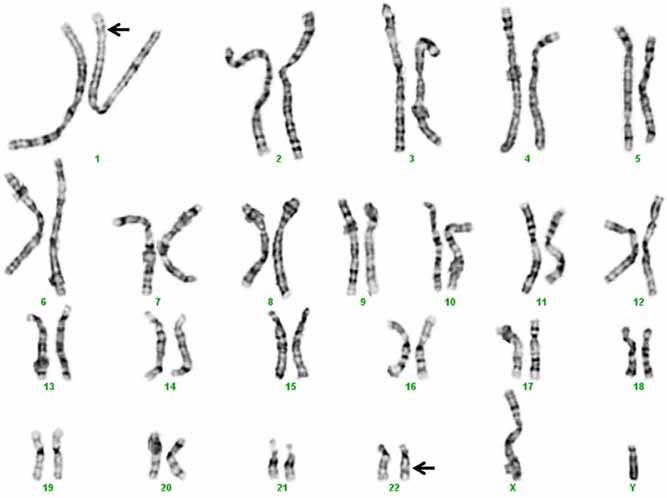
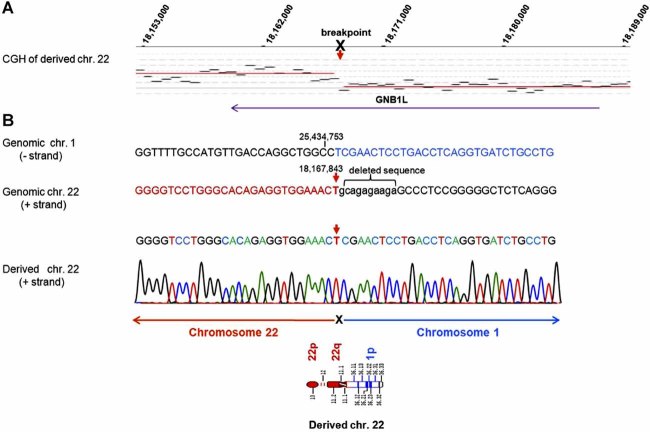
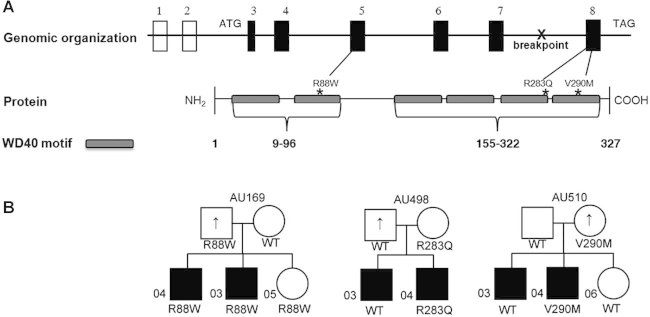
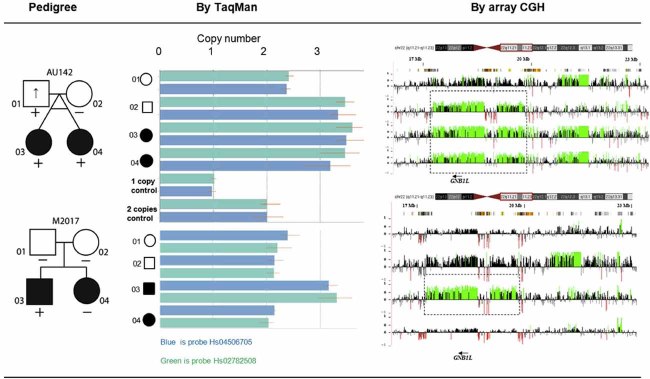
Structural variations in the chromosome 22q11.2 region mediated by nonallelic homologous recombination result in 22q11.2 deletion (del22q11.2) and 22q11.2 duplication (dup22q11.2) syndromes. The majority of del22q11.2 cases have facial and cardiac malformations, immunologic impairments, specific cognitive profile and increased risk for schizophrenia and autism spectrum disorders (ASDs). The phenotype of dup22q11.2 is frequently without physical features but includes the spectrum of neurocognitive abnormalities. Although there is substantial evidence that haploinsufficiency for TBX1 plays a role in the physical features of del22q11.2, it is not known which gene(s) in the critical 1.5 Mb region are responsible for the observed spectrum of behavioral phenotypes. We identified an individual with a balanced translocation 46,XY,t(1;22)(p36.1;q11.2) and a behavioral phenotype characterized by cognitive impairment, autism, and schizophrenia in the absence of congenital malformations. Using somatic cell hybrids and comparative genomic hybridization (CGH) we mapped the chromosome-22 breakpoint within intron 7 of the GNB1L gene. Copy number evaluations and direct DNA sequencing of GNB1L in 271 schizophrenia and 513 autism cases revealed dup22q11.2 in two families with autism and private GNB1L missense variants in conserved residues in three families (P = 0.036). The identified missense variants affect residues in the WD40 repeat domains and are predicted to have deleterious effects on the protein. Prior studies provided evidence that GNB1L may have a role in schizophrenia. Our findings support involvement of GNB1L in ASDs as well.
Copyright © 2011 Wiley Periodicals, Inc.
Figures
References
-
- Antshel KM, Aneja A, Strunge L, Peebles J, Fremont WP, Stallone K, Abdulsabur N, Higgins AM, Shprintzen RJ, Kates WR. Autistic spectrum disorders in velo-cardio facial syndrome (22q11.2 deletion) J Autism Dev Disord. 2007;37(9):1776–1786. - PubMed
-
- Antshel KM, Fremont W, Kates WR. The neurocognitive phenotype in velo-cardio-facial syndrome: A developmental perspective. Dev Disabil Res Rev. 2008;14(1):43–51. - PubMed
-
- APA. Diagnostic and statistical manual of mental disorders. Washington DC: American Psychiatric Association; 1994.
Publication types
MeSH terms
Substances
Grants and funding
- P50 HD055782/HD/NICHD NIH HHS/United States
- UC2 HL102926/HL/NHLBI NIH HHS/United States
- RC2 HG005608/HG/NHGRI NIH HHS/United States
- R01 NS069719/NS/NINDS NIH HHS/United States
- MH065558/MH/NIMH NIH HHS/United States
- HL 102926/HL/NHLBI NIH HHS/United States
- R01 HD065285/HD/NICHD NIH HHS/United States
- HL 102924/HL/NHLBI NIH HHS/United States
- HD065285/HD/NICHD NIH HHS/United States
- HD035469/HD/NICHD NIH HHS/United States
- R01 MH065558/MH/NIMH NIH HHS/United States
- NS069719/NS/NINDS NIH HHS/United States
- P01 HD035469/HD/NICHD NIH HHS/United States
- R01 MH092367/MH/NIMH NIH HHS/United States
- HL 1029230/HL/NHLBI NIH HHS/United States
- RC2 HL102926/HL/NHLBI NIH HHS/United States
- HD055782/HD/NICHD NIH HHS/United States
- U19 HD035469/HD/NICHD NIH HHS/United States
- P50 HD055748/HD/NICHD NIH HHS/United States
- RC2 HL102924/HL/NHLBI NIH HHS/United States
- MH092367/MH/NIMH NIH HHS/United States
- HHMI/Howard Hughes Medical Institute/United States
- HG005608/HG/NHGRI NIH HHS/United States
- UC2 HL102924/HL/NHLBI NIH HHS/United States
LinkOut - more resources
Full Text Sources
Miscellaneous