Review
. 2012 Jul-Aug;3(4):581-92.
doi: 10.1002/wrna.120. Epub 2011 Nov 17.

Genetic variation of pre-mRNA alternative splicing in human populations

Affiliations
Review

Genetic variation of pre-mRNA alternative splicing in human populations

Zhi-Xiang Lu et al. Wiley Interdiscip Rev RNA. 2012 Jul-Aug.

Abstract

The precise splicing outcome of a transcribed gene is controlled by complex interactions between cis regulatory splicing signals and trans-acting regulators. In higher eukaryotes, alternative splicing is a prevalent mechanism for generating transcriptome and proteome diversity. Alternative splicing can modulate gene function, affect organismal phenotype and cause disease. Common genetic variation that affects splicing regulation can lead to differences in alternative splicing between human individuals and consequently impact expression level or protein function. In several well-documented examples, such natural variation of alternative splicing has indeed been shown to influence disease susceptibility and drug response. With new microarray and sequencing-based genomic technologies that can analyze eukaryotic transcriptomes at the exon or nucleotide level, it has become possible to globally compare the alternative splicing profiles across human individuals in any tissue or cell type of interest. Recent large-scale transcriptome studies using high-density splicing-sensitive microarray and deep RNA sequencing (RNA-Seq) have revealed widespread genetic variation of alternative splicing in humans. In the future, an extensive catalog of alternative splicing variation in human populations will help elucidate the molecular underpinnings of complex traits and human diseases, and shed light on the mechanisms of splicing regulation in human cells.


Figures

Figure 1
Figure 1
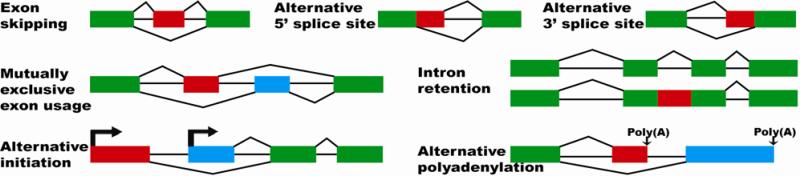
Basic types of alternative splicing and transcript isoform variation.
Figure 2
Figure 2
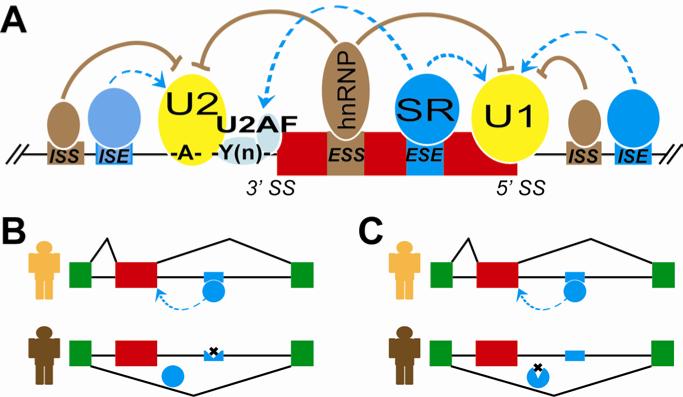
Mechanisms of alternative splicing regulation and variation in humans. (A) Alternative splicing is controlled by an intricate regulatory network involving cis splicing elements and trans splicing regulators. The essential core splicing signals include the 5’ splice site (5’ SS), 3’ splice site (3’ SS), branch site (A) and polypyrimidine tract (Y(n)). Other auxiliary cis elements in exons and flanking introns include the exonic splicing enhancer (ESE), intronic splicing enhancer (ISE), exonic splicing silencer (ESS), and intronic splicing silencer (ISS). These auxiliary elements are recognized by transacting splicing regulators that positively or negatively regulate exon inclusion. Positive trans regulators are depicted in blue and negative trans regulators are depicted in brown. (B) A cis polymorphism disrupts an intronic splicing enhancer element and abolishes the interaction between the cis element and the trans regulator, resulting in the switch from the exon inclusion isoform to the exon skipping isoform. (C) A trans polymorphism alters the RNA binding activity of the trans splicing regulator and abolishes the interaction between the cis element and the trans regulator, resulting in the switch from the exon inclusion isoform to the exon skipping isoform.
Figure 3
Figure 3
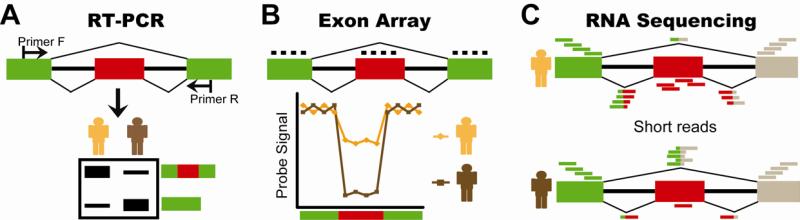
Molecular and genomic tools for analysis of alternative splicing. (A) RT-PCR. For any alternatively spliced exon of interest, a pair of forward and reverse PCR primers can be designed to target the flanking exons (top panel). After the RT-PCR reaction, PCR products of varying sizes corresponding to distinct mRNA isoforms can be separated and visualized by electrophoresis (bottom panel). The intensities of RT-PCR bands can be quantified to estimate the relative proportions of distinct mRNA isoforms. (B) Exon array. Splicing-sensitive exon arrays use oligonucleotide probes that target specific exons or exon-exon junctions to analyze alternative splicing (top panel). Some platforms only contain probes targeting exon sequences, while others include probes for both exons and exon-exon junctions. The fluorescent intensities of individual probes can be used to infer the splicing activities of alternatively spliced exons (bottom panel). (C) RNA sequencing (“RNA-Seq”). By mapping RNA-Seq reads to exons and exon-exon junctions, one can annotate exon-intron structures and estimate the splicing levels of individual exons. In this diagram, the RNA-Seq data of the individual depicted in the top panel indicates that the alternatively spliced exon is predominantly included. By contrast, the RNA-Seq data of the individual depicted in the bottom panel indicates that the alternatively spliced exon is predominantly skipped.
Figure 4
Figure 4
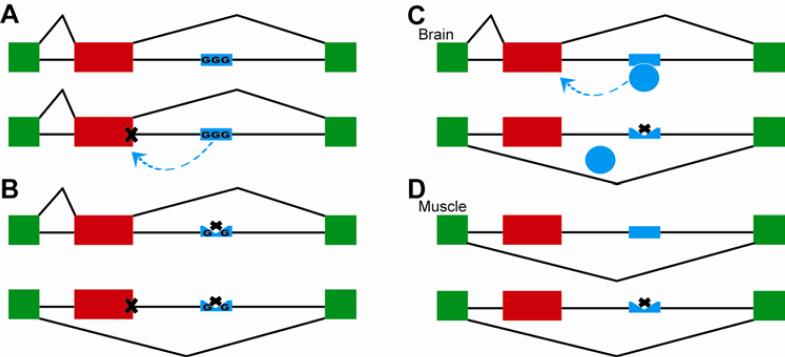
Genetic variation of alternative splicing provides insights into the mechanisms of splicing regulation. (A-B) The splicing effect of a SNP can be buffered by other splicing regulatory elements in the surrounding region. (A) The intronic poly-G runs act as splicing enhancer elements when located downstream of weak 5’ splice sites. A SNP that significantly weakens the 5’ splice site is buffered by the downstream poly-G run and so it does not affect inclusion of the exon. (B) In the absence of the downstream intronic poly-G run, the same 5’ splice site SNP results in the switch from the exon inclusion isoform to the exon skipping isoform. (C-D) The tissue specificity of splicing QTLs suggests tissue-specific cis splicing elements. A cis intronic SNP results in the switch from the exon inclusion isoform to the exon skipping isoform in the brain (C), while in the muscle both alleles undergo complete skipping of the exon (D). These patterns suggest that the SNP disrupts a brain-specific cis splicing enhancer element.

References

    1. Wang Z, Burge CB. Splicing regulation: from a parts list of regulatory elements to an integrated splicing code. Rna. 2008;14:802–813. - PMC - PubMed
    1. Modrek B, Lee C. A genomic view of alternative splicing. Nat Genet. 2002;30:13–19. - PubMed
    1. Stamm S, Ben-Ari S, Rafalska I, Tang Y, Zhang Z, Toiber D, Thanaraj TA, Soreq H. Function of alternative splicing. Gene. 2005;344:1–20. - PubMed
    1. Johnson JM, Castle J, Garrett-Engele P, Kan Z, Loerch PM, Armour CD, Santos R, Schadt EE, Stoughton R, Shoemaker DD. Genome-wide survey of human alternative pre-mRNA splicing with exon junction microarrays. Science. 2003;302:2141–2144. - PubMed
    1. Wang ET, Sandberg R, Luo S, Khrebtukova I, Zhang L, Mayr C, Kingsmore SF, Schroth GP, Burge CB. Alternative isoform regulation in human tissue transcriptomes. Nature. 2008;456:470–476. - PMC - PubMed

Publication types

LinkOut - more resources