. 2011 Nov 16;101(10):2370-9.
doi: 10.1016/j.bpj.2011.10.017. Epub 2011 Nov 15.

How does stochastic ryanodine receptor-mediated Ca leak fail to initiate a Ca spark?

Affiliations

How does stochastic ryanodine receptor-mediated Ca leak fail to initiate a Ca spark?

Daisuke Sato et al. Biophys J. .

Abstract

Spontaneous calcium (Ca) sparks are initiated by single ryanodine receptor (RyR) opening. Once one RyR channel opens, it elevates local [Ca] in the cleft space ([Ca](Cleft)), which opens other RyR channels in the same Ca release unit (CaRU) via Ca-induced Ca-release. Experiments by Zima et al. (J. Physiol. 588:4743-4757, 2010) demonstrate that spontaneous Ca sparks occur only when intrasarcoplasmic-reticulum (SR) [Ca] ([Ca](SR)) is above a threshold level, but that RyR-mediated SR Ca leak exists without Ca sparks well below this threshold [Ca](SR). We examine here how single RyR opening at lower [Ca](SR) can fail to recruit Ca sparks at a CaRU, while still contributing to SR Ca leak. We assess this using a physiologically detailed mathematical model of junctional SR Ca release in which RyR gating is regulated by [Ca](SR) and [Ca](Cleft). We find that several factors contribute to the failure of Ca sparks as [Ca](SR) declines: 1), lower [Ca](SR) reduces driving force and thus limits local [Ca](Cleft) achieved and the rate of rise during RyR opening; 2), low [Ca](SR) limits RyR open time (τ(O)), which further reduces local [Ca](Cleft) attained; 3), low τ(O) and fast [Ca](Cleft) dissipation after RyR closure shorten the opportunity for neighboring RyR activation; 4), at low [Ca](SR), the RyR exhibits reduced [Ca](Cleft) sensitivity. We conclude that all of these factors conspire to reduce the probability of Ca sparks as [Ca](SR) declines, despite continued RyR-mediated Ca leak. In addition, these same factors explain the much lower efficacy of L-type Ca channel opening to trigger local SR Ca release at low [Ca](SR) during excitation-contraction coupling. Conversely, all of these factors are fundamentally important for increasing the propensity for pro-arrhythmic Ca sparks and waves in cardiac myocytes at high [Ca](SR).


Figures

Figure 1
Figure 1
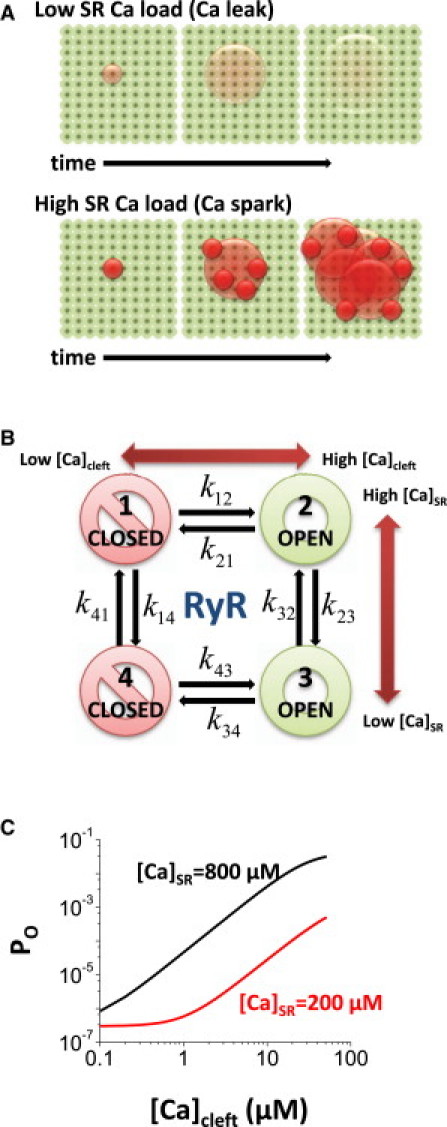
(A) Schematic illustration of CaRU RyR array (green spheres), Ca leak (upper), and a Ca spark (lower). (B) RyR gating scheme. (C) Open probability (Po) of RyR as a function of [Ca]Cleft for two levels of [Ca]SR.
Figure 2
Figure 2
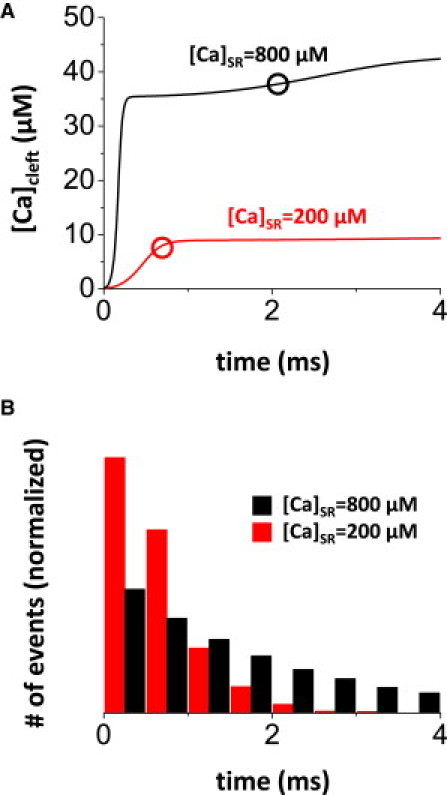
(A) Ca accumulation in the cleft space during single RyR opening with low ([Ca]SR = 200 μM) and high ([Ca]SR = 800 μM) SR Ca load. Circles indicate mean open time for each case. Slow increase of [Ca]Cleft at 1–4 ms reflects slow accumulation of [Ca] at the submembrane space. (B) Normalized open-time distribution for simulated events.
Figure 3
Figure 3
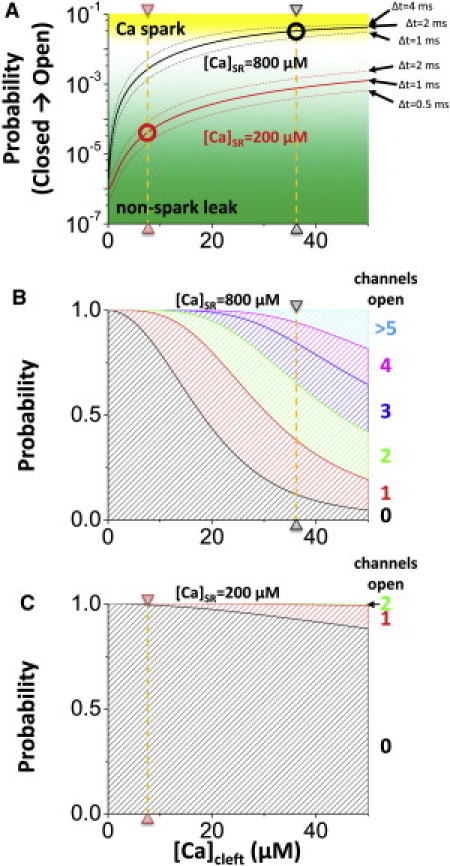
(A) Probability of transition from the closed to the open state when RyR channel is exposed to [Ca]Cleft for the indicated Δt ms. Circles indicate [Ca]Cleft level if RyR opens for mean open time for each case (black, low SR Ca load;, red, high SR Ca load). (B) Probability that n RyR channels will open when the CaRU is exposed to [Ca]Cleft for 2 ms with a high SR Ca load (800 μM). The orange line indicates the [Ca]Cleft level if RyR opens for the mean open time. (C) Probability that n RyR channels open when the CaRU is exposed to [Ca]Cleft for 1 ms with low SR Ca load (200 μM). The orange line indicates [Ca]Cleft level if RyR opens for the mean open time.
Figure 4
Figure 4
[Ca]SR dependence of RyR gating. (A) Mean open time versus [Ca]SR. (B) [Ca]Cleft versus [Ca]SR when a single RyR opens for the mean open time. (C) Probability of transition from the closed to the open state when the RyR channel is exposed to [Ca]Cleft for the mean open time. (D) Probabilities that n RyR channels open when the CaRU is exposed to [Ca]Cleft for the mean open time.
Figure 5
Figure 5
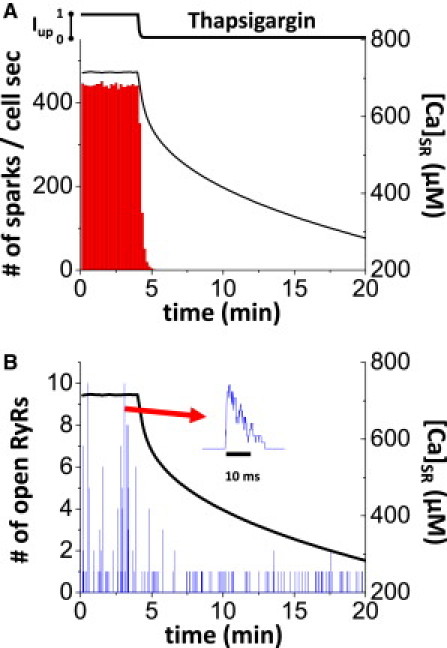
Numerical experiment using the physiologically detailed model of Ca cycling. (A) Ca-spark frequency and SR Ca load. The SERCA pump (Iup) is decreased to simulate thapsigargin exposure. Ca spark frequency (bars) and SR Ca load (line) versus time. (B) Example of single CaRU activity from simulation in A. Number of open channels versus time. (Inset) A typical Ca spark.
Figure 6
Figure 6
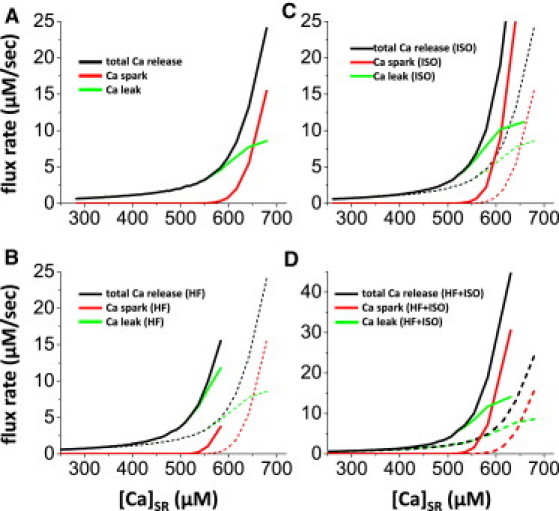
SR Ca leak-load relationships. (A) Control SR Ca flux rates for total, Ca spark and nonspark Ca leak versus SR Ca load ([Ca]SR). (B) Same analysis for model adjusted for HF. (C) Same analysis for model with ISO adjustments. (D) Same analysis when HF is exposed to ISO. Broken curves in BD are data from A for comparison.
Figure 7
Figure 7
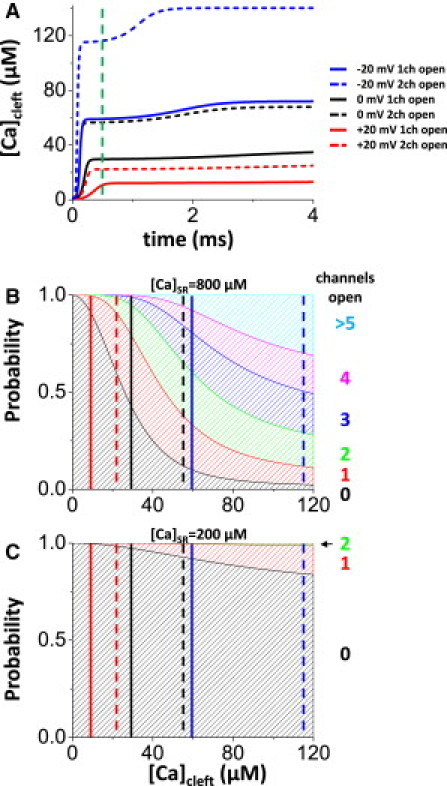
L-type ICa and induction of RyR channel opening. (A) Time course of [Ca]cleft during opening of one or two Ca channels at different Vm. (B) Probabilities that n RyR channels will open when the CaRU is exposed to [Ca]Cleft for 0.5 ms (open time) with high SR Ca load ([Ca]SR = 800 μM). (C) Same as B but for [Ca]SR = 200 μM.
Figure 8
Figure 8
(A) ECC gain versus [Ca]SR at Vm = −20, 0, and +40 mV. Gain is defined by ∫ Irel/∫ ICaL. (B) Fractional release versus [Ca]SR at Vm = −20, 0, and +40 mV. Fractional release is defined by ∫ Irel/total SR Ca. (C) Normalized peak ICa and peak SR Ca release flux versus test Vm.

References

    1. Bers D.M. Kluwer Academic; Boston: 2001. Excitation Contraction Coupling and Cardiac Contractile Force.
    1. George C.H. Sarcoplasmic reticulum Ca2+ leak in heart failure: mere observation or functional relevance? Cardiovasc. Res. 2008;77:302–314. - PubMed
    1. Chelu M.G., Wehrens X.H. Sarcoplasmic reticulum calcium leak and cardiac arrhythmias. Biochem. Soc. Trans. 2007;35:952–956. - PubMed
    1. Santiago D.J., Curran J.W., et al. Shannon T.R. Ca sparks do not explain all ryanodine receptor-mediated SR Ca leak in mouse ventricular myocytes. Biophys. J. 2010;98:2111–2120. - PMC - PubMed
    1. Zima A.V., Bovo E., et al. Blatter L.A. Ca2+ spark-dependent and -independent sarcoplasmic reticulum Ca2+ leak in normal and failing rabbit ventricular myocytes. J. Physiol. 2010;588:4743–4757. - PMC - PubMed

Publication types

MeSH terms