Review
. 2012 Feb;31(2):73-99.
doi: 10.5732/cjc.011.10320. Epub 2011 Nov 18.

Breast cancer resistance protein (BCRP/ABCG2): its role in multidrug resistance and regulation of its gene expression

Affiliations
Review

Breast cancer resistance protein (BCRP/ABCG2): its role in multidrug resistance and regulation of its gene expression

Takeo Nakanishi et al. Chin J Cancer. 2012 Feb.

Abstract

Breast cancer resistance protein (BCRP)/ATP-binding cassette subfamily G member 2 (ABCG2) is an ATP-binding cassette (ABC) transporter identified as a molecular cause of multidrug resistance (MDR) in diverse cancer cells. BCRP physiologically functions as a part of a self-defense mechanism for the organism; it enhances elimination of toxic xenobiotic substances and harmful agents in the gut and biliary tract, as well as through the blood-brain, placental, and possibly blood-testis barriers. BCRP recognizes and transports numerous anticancer drugs including conventional chemotherapeutic and targeted small therapeutic molecules relatively new in clinical use. Thus, BCRP expression in cancer cells directly causes MDR by active efflux of anticancer drugs. Because BCRP is also known to be a stem cell marker, its expression in cancer cells could be a manifestation of metabolic and signaling pathways that confer multiple mechanisms of drug resistance, self-renewal (stemness), and invasiveness (aggressiveness), and thereby impart a poor prognosis. Therefore, blocking BCRP-mediated active efflux may provide a therapeutic benefit for cancers. Delineating the precise molecular mechanisms for BCRP gene expression may lead to identification of a novel molecular target to modulate BCRP-mediated MDR. Current evidence suggests that BCRP gene transcription is regulated by a number of trans-acting elements including hypoxia inducible factor 1α, estrogen receptor, and peroxisome proliferator-activated receptor. Furthermore, alternative promoter usage, demethylation of the BCRP promoter, and histone modification are likely associated with drug-induced BCRP overexpression in cancer cells. Finally, PI3K/AKT signaling may play a critical role in modulating BCRP function under a variety of conditions. These biological events seem involved in a complicated manner. Untangling the events would be an essential first step to developing a method to modulate BCRP function to aid patients with cancer. This review will present a synopsis of the impact of BCRP-mediated MDR in cancer cells, and the molecular mechanisms of acquired MDR currently postulated in a variety of human cancers.


Figures
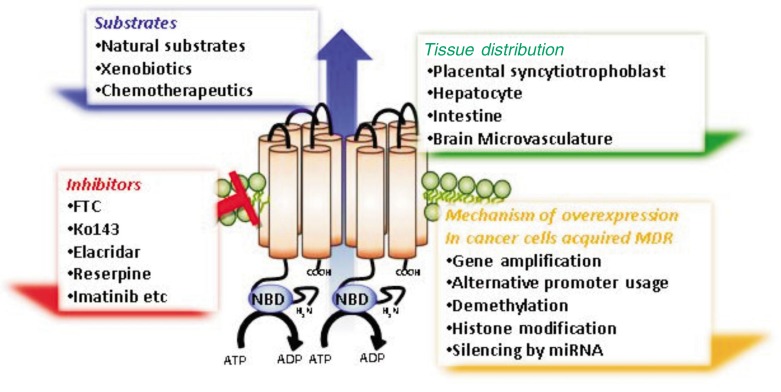
Figure 1.
Figure 1.. Summary of BCRP function, tissue distribution, and mechanism of overexpression in drug-resistant cancer cells.
BCRP consists of 6 transmembrane helices and homodimerizes to function at the plasma membranes. It pumps natural substrates, including folate, steroid hormones, and urate; toxic xenobiotics; and anticancer agents, including conventional chemotherapeutics and tyrosine kinase inhibitors. NBD, nucleotide-binding domain to which ATP can bind.
Figure 2.
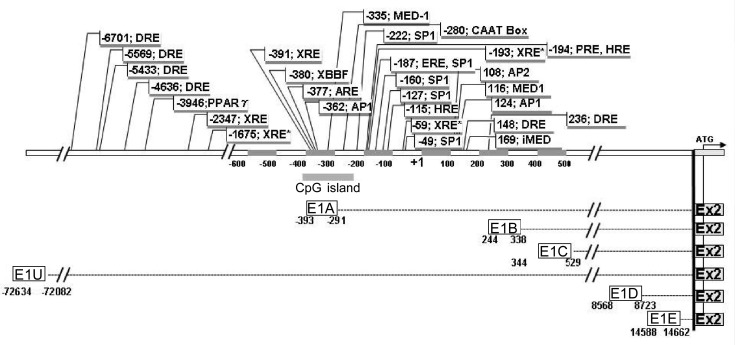
Figure 2.. Cis-regulatory elements in BCRP promoter and splice variants of BCRP transcripts.
Identified cis-acting elements are shown in the promoter region of BCRP gene with identified splice variants of BCRP mRNA. A putative transcription start site (TSS, +1), defined as previously described (GenBank AF15130.1), was found 529 bp upstream of the Ex1 and 2 junction, and 18899 bp upstream of Ex2. An active proximal promoter region was identified at nucleotides -300 to -50 relative to the TSS. The same Ex2 acceptor is used for all 5′-UTR exons (E1U, E1A, E1B, E1C, E1E, and E1D). Variable TSSs are found for E1U, E1B, and E1C. Figure is not completely to scale and all nucleotide positions are shown relative to the TSS (+1). XRE sites with superscript “*” are also identified as core sequences for DRE. PPAR, peroxisome proliferator-activated receptor; XRE, xenobiotic response element; DRE, dioxin response element; XBBF, X-box binding factor; ARE, antioxidant response element; HRE, hypoxia response element; PRE, progesterone response element; MED, multiple start site element downstream; iMED, inverted MED.
Figure 3.
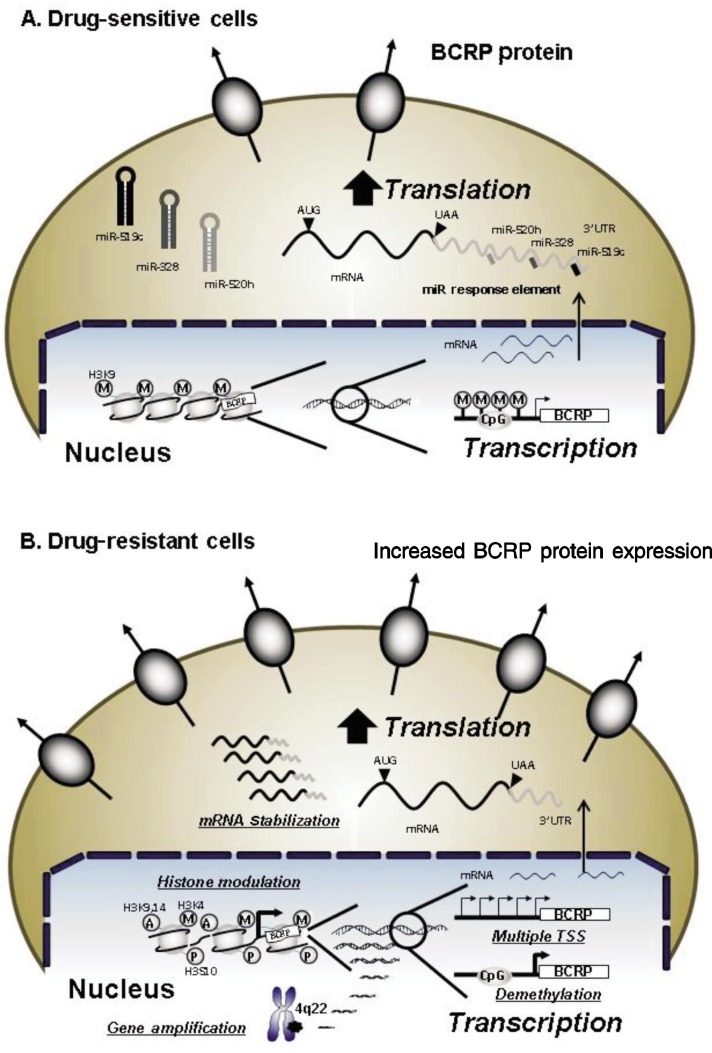
Figure 3.. Putative mechanisms for BCRP overexpression in drug-resistant cells.
A, in drug-sensitive cells, BCRP transcription is regulated by histone 3 trimethylated at lysine 9 (H3K9me3) and the proximal promoter region is reported to be methylated in cells prior to drug selection or treatment. Synthesized mRNA is negatively regulated by possible candidate miRs, including miR-519c, miR-328, and miR-520h, which are purported to bind miR response elements in 3′-UTR of BCRP mRNA. Thus, BCRP expression is transcriptionally and post-transcriptionally regulated. B, in drug-resistant cells, several possible mechanisms are hypothesized based on current evidence. BCRP gene amplification is observed in some drug-selected cancer cells. Transcription factors become more accessible because of histone 3 modulations, including acetylation at lysine 9 and 14 (H3K9ac, H3K14ac), methylation at lysine 4 (H3K4me), and phosphorylation at serine 10 (H3S10p). Multiple TSSs are likely used for induction of BCRP. Demethylation of CpG islands around promoter regions may contribute to overexpression of BCRP in response to drugs. Once BCRP mRNA is synthesized, its 3′-UTR becomes truncated, resulting in deletion of miR response elements, which in turn increases BCRP mRNA stability and levels. M: methylation; A: acetylation; P: phosphorylation.

References

    1. Roninson IB, Chin JE, Choi KG, et al. Isolation of human MDR DNA sequences amplified in multidrug-resistant KB carcinoma cells. Proc Natl Acad Sci USA. 1986;83:4538–4542. - PMC - PubMed
    1. Cole S, Bhardwaj G, Gerlach J, et al. Overexpression of a transporter gene in a multidrug-resistant human lung cancer cell line. Science. 1992;258:1650–1654. - PubMed
    1. Ross DD, Doyle L, Schiffer C, et al. Expression of multidrug resistance-associated protein (MRP) mRNA in blast cells from acute myeloid leukemia (AML) patients. Leukemia. 1996;10:48–55. - PubMed
    1. Chen YN, Mickley LA, Schwartz AM, et al. Characterization of adriamycin-resistant human breast cancer cells which display overexpression of a novel resistance-related membrane protein. J Biol Chem. 1990;265:10073–10080. - PubMed
    1. Doyle LA, Yang W, Abruzzo LV, et al. A multidrug resistance transporter from human MCF-7 breast cancer cells. Proc Natl Acad Sci U S A. 1998;95:15665–15670. - PMC - PubMed

MeSH terms

Substances