


Multidrug resistance associated proteins in multidrug resistance
- PMID: 22098952
- PMCID: PMC3777468
- DOI: 10.5732/cjc.011.10329
Multidrug resistance associated proteins in multidrug resistance
Abstract
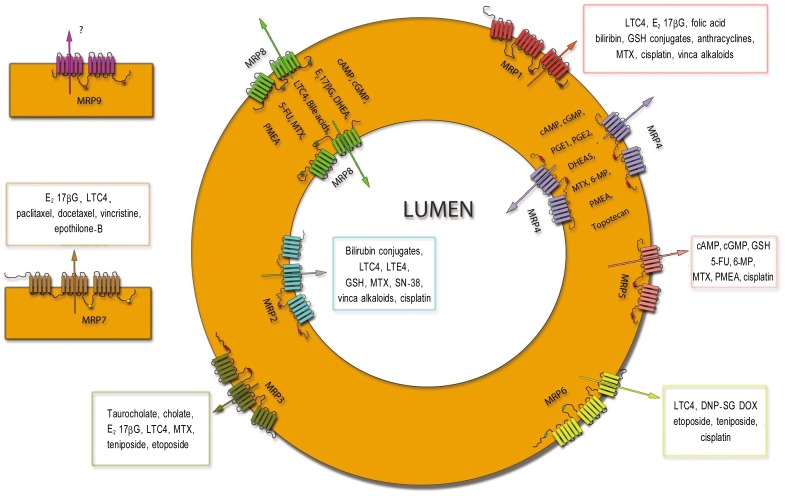
Multidrug resistance proteins (MRPs) are members of the C family of a group of proteins named ATP-binding cassette (ABC) transporters. These ABC transporters together form the largest branch of proteins within the human body. The MRP family comprises of 13 members, of which MRP1 to MRP9 are the major transporters indicated to cause multidrug resistance in tumor cells by extruding anticancer drugs out of the cell. They are mainly lipophilic anionic transporters and are reported to transport free or conjugates of glutathione (GSH), glucuronate, or sulphate. In addition, MRP1 to MRP3 can transport neutral organic drugs in free form in the presence of free GSH. Collectively, MRPs can transport drugs that differ structurally and mechanistically, including natural anticancer drugs, nucleoside analogs, antimetabolites, and tyrosine kinase inhibitors. Many of these MRPs transport physiologically important anions such as leukotriene C4, bilirubin glucuronide, and cyclic nucleotides. This review focuses mainly on the physiological functions, cellular resistance characteristics, and probable in vivo role of MRP1 to MRP9.
Figures
References
-
- Gottesman MM, Fojo T, Bates SE. Multidrug resistance in cancer: role of ATP-dependent transporters. Nat Rev Cancer. 2002;2:48–58. - PubMed
-
- Jemal A, Center MM, Ward E, et al. Cancer occurrence. Methods Mol Biol. 2009;471:3–29. - PubMed
-
- Gottesman MM. Mechanisms of cancer drug resistance. Annu Rev Med. 2002;53:615–627. - PubMed
-
- Loe DW, Deeley RG, Cole SP. Characterization of vincristine transport by the M (r) 190 000 multidrug resistance protein (MRP): evidence for cotransport with reduced glutathione. Cancer Res. 1998;58:5130–5136. - PubMed
-
- Redmond KM, Wilson TR, Johnston PG, et al. Resistance mechanisms to cancer chemotherapy. Front Biosci. 2008;13:5138–5154. - PubMed
Publication types
MeSH terms
Substances
Grants and funding
LinkOut - more resources
Full Text Sources
Miscellaneous