


Prometheus's heart: what lies beneath
- PMID: 22099480
- PMCID: PMC3823287
- DOI: 10.1111/j.1582-4934.2011.01487.x
Prometheus's heart: what lies beneath
Abstract
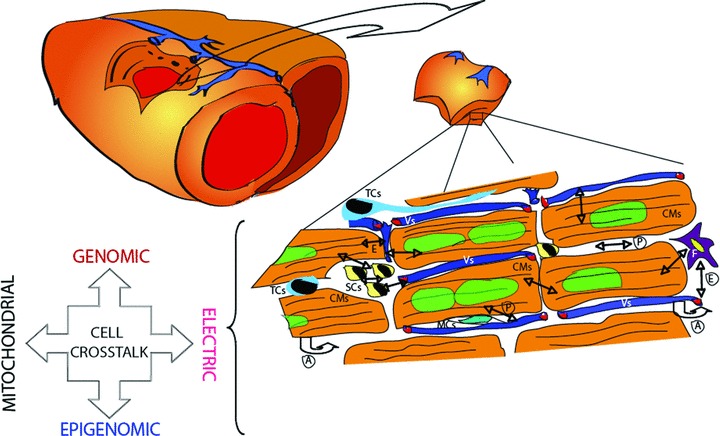
A heart attack kills off many cells in the heart. Parts of the heart become thin and fail to contract properly following the replacement of lost cells by scar tissue. However, the notion that the same adult cardiomyocytes beat throughout the lifespan of the organ and organism, without the need for a minimum turnover, gives way to a fascinating investigations. Since the late 1800s, scientists and cardiologists wanted to demonstrate that the cardiomyocytes cannot be generated after the perinatal period in human beings. This curiosity has been passed down in subsequent years and has motivated more and more accurate studies in an attempt to exclude the presence of renewed cardiomyocytes in the tissue bordering the ischaemic area, and then to confirm the dogma of the heart as terminally differentiated organ. Conversely, peri-lesional mitosis of cardiomyocytes were discovered initially by light microscopy and subsequently confirmed by more sophisticated technologies. Controversial evidence of mechanisms underlying myocardial regeneration has shown that adult cardiomyocytes are renewed through a slow turnover, even in the absence of damage. This turnover is ensured by the activation of rare clusters of progenitor cells interspersed among the cardiac cells functionally mature. Cardiac progenitor cells continuously interact with each other, with the cells circulating in the vessels of the coronary microcirculation and myocardial cells in auto-/paracrine manner. Much remains to be understood; however, the limited functional recovery in human beings after myocardial injury clearly demonstrates weak regenerative potential of cardiomyocytes and encourages the development of new approaches to stimulate this process.
© 2011 The Authors Journal of Cellular and Molecular Medicine © 2011 Foundation for Cellular and Molecular Medicine/Blackwell Publishing Ltd.
Figures
References
-
- Goldenberg B. Ueber Atrophie und Hypertrophie der Muskelfasern des Herzens. Virchows Arch Pathol Anat Physiol Klin, Med. 1886;103:88–130.
-
- Kaufmann E. Lehrbuch der spez. path. Anat (Berl) 1928;1:56.
-
- Nicholls JA. The Principles of Pathology. Vol. 2. Philadelphia: Lea & Febiger; 1909. p. 158.
-
- Tangl F. Ueber die Herzhypertrophie u. das Physiologische Wachstum des Herzens. Virchows Arch Pathol Anat. 1889;116:432.
-
- Wideroe S. Histologische Studien über die Muskulatur des Herzens. Virchows Arch Pathol Anat. 1911;204:190–6.
Publication types
MeSH terms
LinkOut - more resources
Full Text Sources
