


Abnormal anterior cingulate cortical activity during emotional n-back task performance distinguishes bipolar from unipolar depressed females
- PMID: 22099606
- PMCID: PMC3601380
- DOI: 10.1017/S003329171100242X
Abnormal anterior cingulate cortical activity during emotional n-back task performance distinguishes bipolar from unipolar depressed females
Abstract
Background: Depression in the context of bipolar disorder (BDd) is often misdiagnosed as unipolar disorder depression (UDd) leading to poor clinical outcomes for many bipolar sufferers. We examined neural circuitry supporting emotion regulation in females with either BDd or UDd as a first stage toward identifying biomarkers that may differentiate BDd from UDd.
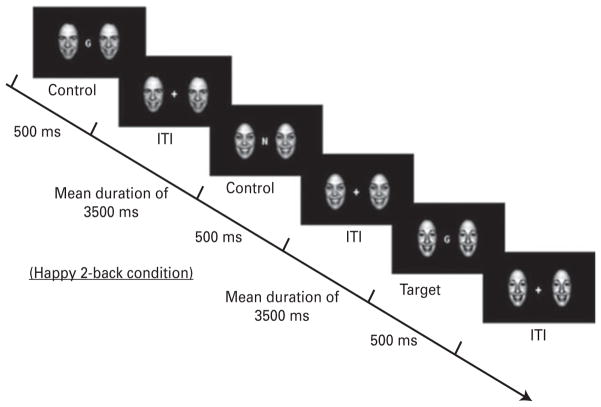
Method: Fifty-seven females aged 18-45 years participated in this study: 23 with UDd, 18 with bipolar disorder type I depression (BDId) and 16 healthy females. During 3-T functional magnetic resonance imaging (fMRI), the participants performed an emotional face n-back (EFNBACK) task, that is an n-back task with high (2-back) and low (0-back) memory load conditions flanked by two positive, negative or neutral face distracters. This paradigm examines executive control with emotional distracters-emotion regulation.
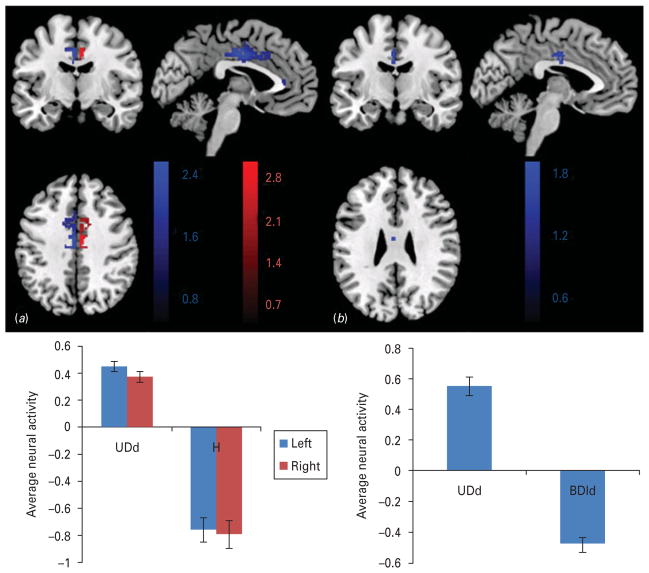
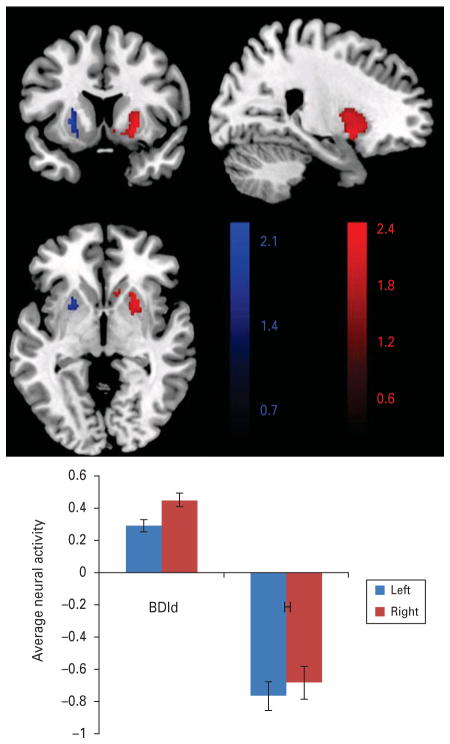
Results: High memory load with neutral face distracters elicited greater bilateral and left dorsal anterior midcingulate cortex (dAMCC) activity in UDd than in healthy and BDId females respectively, and greater bilateral putamen activity in both depressed groups versus healthy females. High memory load with happy face distracters elicited greater left putamen activity in UDd than in healthy females. Psychotropic medication was associated with greater putamen activity to these contrasts in UDd females.
Conclusions: During high memory load with neutral face distracters, elevated dAMCC activity in UDd suggests abnormal recruitment of attentional control circuitry to maintain task performance, whereas elevated putamen activity unrelated to psychotropic medication in BDId females may suggest an attentional bias toward ambiguous neutral face distracters. Differential patterns of functional abnormalities in neural circuitry supporting attentional control during emotion regulation, especially in the dAMCC, is a promising neuroimaging measure to distinguish UDd from BDId in females.
Conflict of interest statement
None.
Figures
References
-
- Annett M. A classification of hand preference by association analysis. British Journal of Psychology. 1970;61:303–321. - PubMed
-
- Blair K, Spreen O. Predicting premorbid IQ: a revision of the National Adult Reading Test. Clinical Neuropsychologist. 1989;3:129–136.
-
- Bush G, Shin LM. The Multi-Source Interference Task: an fMRI task that reliably activates the cingulofrontal-parietal cognitive/attention network. Nature Protocols. 2006;1:308–313. - PubMed
Publication types
MeSH terms
Substances
Grants and funding
- K23 MH074459/MH/NIMH NIH HHS/United States
- R01MH073953/MH/NIMH NIH HHS/United States
- R01MH07697/MH/NIMH NIH HHS/United States
- P01 MH041712/MH/NIMH NIH HHS/United States
- K01 MH083001/MH/NIMH NIH HHS/United States
- U01 MH092221/MH/NIMH NIH HHS/United States
- R01 MH073801/MH/NIMH NIH HHS/United States
- R01 MH076971/MH/NIMH NIH HHS/United States
- UL1 TR000005/TR/NCATS NIH HHS/United States
- K01MH083001/MH/NIMH NIH HHS/United States
- R01 MH073953/MH/NIMH NIH HHS/United States
- UL1 RR024153/RR/NCRR NIH HHS/United States
- K-23MH074459/MH/NIMH NIH HHS/United States
- U01MH092221/MH/NIMH NIH HHS/United States
- 5R01MH041712-19/MH/NIMH NIH HHS/United States
- R01 MH073967/MH/NIMH NIH HHS/United States
