Review
. 2011:76:1-26.
doi: 10.1016/B978-0-12-386481-9.00001-8.

Sensory functions for degenerin/epithelial sodium channels (DEG/ENaC)

Affiliations
Review

Sensory functions for degenerin/epithelial sodium channels (DEG/ENaC)

Yehuda Ben-Shahar. Adv Genet. 2011.

Abstract

All animals use a sophisticated array of receptor proteins to sense their external and internal environments. Major advances have been made in recent years in understanding the molecular and genetic bases for sensory transduction in diverse modalities, indicating that both metabotropic and ionotropic pathways are important in sensory functions. Here, I review the historical background and recent advances in understanding the roles of a relatively newly discovered family of receptors, the degenerin/epithelial sodium channels (DEG/ENaC). These animal-specific cation channels show a remarkable sequence and functional diversity in different species and seem to exert their functions in diverse sensory modalities. Functions for DEG/ENaC channels have been implicated in mechanosensation as well as chemosensory transduction pathways. In spite of overall sequence diversity, all family members share a unique protein topology that includes just two transmembrane domains and an unusually large and highly structured extracellular domain, that seem to be essential for both their mechanical and chemical sensory functions. This review will discuss many of the recent discoveries and controversies associated with sensory function of DEG/ENaC channels in both vertebrate and invertebrate model systems, covering the role of family members in taste, mechanosensation, and pain.


Figures

Figure 1.1
Figure 1.1
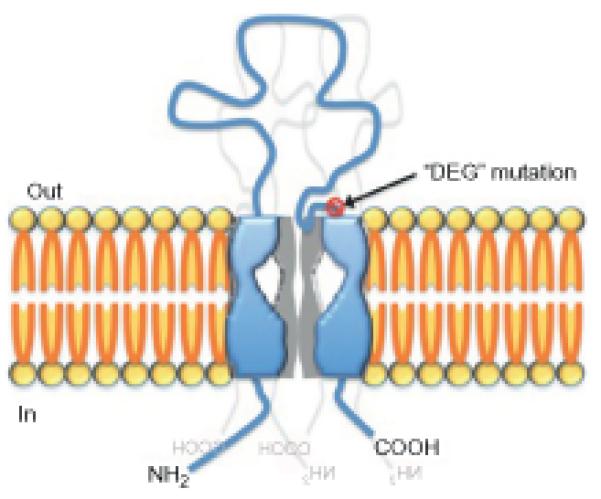
Topology of a typical DEG/ENaC channel. Each channel comprises three subunits (or multiples of three). Channels can be either homomeric or heteromeric protein complexes and are likely to include other accessory proteins. Each subunit comprises two transmembrane domains, two short intracellular domains (N terminus is typically longer than the C terminus), and an unusually large and highly structured extracellular domain. The “DEG mutation” represents an amino acid residue, which was shown to lock DEG/ ENaC channels in a constitutively open state (Snyder et al., 2000).
Figure 1.2
Figure 1.2
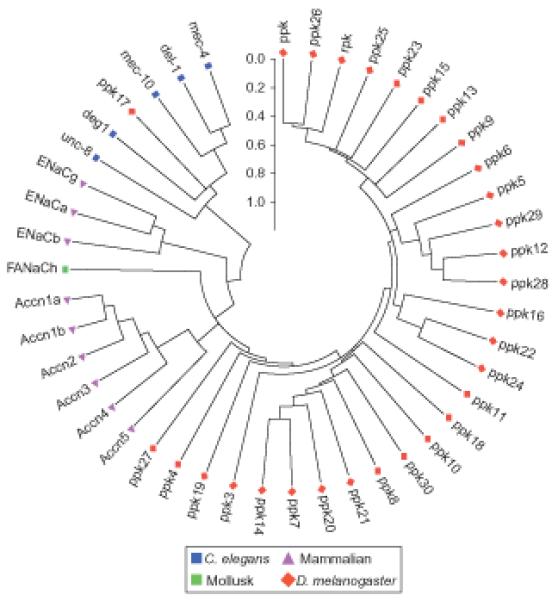
Molecular phylogenetic anaylsis of DEG/ENaC protein sequences. Evolutionary analyses were conducted in MEGA5 using default parameters (Tamura et al., 2007). The evolutionary history was inferred by using the Maximum Likelihood method based on the JTT matrix-based model (Jones et al., 1992). The tree with the highest log likelihood (− 9302.3626) is shown. Initial tree(s) for the heuristic search were obtained automatically as follows. When the number of common sites is less than 100, or less than one-fourth of the total number of sites, the maximum parsimony method was used; otherwise BIONJ method with MCL distance matrix was used. The tree is drawn to scale, with branch lengths measured in the number of substitutions per site. The analysis involved 45 amino acid sequences, which included representatives from Drosophila (rpk, and all ppk genes), C. elegans (mec-4, del-1, mec-10, deg-1, unc-8), mouse (Accn and ENaC genes), and the FMRFamide-gated channel from the pond snail (FaNaCh). All sequences were downloaded from the NCBI database, using the most updated reference sequence for each protein. All positions containing gaps and missing data were eliminated. There were a total of 86 positions in the final dataset.
Figure 1.3
Figure 1.3
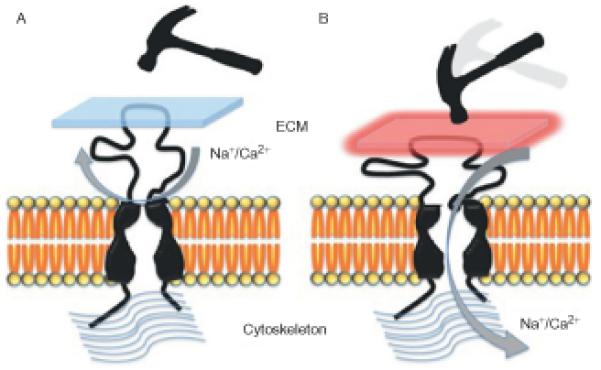
A model for the possible role of DEG/ENaC channels in the response to mechanical stimuli. (A) The large extracellular domain is attached to the extracellular matrix (ECM) either directly or possibly via other linker proteins. The short intracellular domains are attached directly or via other proteins to the cytoskeleton. (B) Upon mechanical pressure, the extracellular domain compresses, which results in opening of the pore, leading to influx of cations, which depolarizes the sensory cell. Currently, there are no conclusive data to support any of the models proposed for the mechanical gating of DEG/ENaC channels.

References

    1. Adams CM, Anderson MG, Motto DG, Price MP, Johnson WA, Welsh MJ. Ripped pocket and pickpocket, novel Drosophila DEG/ENaC subunits expressed in early development and in mechanosensory neurons. J. Cell Biol. 1998a;140:143–152. - PMC - PubMed
    1. Adams CM, Snyder PM, Price MP, Welsh MJ. Protons activate brain Na channel 1 by inducing a conformational change that exposes a residue associated with neurode-generation. J. Biol. Chem. 1998b;273:30204–30207. - PubMed
    1. Ainsley JA, Pettus JM, Bosenko D, Gerstein CE, Zinkevich N, Anderson MG, Adams CM, Welsh MJ, Johnson WA. Enhanced locomotion caused by loss of the Drosophila DEG/ENaC protein Pickpocket1. Curr. Biol. 2003;13:1557–1563. - PubMed
    1. Albeg A, Smith C, Chatzigeorgiou M, Feitelson DG, Hall DH, Schafer WR, Miller DM, 3rd, Treinin M. C. elegans multi-dendritic sensory neurons: Morphology and function. Mol. Cell. Neurosci. 2010;46:308–317. - PMC - PubMed
    1. Arnadottir J, Chalfie M. Eukaryotic mechanosensitive channels. Annu. Rev. Biophys. 2010;39:111–137. - PubMed

MeSH terms

LinkOut - more resources