


Echium oil reduces atherosclerosis in apoB100-only LDLrKO mice
- PMID: 22100249
- PMCID: PMC3258669
- DOI: 10.1016/j.atherosclerosis.2011.10.025
Echium oil reduces atherosclerosis in apoB100-only LDLrKO mice
Abstract
Introduction: The anti-atherogenic and hypotriglyceridemic properties of fish oil are attributed to its enrichment in eicosapentaenoic acid (EPA; 20:5, n-3) and docosahexaenoic acid (DHA; 22:6, n-3). Echium oil contains stearidonic acid (SDA; 18:4, n-3), which is metabolized to EPA in humans and mice, resulting in decreased plasma triglycerides.
Objective: We used apoB100 only, LDLrKO mice to investigate whether echium oil reduces atherosclerosis.
Methods: Mice were fed palm, echium, or fish oil-containing diets for 16 weeks and plasma lipids, lipoproteins, and atherosclerosis were measured.
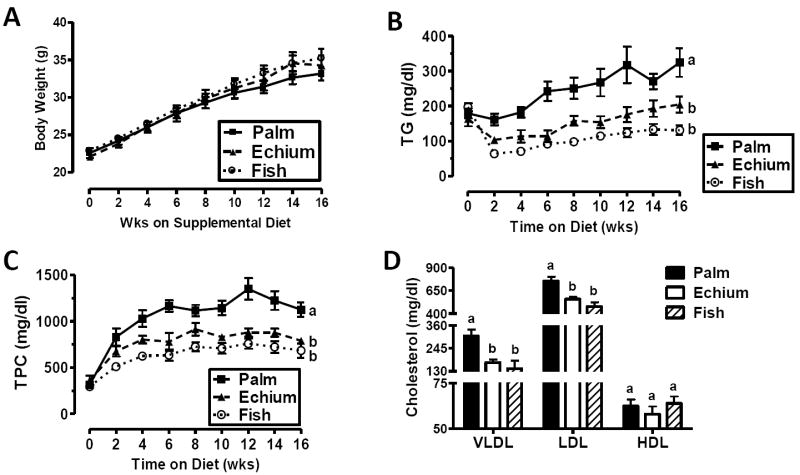
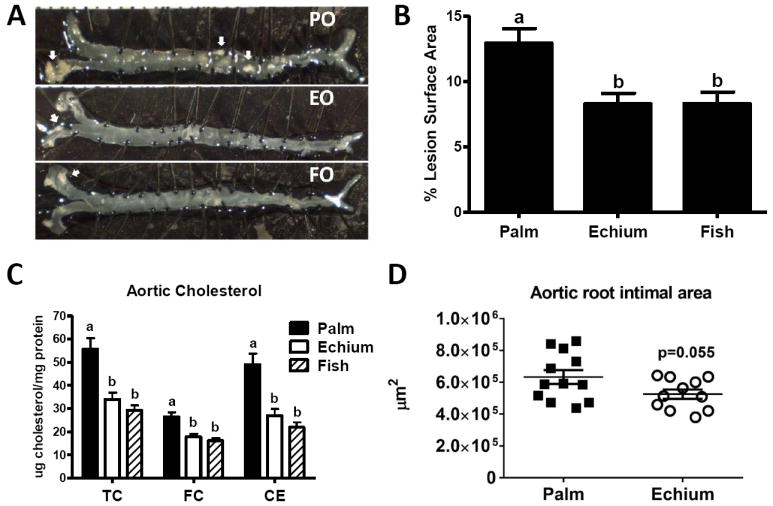
Results: Compared to palm oil, echium oil feeding resulted in significantly less plasma triglyceride and cholesterol levels, and atherosclerosis, comparable to that of fish oil.
Conclusion: This is the first report that echium oil is anti-atherogenic, suggesting that it may be a botanical alternative to fish oil for atheroprotection.
Copyright © 2011 Elsevier Ireland Ltd. All rights reserved.
Figures
References
-
- Expert Panel on Detection, Evaluation, and Treatment of High Blood Cholesterol in Adults. Executive Summary of the Third Report of the National Cholesterol Education Program (NCEP) Expert Panel on Detection, Evaluation, and Treatment of High Blood Cholesterol in Adults (Adult Treatment Panel III) JAMA: The Journal of the American Medical Association. 2001;285:2486–2497. - PubMed
-
- Kris-Etherton PM, Harris WS, Appel LJ. Fish consumption, fish oil, omega-3 fatty acids, and cardiovascular disease. Circulation. 2002;106:2747–2757. - PubMed
-
- Kris-Etherton PM, Taylor DS, Yu-Poth S, Huth P, Moriarty K, Fishell V, et al. Polyunsaturated fatty acids in the food chain in the United States. Am J Clin Nutr. 2000;71:179S–188S. - PubMed
-
- Huang YS, Smith RS, Redden PR, Cantrill RC, Horrobin DF. Modification of liver fatty acid metabolism in mice by n-3 and n-6 delta 6-desaturase substrates and products. Biochim Biophys Acta. 1991;1082:319–327. - PubMed
-
- Singer P, Berger I, Wirth M, Godicke W, Jaeger W, Voigt S. Slow desaturation and elongation of linoleic and alpha-linolenic acids as a rationale of eicosapentaenoic acid-rich diet to lower blood pressure and serum lipids in normal, hypertensive and hyperlipemic subjects. Prostaglandins Leukot Med. 1986;24:173–193. - PubMed
Publication types
MeSH terms
Substances
Grants and funding
LinkOut - more resources
Full Text Sources
Medical
Research Materials
