


Abnormal event-related potentials in young and middle-aged adults with the ApoE ε4 allele
- PMID: 22100309
- PMCID: PMC4343300
- DOI: 10.1016/j.ijpsycho.2011.11.001
Abnormal event-related potentials in young and middle-aged adults with the ApoE ε4 allele
Abstract
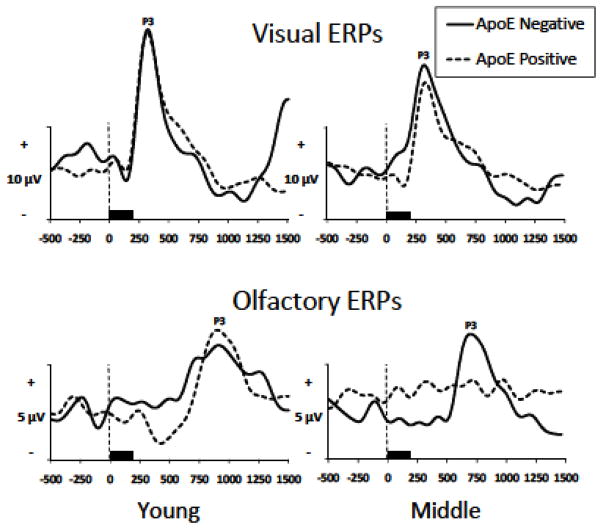
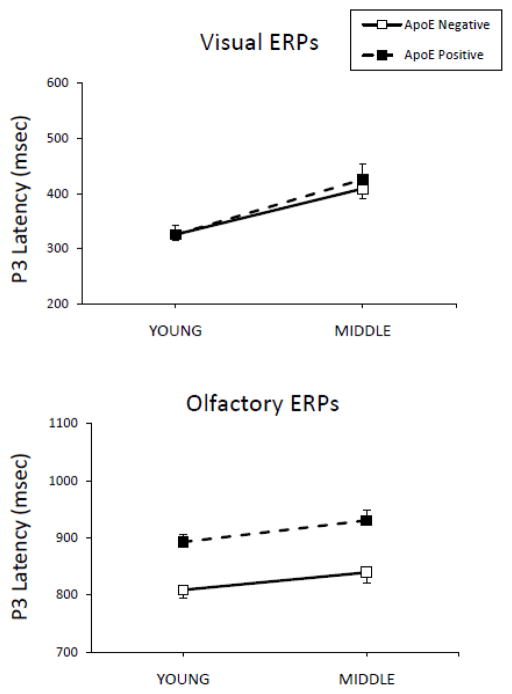
The largest genetic susceptibility factor for Alzheimer's disease is the Apolipoprotein E (ApoE) ε4 allele. Cognitive decline and olfactory impairment are greater in those positive for the ε4 allele. This study sought to determine if the olfactory event-related potential (OERP), compared to the visual ERP, would be sensitive to these subtle declines. Participants included 40 individuals from two age groups, half of each group were ε4 allele positive and half were ε4 negative. Visual ERPs did not demonstrate significant differences between ApoE groups. OERPs demonstrated robust age by ApoE interactions. P3 latencies were significantly longer in ε4 young and middle age participants. These findings suggest that very early olfactory and cognitive changes related to ApoE status are detectible via the OERP.
Copyright © 2011 Elsevier B.V. All rights reserved.
Conflict of interest statement
The authors have no actual or potential conflicts of interest associated with this research.
Figures
References
-
- Averback P. 2 New Lesions in Alzheimers-Disease. Lancet. 1983;2(8360):1203. - PubMed
-
- Bacon AW, Bondi MW, Salmon DP, Murphy C. Very early changes in olfactory functioning due to Alzheimer’s disease and the role of apolipoprotein E in olfaction. Ann N Y Acad Sci. 1998;855:723–31. - PubMed
-
- Braak H, Braak E. Frequency of stages of Alzheimer-related lesions in different age categories. Neurobiol Aging. 1997;18:351–7. - PubMed
-
- Cain WS, Gent J, Catalanotto FA, Goodspeed RB. Clinical evaluation of olfaction. Am J Otolaryngol. 1983;4(4):252–6. - PubMed
-
- Calhoun-Haney R, Murphy C. Apolipoprotein epsilon 4 is associated with more rapid decline in odor identification than in odor threshold or Dementia Rating Scale scores. Brain Cognition. 2005;58(2):178–82. - PubMed
Publication types
MeSH terms
Substances
Grants and funding
LinkOut - more resources
Full Text Sources
Medical
Miscellaneous
