. 2012 Mar 1;21(5):1138-44.
doi: 10.1093/hmg/ddr542. Epub 2011 Nov 18.

Cellular prion protein is essential for oligomeric amyloid-β-induced neuronal cell death

Affiliations

Cellular prion protein is essential for oligomeric amyloid-β-induced neuronal cell death

Wataru Kudo et al. Hum Mol Genet. .

Abstract

In Alzheimer disease (AD), amyloid-β (Aβ) oligomer is suggested to play a critical role in imitating neurodegeneration, although its pathogenic mechanism remains to be determined. Recently, the cellular prion protein (PrP(C)) has been reported to be an essential co-factor in mediating the neurotoxic effect of Aβ oligomer. However, these previous studies focused on the synaptic plasticity in either the presence or the absence of PrP(C) and no study to date has reported whether PrP(C) is required for the neuronal cell death, the most critical element of neurodegeneration in AD. Here, we show that Prnp(-/-) mice are resistant to the neurotoxic effect of Aβ oligomer in vivo and in vitro. Furthermore, application of an anti-PrP(C) antibody or PrP(C) peptide prevents Aβ oligomer-induced neurotoxicity. These findings are the first to demonstrate that PrP(C) is required for Aβ oligomer-induced neuronal cell death, the pathology essential to cognitive loss.


Figures
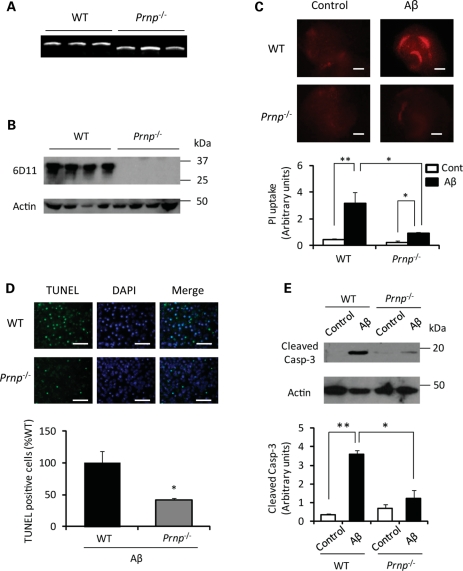
Figure 1.
Figure 1.
PrPC is essential for Aβ oligomer-induced neurotoxicity. (A) DNA was extracted from WT and Prnp−/− mice and each genotype was identified by PCR with the primer sets specifically detecting each genotype as described in the previous study (20). WT yields a 1100 bp PCR product and Prnp−/− yields a 850 bp PCR product. (B) Total protein (20 μg) from whole brain of the indicated genotype was analyzed by immunoblot with anti-PrP antibody (6D11). Immunoblot analysis shows the expected glycoforms of PrPC in WT samples migrating between 25–37 kDa, and no band in Prnp−/− samples. (C) The slices were treated with Aβ1–42 oligomer or the control reverse Aβ42–1 peptide (500 nm) in the presence of PI (red) for 48 h. Representative pictures showed that Aβ oligomer-induced PI uptake was significantly reduced in the slice cultures from Prnp−/− mice. The PI uptake was quantitatively analyzed (n= 5). Slices from WT or Prnp−/− mice with the control Aβ42–1 peptide show no difference. Scale bar, 500 μm (**P< 0.01 or *P< 0.05). (D) The number of TUNEL-positive cells (green) was also significantly reduced in Prnp−/− hippocampal slice culture (n= 5). Scale bar, 100 μm (*P< 0.05). (E) Representative western blot data show that the expression of active caspase-3 is significantly reduced in Prnp−/−slices after a 24 h treatment with Aβ oligomer (n= 4) (**P< 0.01 or *P< 0.05).
Figure 2.
Figure 2.
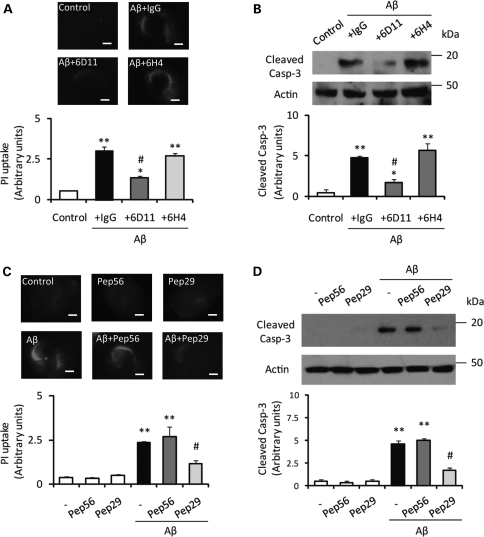
Aβ oligomer-induced neuronal cell loss is prevented by blocking the PrPC-Aβ interaction with PrPC-specific antibodies or peptides. (A) The intensity of PI in slices treated with Aβ oligomer after the addition of 6D11 antibody, control immunoglobulin G (IgG) or 6H4 1 h before Aβ oligomer treatment (n= 5). The PI updake is significantly reduced by 6D11 antibody but not by either IgG or 6H4 antibody. Scale bar, 500 μm (**P< 0.01 versus control #P< 0.05 versus +IgG). (B) Pretreatment with 6D11 suppressed the activation of caspase-3 induced by Aβ oligomer (n= 4) (**P< 0.01 versus control #P< 0.05 versus +IgG). (C) Co-treatment of synthesized peptide-29, corresponding to PrPC98–107, significantly prevents Aβ oligomer-induced PI uptake (n= 5). Scale bar, 500 μm (**P< 0.01 versus control #P< 0.05 versus non-peptide). (D) Co-treatment with peptide-29 suppressed the activation of caspase-3 induced by Aβ oligomer (n= 4) (**P< 0.01 versus control #P< 0.05 versus non-peptide).
Figure 3.
Figure 3.
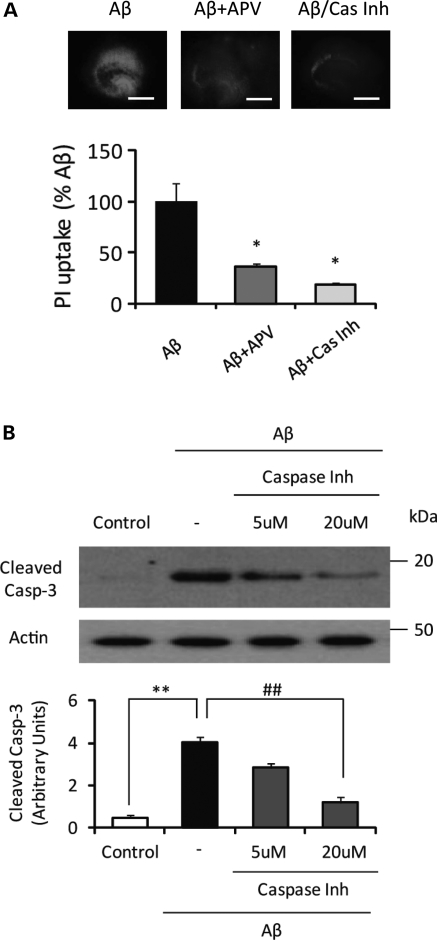
NMDA antagonist (APV) and caspsase inhibitor (Z-VAD-FMK) treatment significantly attenuate Aβ oligomer-induced PI uptake. (A) The slices were treated with Aβ1–42 oligomer (500 nm). APV (20 μm) or Z-VAD-FMK (Cas Inh) (20 μm) was co-applied with Aβ oligomer (n= 5). Both APV and Z-VAD-FMK dramatically reduced the level of PI uptake induced by Aβ1–42 oligomer. Scale bar, 500 μm (*P< 0.05 versus Aβ). (B) Pretreatment of caspase inhibitor, Z-VAD-FMK (20 μm), significantly reduced Aβ oligomer-induced caspase-3 activation (n= 3) (**P< 0.01 versus control, ##P< 0.01 versus non- inhibitor).
Figure 4.
Figure 4.
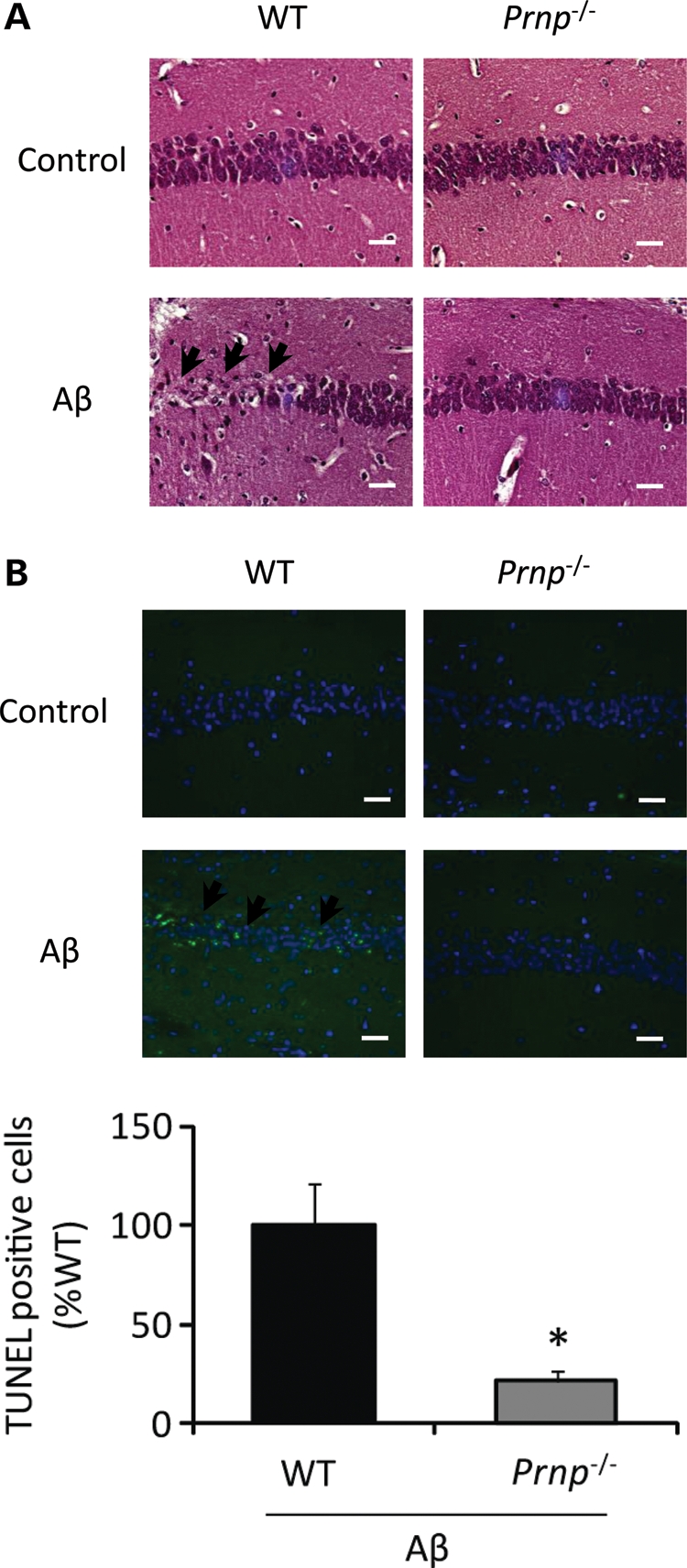
PrPC is essential for Aβ oligomer-induced neurotoxicity in vivo. (A) Prnp−/− and WT mice were sacrificed and brain tissues stained with H&E at 20 days after Aβ oligomer injection. Neuronal cell loss in hippocampus was evident in WT mice injected with Aβ oligomer (arrows) but not in Prnp−/− mice. Scale bar, 100 μm. (B) The number of TUNEL-positive cells (arrows) in hippocampus was dramatically reduced in Prnp−/− mice after Aβ oligomer injection compared with WT mice (n= 5). Scale bar, 100 μm (*P< 0.05).
Figure 5.
Figure 5.
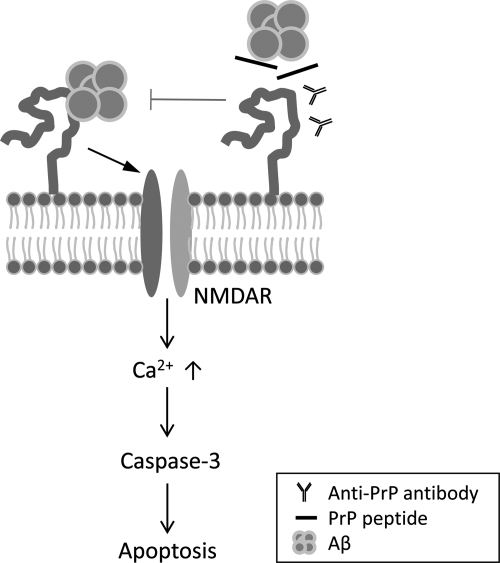
Hypothetical model for Aβ oligomer-induced neurotoxic signaling through PrPC. Aβ oligomer binding to PrPC at plasma membrane activates NMDA receptors and subsequent caspase-3-dependent neuronal cell death. Treatment with anti-PrPC antibody or competitive PrPC peptides prevents the activation of NMDA receptor, suggesting that PrPC/Aβ oligomer interaction is a key mechanism of Aβ oligomer-induced neurotoxicity.

References

    1. Lauren J., Gimbel D.A., Nygaard H.B., Gilbert J.W., Strittmatter S.M. Cellular prion protein mediates impairment of synaptic plasticity by amyloid-beta oligomers. Nature. 2009;457:1128–1132. - PMC - PubMed
    1. Gimbel D.A., Nygaard H.B., Coffey E.E., Gunther E.C., Lauren J., Gimbel Z.A., Strittmatter S.M. Memory impairment in transgenic Alzheimer mice requires cellular prion protein. J. Neurosci. 2010;30:6367–6374. - PMC - PubMed
    1. Balducci C., Beeg M., Stravalaci M., Bastone A., Sclip A., Biasini E., Tapella L., Colombo L., Manzoni C., Borsello T., et al. Synthetic amyloid-beta oligomers impair long-term memory independently of cellular prion protein. Proc. Natl Acad. Sci. USA. 2010;107:2295–2300. - PMC - PubMed
    1. Calella A.M., Farinelli M., Nuvolone M., Mirante O., Moos R., Falsig J., Mansuy I.M., Aguzzi A. Prion protein and Abeta-related synaptic toxicity impairment. EMBO Mol. Med. 2010;2:306–314. - PMC - PubMed
    1. Kessels H.W., Nguyen L.N., Nabavi S., Malinow R. The prion protein as a receptor for amyloid-beta. Nature. 2010;466:E3–E4. ; discussion E4–5. - PMC - PubMed

Publication types