


Progesterone at encoding predicts subsequent emotional memory
- PMID: 22101178
- PMCID: PMC3222892
- DOI: 10.1101/lm.023267.111
Progesterone at encoding predicts subsequent emotional memory
Abstract
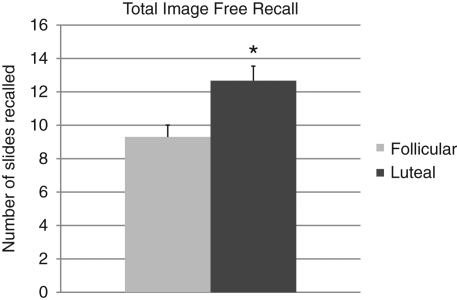
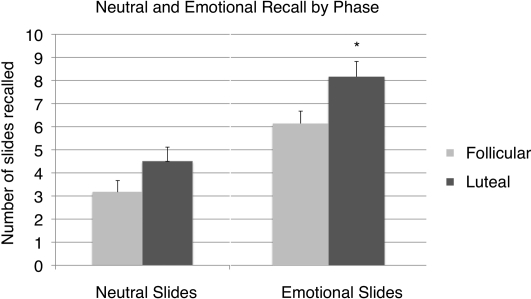
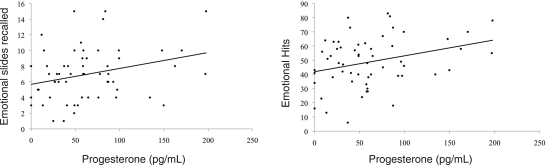
Significant sex differences in the well-documented relationship between stress hormones and memory have emerged in recent studies. The potentiating effects of glucocorticoids on memory vary across the menstrual cycle, suggesting a potential interaction between these stress hormones and endogenously cycling sex hormones. Here, we show that memory for emotional materials changes significantly in accordance with hormonal changes across the menstrual cycle, suggesting that ovarian sex hormones influence the modulation of emotional memories. Sixty healthy, naturally cycling women rated 120 images on arousal and valence. One week later they completed free recall and recognition memory tests. Their menstrual cycle phases were estimated by self-report and confirmed by salivary assay of 17β-estradiol and progesterone. Memory for emotional items only was significantly better in the high hormone (luteal) phase compared with the low hormone (follicular) phase on the free recall test; on both tests memory correlated positively with progesterone collected at the time of encoding. These findings suggest that emotional memory performance changes across the menstrual cycle, and that this change is in part mediated by endogenous progesterone cycling.
© 2011 Cold Spring Harbor Laboratory Press
Figures
References
-
- Abercrombie HC, Kalin NH, Thurow ME, Rosenkranz MA, Davidson RJ 2003. Cortisol variations in humans affects memory for emotionally laden and neutral information. Behav Neurosci 117: 505–516 - PubMed
-
- Andreano JM, Cahill L 2006. Glucocorticoid release and memory consolidation in men and women. Psychol Sci 17: 466–470 - PubMed
-
- Andreano JM, Arjomandi H, Cahill L 2008. Menstrual cycle modulation of the relationship between cortisol and long-term memory. Psychoneuroendocrinology 33: 874–882 - PubMed
-
- Arborelius L, Owens MJ, Plotsky PM, Nemeroff CB 1999. The role of corticotropin-releasing factor in depression and anxiety disorders. J Endocrinol 160: 1–12 - PubMed
Publication types
MeSH terms
Substances
Grants and funding
LinkOut - more resources
Full Text Sources