


Rationale, study design and sample characteristics of a randomized controlled trial of directly administered antiretroviral therapy for HIV-infected prisoners transitioning to the community - a potential conduit to improved HIV treatment outcomes
- PMID: 22101218
- PMCID: PMC3268833
- DOI: 10.1016/j.cct.2011.11.002
Rationale, study design and sample characteristics of a randomized controlled trial of directly administered antiretroviral therapy for HIV-infected prisoners transitioning to the community - a potential conduit to improved HIV treatment outcomes
Abstract
Background: HIV-infected prisoners experience poor HIV treatment outcomes post-release. Directly administered antiretroviral therapy (DAART) is a CDC-designated, evidence-based adherence intervention for drug users, yet untested among released prisoners.
Methods: Sentenced HIV-infected prisoners on antiretroviral therapy (ART) and returning to New Haven or Hartford, Connecticut were recruited and randomized 2:1 to a prospective controlled trial (RCT) of 6 months of DAART versus self-administered therapy (SAT); all subjects received case management services. Subjects meeting DSM-IV criteria for opioid dependence were offered immediate medication-assisted treatment. Trained outreach workers provided DAART once-daily, seven days per week, including behavioral skills training during the last intervention month. Both study groups were assessed for 6 months after the intervention period. Assessments occurred within 90 days pre-release (baseline), day of release, and then monthly for 12 months. Viral load (VL) and CD4 testing was conducted baseline and quarterly; genotypic resistance testing was conducted at baseline, 6 and 12 months. The primary outcome was pre-defined as viral suppression (VL<400 copies/mL) at 6 months.
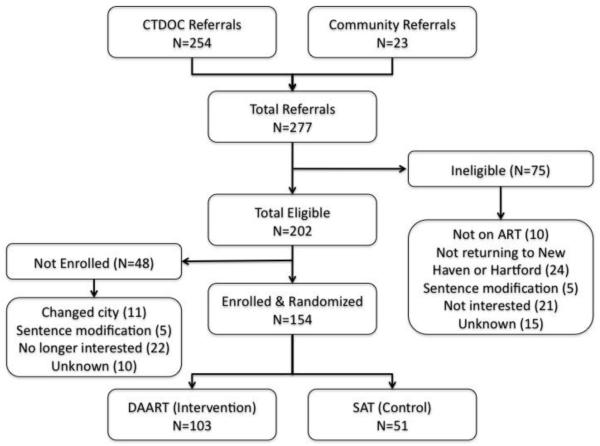
Results: Between 2004 and 2009, 279 participants were screened, of which 202 met eligibility criteria and 154 were ultimately enrolled in the study; 103 subjects were randomized to DAART and 51 to SAT. Subjects were mostly male (81.2%), people of color (87.0%), had an alcohol use disorder (39.7%), had underlying depression (54.2%), were virally suppressed (78.8%) and had a mean CD4=390.7 cells/mL.
Conclusions: Outcomes from this RCT will contribute greatly to HIV treatment outcomes after release from prison, a period associated with adverse HIV and other medical consequences.
Copyright © 2011 Elsevier Inc. All rights reserved.
Figures
References
-
- Glaze LE. Bureau of Justice Statistics. U.S. Department of Justice; Washington, D.C.: 2010. Correctional Populations in the United States, 2009.
-
- Maruschak LM. Bureau of Justice Statistics. U.S. Department of Justice; Washington: 2009. HIV in Prisons, 2007-08.
-
- Satcher Johnson A, Hu X, Hughes D, Campsmith M, Hall I, Prejean J, et al. The HIV/AIDS Surveillance Report. The HIV/AIDS Surveillance Report. Division of HIV/AIDS Prevention, National Center for HIV/AIDS, Viral Hepatitis, STD, and TB Prevention. Coordinating Center for Infectious Diseases, Centers for Disease Control and Prevention (CDC), U.S. Department of Health and Human Services; Atlanta: 2007.
-
- Mumola C. Substance abuse and treatment of state and federal prisoners, 1997. Bureau of Justice Statistics, US Department of Justice, Office of Justice Programs; Washington, DC: 1999.
Publication types
MeSH terms
Substances
Grants and funding
LinkOut - more resources
Full Text Sources
Medical
Research Materials
Miscellaneous
