


The Family Health Promotion Project (FHPP): design and baseline data from a randomized trial to increase colonoscopy screening in high risk families
- PMID: 22101228
- PMCID: PMC4303240
- DOI: 10.1016/j.cct.2011.11.005
The Family Health Promotion Project (FHPP): design and baseline data from a randomized trial to increase colonoscopy screening in high risk families
Abstract
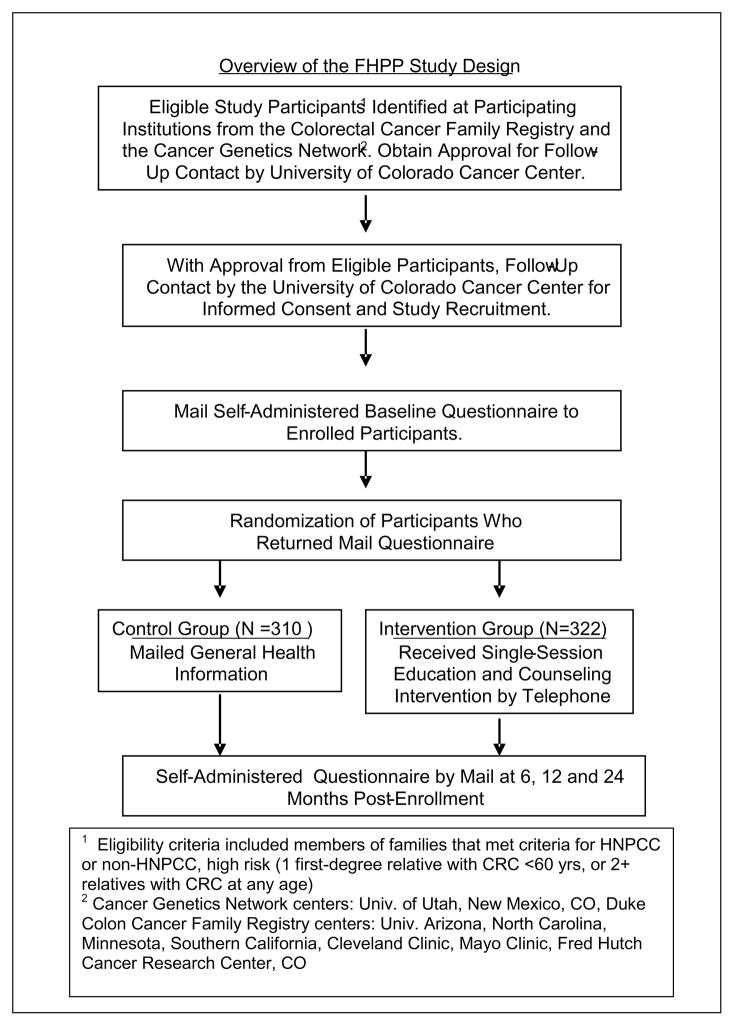
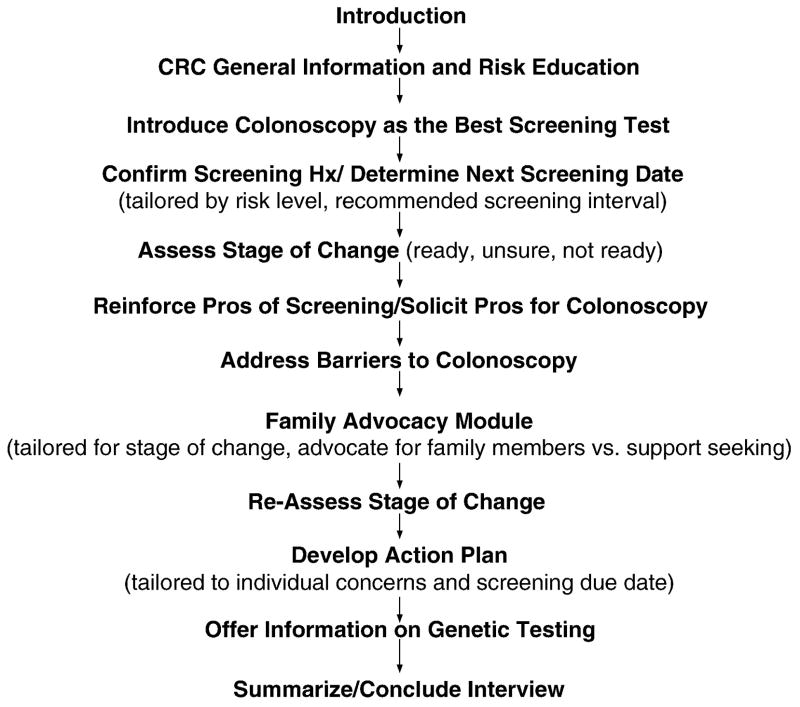
Colorectal cancer (CRC) is a significant cause of mortality and morbidity in the United States, much of which could be prevented through adequate screening. Consensus guidelines recommend that high-risk groups initiate screening earlier with colonoscopy and more frequently than average risk persons. However, a large proportion of high risk individuals do not receive regular colonoscopic screening. The Family Health Promotion Project (FHPP) is a randomized-controlled trial to test the effectiveness of a telephone-based counseling intervention to increase adherence to risk-appropriate colonoscopy screening in high risk individuals. Unaffected members of CRC families from two national cancer family registries were enrolled (n=632) and randomized to receive either a single session telephone counseling intervention using Motivational Interviewing techniques or a minimal mail-out intervention. The primary endpoint, rate of colonoscopy screening, was assessed at 6, 12 and 24 months post-enrollment. In this paper, we describe the research design and telephone counseling intervention of the FHPP trial, and report baseline data obtained from the two high risk cohorts recruited into this trial. Results obtained at baseline confirm the need for interventions to promote colonoscopy screening among these high risk individuals, as well as highlighting several key opportunities for intervention, including increasing knowledge about risk-appropriate screening guidelines, and providing both tailored risk information and barriers counseling.
Copyright © 2011 Elsevier Inc. All rights reserved.
References
-
- Ries L, Melbert D, Krapcho M, Stinchcomb D, Howlader N, Horner M, et al. SEER Cancer Statistics Review 1975–2005. Bethesda, MD: National Cancer Institute; 2008. http://seer.cancer.gov/csr/1975-2005/, based on November 2007 SEER data submission, posted to the SEER web site.
-
- American Cancer Society. Colorectal Cancer Facts and Figures 2011–13. Atlanta: American Cancer Society; 2011.
-
- Levin B, Lieberman DA, McFarland B, et al. American Cancer Society Colorectal Cancer Advisory Group; US Multi-Society Task Force; American College of Radiology Colon Cancer Committee. Screening and surveillance for the early detection of colorectal cancer and adenomatous polyps, 2008: a joint guideline from the American Cancer Society, the US Multi-Society Task Force on Colorectal Cancer and the American College of Radiology. Gastroenterology. 2008;134:1570–95. - PubMed
-
- Fuchs CS, Giovannucci EL, Colditz GA, Hunter DJ, Speizer FE, Willet WC. A prospective study of family history and the risk of colorectal cancer. N Eng J Med. 1994;331:1669–1674. - PubMed
-
- Burt RW, DiSario JA, Cannon-Albright L. Genetics of colon cancer: impact of inheritance on colon cancer risk. Annu Rev Med. 1995;46:371–379. - PubMed
Publication types
MeSH terms
Grants and funding
LinkOut - more resources
Full Text Sources
Medical
