


The role of the ENaC-regulatory complex in aldosterone-mediated sodium transport
- PMID: 22101317
- PMCID: PMC3270213
- DOI: 10.1016/j.mce.2011.11.003
The role of the ENaC-regulatory complex in aldosterone-mediated sodium transport
Abstract
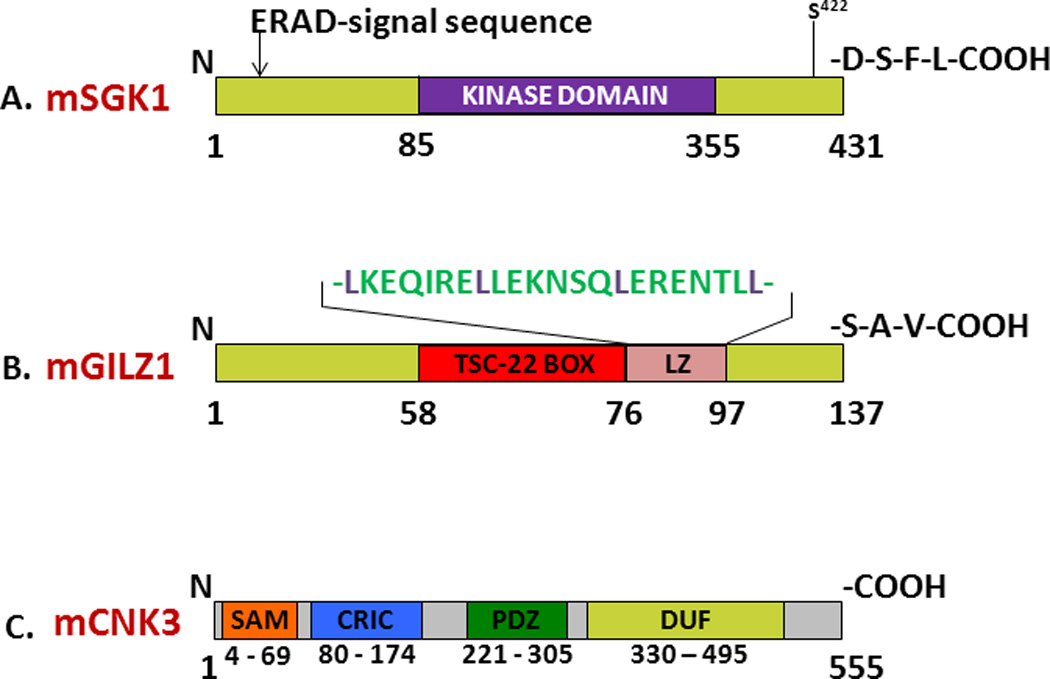
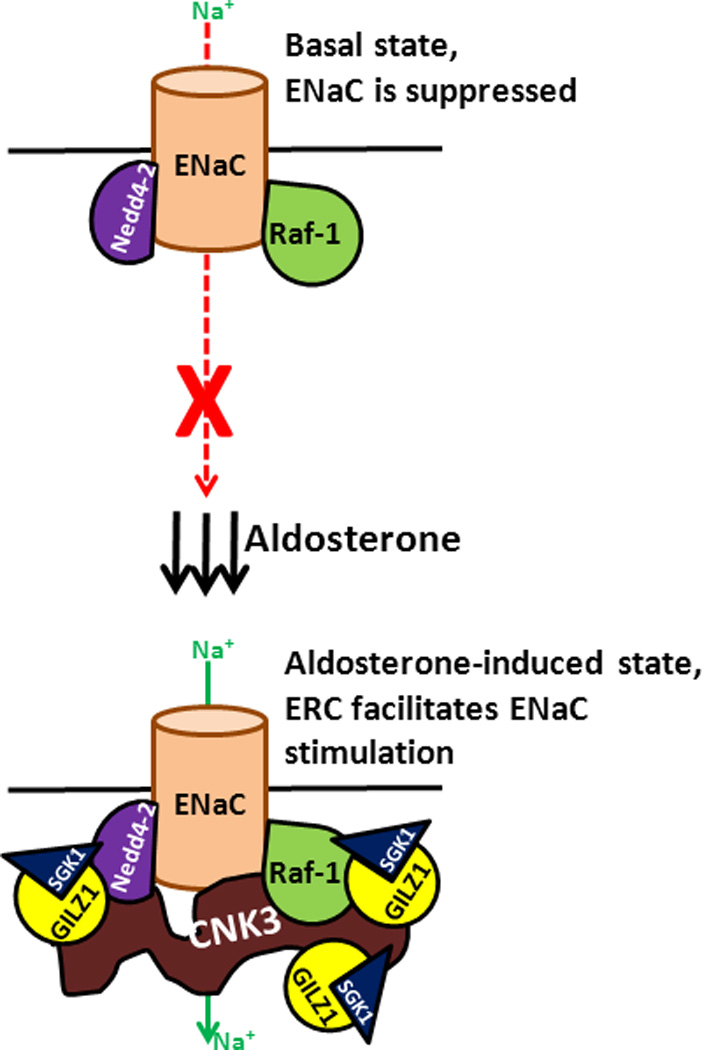
The mineralocorticoid aldosterone is indispensable for the control of blood pressure and fluid volume in mammals. It acts in large part to increase the abundance and activity of the epithelial Na(+) channel (ENaC), which mediates apical Na(+) entry in the distal parts of the kidney tubules. Aldosterone acts through the mineralocorticoid receptor to alter the transcription of specific genes, including SGK1 and GILZ1. Recent evidence suggests that these key aldosterone-regulated factors function within a unique multi-protein ENaC-regulatory-complex that governs the net cell surface expression and activity of the channel. Another aldosterone-induced protein, CNK3 (connector enhancer of kinase suppressor of Ras 3), also stimulates ENaC and has all of the features of a scaffolding protein. With these observations in mind, we discuss the possibility that CNK3 coordinates the dynamic assembly of the ENaC-regulatory-complex, and promotes context-appropriate aldosterone signal transduction in the regulation of epithelial Na(+) transport.
Copyright © 2011 Elsevier Ireland Ltd. All rights reserved.
Figures
References
-
- Alvarez de la Rosa D, Canessa CM. Role of SGK in hormonal regulation of epithelial sodium channel in A6 cells. Am J Physiol Cell Physiol. 2003;284:C404–C414. - PubMed
-
- Alvarez de la Rosa D, Zhang P, Naray-Fejes-Toth A, Fejes-Toth G, Canessa CM. The serum and glucocorticoid kinase sgk increases the abundance of epithelial sodium channels in the plasma membrane of Xenopus oocytes. J Biol Chem. 1999;274:37834–37839. - PubMed
-
- Arteaga MF, Wang L, Ravid T, Hochstrasser M, Canessa CM. An amphipathic helix targets serum and glucocorticoid-induced kinase 1 to the endoplasmic reticulum-associated ubiquitin-conjugation machinery. Proceedings of the National Academy of Sciences of the United States of America. 2006;103:11178–11183. - PMC - PubMed
-
- Asselin-Labat ML, Biola-Vidamment A, Kerbrat S, Lombes M, Bertoglio J, Pallardy M. FoxO3 mediates antagonistic effects of glucocorticoids and interleukin-2 on glucocorticoid-induced leucine zipper expression. Mol Endocrinol. 2005;19:1752–1764. - PubMed
-
- Asselin-Labat ML, David M, Biola-Vidamment A, Lecoeuche D, Zennaro MC, Bertoglio J, Pallardy M. GILZ, a new target for the transcription factor FoxO3, protects T lymphocytes from interleukin-2 withdrawal-induced apoptosis. Blood. 2004;104:215–223. - PubMed
Publication types
MeSH terms
Substances
Grants and funding
LinkOut - more resources
Full Text Sources
Molecular Biology Databases
