. 2011 Nov 20;17(12):1602-9.
doi: 10.1038/nm.2535.

A mechanism for glycoconjugate vaccine activation of the adaptive immune system and its implications for vaccine design

Affiliations

A mechanism for glycoconjugate vaccine activation of the adaptive immune system and its implications for vaccine design

Fikri Y Avci et al. Nat Med. .

Abstract

Glycoconjugate vaccines have provided enormous health benefits globally, but they have been less successful in some populations at high risk for developing disease. To identify new approaches to enhancing glycoconjugate effectiveness, we investigated molecular and cellular mechanisms governing the immune response to a prototypical glycoconjugate vaccine. We found that in antigen-presenting cells a carbohydrate epitope is generated upon endolysosomal processing of group B streptococcal type III polysaccharide coupled to a carrier protein. In conjunction with a carrier protein-derived peptide, this carbohydrate epitope binds major histocompatibility class II (MHCII) and stimulates carbohydrate-specific CD4(+) T cell clones to produce interleukins 2 and 4-cytokines essential for providing T cell help to antibody-producing B cells. An archetypical glycoconjugate vaccine that we constructed to maximize the presentation of carbohydrate-specific T cell epitopes is 50-100 times more potent and substantially more protective in a neonatal mouse model of group B Streptococcus infection than a vaccine constructed by methods currently used by the vaccine industry. Our discovery of how glycoconjugates are processed resulting in presentation of carbohydrate epitopes that stimulate CD4(+) T cells has key implications for glycoconjugate vaccine design that could result in greatly enhanced vaccine efficacy.


Conflict of interest statement

COMPETING FINANCIAL INTERESTS

The authors declare no competing financial interests.

Figures
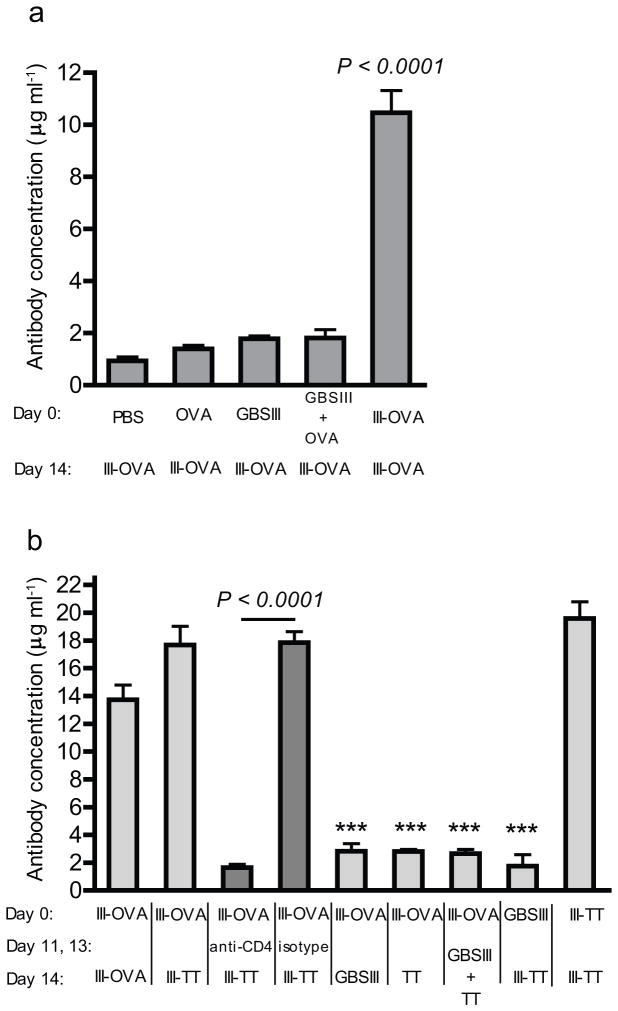
Figure 1
Figure 1. GBSIII-specific IgG secretion can be stimulated by CD4+ T cells recognizing carbohydrate epitopes
(a and b) Concentration of IgG antibody to GBSIII in BALB/c mice primed (day 0) and boosted (day 14) with different antigen combinations, as measured by ELISA in serum obtained on day 21. *** As shown in panel b, mice primed with III-OVA and boosted with unconjugated GBSIII and mice primed with unconjugated GBSIII and boosted with III-TT had significantly lower specific IgG levels than either mice primed and boosted with III-OVA or mice primed with III-OVA and boosted with III-TT (p < 0.0001). None of the mice had detectable antibodies to either GBSIII or OVA before immunization (data not shown).
Figure 2
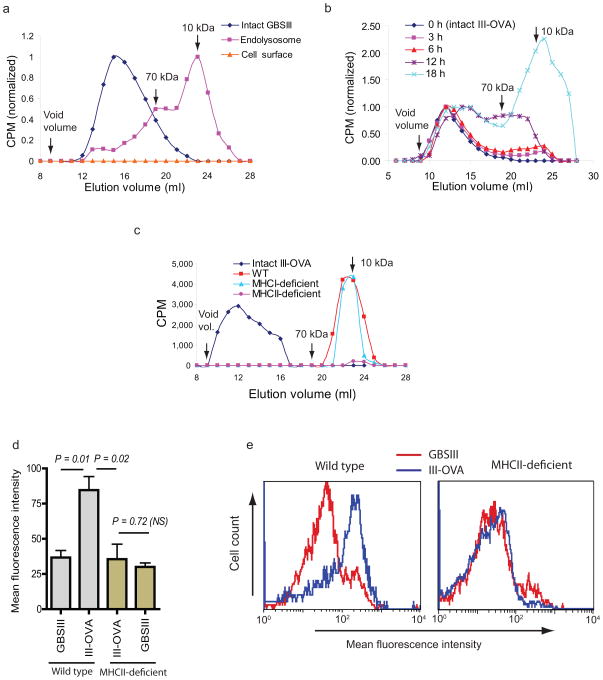
Figure 2. Processing and presentation of a glycoconjugate vaccine. (a) Endosomal processing and failure of presentation of unconjugated GBSIII
Lysates of Raji B-cell endosomes after 18 h of incubation with unconjugated [3H]GBSIII were analyzed by chromatography and found to be processed to smaller molecular size. Cell membranes were co-immunoprecipitated with HLA-DR mAbs, and no [3H]GBSIII was found in the co-IP product. (b) Processing kinetics of GBSIII conjugated to ovalbumin (III-OVA). [3H]III-OVA was analyzed from Raji B-cell endolysosomes (after incubation for 3, 6, 12, and 18 h), and molecular size distribution of the processed polysaccharide was determined. (c) Requirement for MHCII in the presentation of GBSIII epitopes in the III-OVA conjugate vaccine. The elution profile of [3H]III-OVA was obtained from surface extracts of mouse splenic mononuclear cells (2x10⁸) after incubation with [3H]III-OVA and co-immunoprecipitated with anti-I-Ab antibody. (d, e) GBSIII epitopes on the surface of Raji cells incubated with III-OVA. Flow cytometric analysis of wild-type and MHCII-deficient bone marrow dendritic cells after incubation (18 h) with unconjugated GBSIII or III-OVA was followed by surface staining of the cells with mAb to GBSIII. WT, wild-type.
Figure 3
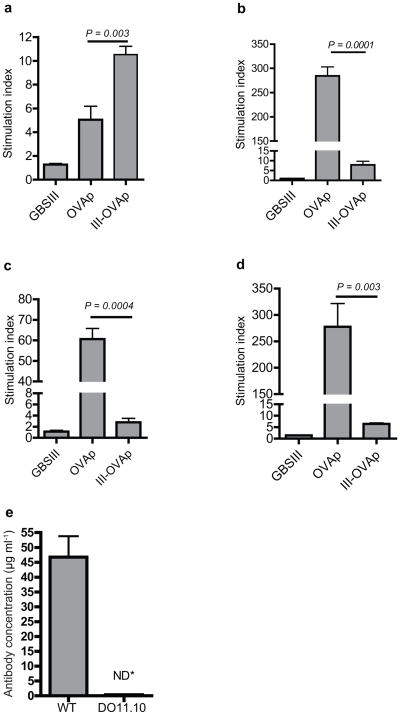
Figure 3. T cells distinguish OVAp from III-OVAp, as presented by APCs
(a–d) Wild-type (WT) BALB/c (a) and DO11.10 (b) mice were immunized with III-OVAp. Wild-type (WT) BALB/c (c) and DO11.10 (d) mice were immunized with OVAp. Naive irradiated splenic mononuclear cells (iAPCs; 105/well) were co-cultured for 4 days with CD4+ T cells (105/well) from each mouse strain and stimulated with III-OVAp, OVAp, or GBSIII. Proliferation was measured by [3H]thymidine incorporation. Data are expressed as the mean stimulation index. Controls included stimulation by GBSIII or no antigen; all negative controls had a stimulation index of ~1. (e) GBSIII-specific IgG concentrations on day 21 after immunization with III-OVAp in DO11.10 and WT BALB/c mice (same mice as in Figs. 3a-d). *ND, not detectable. Neither WT nor DO11.10 mice had detectable antibodies to either GBSIII or OVAp before immunization (not shown).
Figure 4
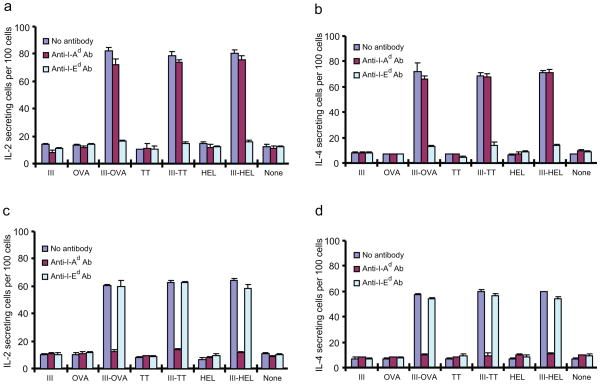
Figure 4. Two CD4+ T-cell clones specifically recognize the carbohydrate portion of a glycoconjugate vaccine in the context of MHCII on APCs
(a–d) ELISpot assays for the detection of CD4+ T-cell clones (clone #1 (a, b) and clone # 2 (c, d))secreting IL-2 (a, c) and IL-4 (b, d) were conducted with several antigens, first in the absence and then in the presence of mAb to I-Ad or I-Ed. Isotype controls for mAb to I-Ad (IgG2b isotype) or mAb to I-Ed (IgG2a isotype) did not inhibit IL-2 or IL-4 production in either T cell clone (data not shown). Irradiated naïve mouse splenocytes were used as APCs.
Figure 5
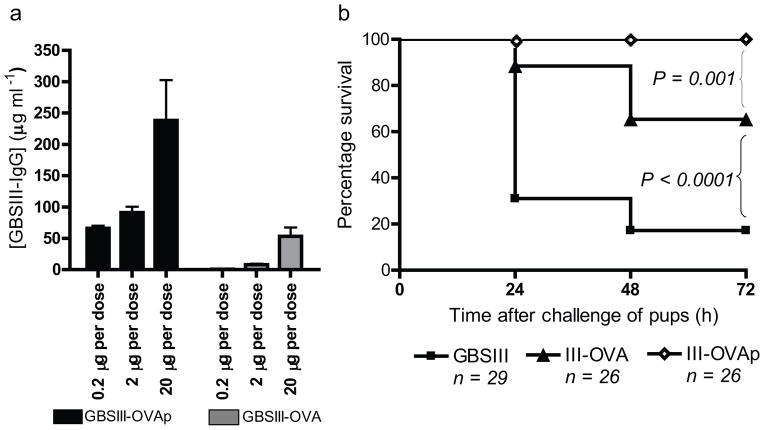
Figure 5. Immunization with III-OVAp induces a significantly stronger humoral immune response and greater protection than immunization with III-OVA
(a) Groups of BALB/c mice (6 mice per group) were vaccinated three times (days 0, 14, and 28) with three different doses (0.2 μg, 2 μg, or 20 μg; as carbohydrate) of either III-OVA or III-OVAp. GBSIII-specific IgG titers were measured in serum obtained on day 35. (b) Survival of pups born to III-OVAp-, III-OVA-, or unconjugated GBSIII–immunized dams and challenged with type III group B Streptococcus (n: number of challenged pups in each group).
Figure 6
Figure 6. Mechanism of T-cell activation by glycoconjugate vaccines: a new working model
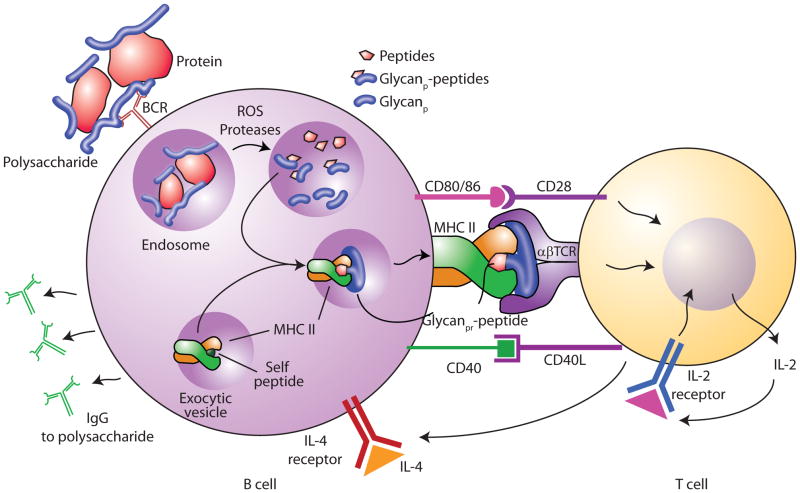
Schematic representation shows the steps in antigen processing and presentation of glycoconjugate vaccines resulting in helper CD4+ T-cell induction of B-cell production of IgG antibodies to the polysaccharide. (1) The carbohydrate portion of the glycoconjugate binds to and cross-links the receptor of a B cell (BCR) whose specific destiny is to produce antibodies to the polysaccharide. (2) The glycoconjugate is internalized into an endosome of the B cell. (3) The carbohydrate portion of this GBSIII glycoconjugate is processed in the endolysosome by ROS into saccharides composed of smaller numbers of repeating units than the full-length polysaccharide used in construction of the vaccine. The protein portion is processed by acidic proteases into peptides. Processing of both the protein and the carbohydrate portions of glycoconjugates generates glycanp-peptides with a molecular size of ~10 kDa. (4) MHCII binding of the peptide portion of the glycanp-peptide allows the presentation by MHCII of the more hydrophilic carbohydrate to the αβ receptor of CD4+ T cells (αβTCR). (5) The αβ receptor of CD4+ T helper cells recognizes and responds to the non-zwitterionic saccharide presented in the context of MHCII. (6) Activation of the T cell by the carbohydrate/MHCII, along with co-stimulation, results in T-cell production of cytokines such as IL-4 and IL-2, which in turn induces maturation of the cognate B cell to become a memory B cell, with consequent production of carbohydrate-specific IgG antibodies.

Comment in

References

    1. Coutinho A, Moller G. B cell mitogenic properties of thymus-independent antigens. Nature New Biol. 1973;245:12–14. - PubMed
    1. Barrett DJ. Human immune responses to polysaccharide antigens: an analysis of bacterial polysaccharide vaccines in infants. Adv Pediatr. 1985;32:139–158. - PubMed
    1. Guttormsen HK, et al. Cognate stimulatory B-Cell-T-Cell interactions are critical for T-cell help recruited by glycoconjugate vaccines. Infect Immun. 1999;67:6375–6384. - PMC - PubMed
    1. Guttormsen HK, Wetzler LM, Finberg RW, Kasper DL. Immunologic memory induced by a glycoconjugate vaccine in a murine adoptive lymphocyte transfer model. Infect Immun. 1998;66:2026. - PMC - PubMed
    1. Avci FA, Kasper DL. How Bacterial Carbohydrates Influence the Adaptive Immune System. Annu Rev immunol. 2010;28:107–130. - PubMed

Publication types

MeSH terms