


High serum glucose levels are associated with a higher perceived age
- PMID: 22102339
- PMCID: PMC3543736
- DOI: 10.1007/s11357-011-9339-9
High serum glucose levels are associated with a higher perceived age
Abstract
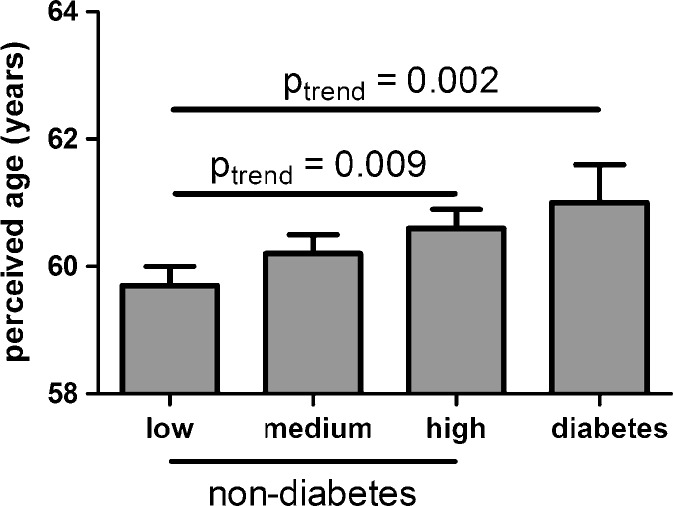
Estimating perceived age by facial photographs is a good estimate of health in elderly populations. Previously, we showed that familial longevity is marked by a more beneficial glucose metabolism already at middle age. As glucose is also related to skin aging, this study aimed to investigate the association between glucose metabolism and perceived age. Perceived age was assessed using facial photographs and non-fasted glucose and insulin were measured in 602 subjects from the Leiden Longevity Study. Non-diabetic subjects (n = 569) were divided in three strata according to their glucose levels, and diabetic subjects (n = 33; as a proxy of long-term hyperglycemic exposure) were included as a fourth stratum. Considered confounding factors were gender, chronological age, current smoking, body mass index, photo-damage score, and insulin levels. Perceived age was increased from 59.6 years (SE = 0.3) in the first stratum to 61.2 years (SE = 0.6) in diabetic subjects (p for trend = 0.002). In non-diabetic subjects only, perceived age was increased from 59.6 years (SE = 0.3) in the first stratum to 60.6 years (SE = 0.3) in the third stratum (p for trend = 0.009). Continuously, perceived age increased 0.40 years (SE = 0.14, p = 0.006) per 1 mmol/L increase in glucose level in non-diabetic subjects. The present study demonstrates that, also among non-diabetic subjects, higher glucose levels are associated with a higher perceived age. Future research should be focused on elucidating possible mechanisms linking glucose levels to perceived age.
Figures
References
-
- Beekman M, Nederstigt C, Suchiman HE, Kremer D, van der Breggen R, Lakenberg N, Alemayehu WG, de Craen AJ, Westendorp RG, Boomsma DI, de Geus EJ, Houwing-Duistermaat JJ, Heijmans BT, Slagboom PE. Genome-wide association study (GWAS)-identified disease risk alleles do not compromise human longevity. Proc Natl Acad Sci USA. 2010;107(42):18046–18049. doi: 10.1073/pnas.1003540107. - DOI - PMC - PubMed
-
- Cerami A. Hypothesis. Glucose as a mediator of aging. J Am Geriatr Soc. 1985;33(9):626–634. - PubMed
Publication types
MeSH terms
Substances
LinkOut - more resources
Full Text Sources
Medical
Research Materials