. 2011 Jul;113(7):812-831.
doi: 10.1002/ejlt.201100032.

Replacing fossil oil with fresh oil - with what and for what?

Affiliations
Free PMC article

Replacing fossil oil with fresh oil - with what and for what?

Anders S Carlsson et al. Eur J Lipid Sci Technol. 2011 Jul.
Free PMC article

Abstract

Industrial chemicals and materials are currently derived mainly from fossil-based raw materials, which are declining in availability, increasing in price and are a major source of undesirable greenhouse gas emissions. Plant oils have the potential to provide functionally equivalent, renewable and environmentally friendly replacements for these finite fossil-based raw materials, provided that their composition can be matched to end-use requirements, and that they can be produced on sufficient scale to meet current and growing industrial demands. Replacement of 40% of the fossil oil used in the chemical industry with renewable plant oils, whilst ensuring that growing demand for food oils is also met, will require a trebling of global plant oil production from current levels of around 139 MT to over 400 MT annually. Realisation of this potential will rely on application of plant biotechnology to (i) tailor plant oils to have high purity (preferably >90%) of single desirable fatty acids, (ii) introduce unusual fatty acids that have specialty end-use functionalities and (iii) increase plant oil production capacity by increased oil content in current oil crops, and conversion of other high biomass crops into oil accumulating crops. This review outlines recent progress and future challenges in each of these areas.Practical applications: The research reviewed in this paper aims to develop metabolic engineering technologies to radically increase the yield and alter the fatty acid composition of plant oils and enable the development of new and more productive oil crops that can serve as renewable sources of industrial feedstocks currently provided by non-renewable and polluting fossil-based resources. As a result of recent and anticipated research developments we can expect to see significant enhancements in quality and productivity of oil crops over the coming decades. This should generate the technologies needed to support increasing plant oil production into the future, hopefully of sufficient magnitude to provide a major supply of renewable plant oils for the industrial economy without encroaching on the higher priority demand for food oils. Achievement of this goal will make a significant contribution to moving to a sustainable carbon-neutral industrial society with lower emissions of carbon dioxide to the atmosphere and reduced environmental impact as a result.


Figures

Figure 1
Figure 1
Actual and forecasted global feedstock needs for the chemical industry and plant oil production required for replacement of 40% of feedstock for chemical industry by 2030. Values at 2030 have been forecasted assuming yearly increases in the amount of feedstock needed by the chemical industry and the amount of oil needed for food of about 2 and 1.5%, respectively. Black bar areas indicate fossil oil, hatched areas indicate plant oils for chemical industry and open bar areas indicate plant oils for food and feed.
Figure 2
Figure 2
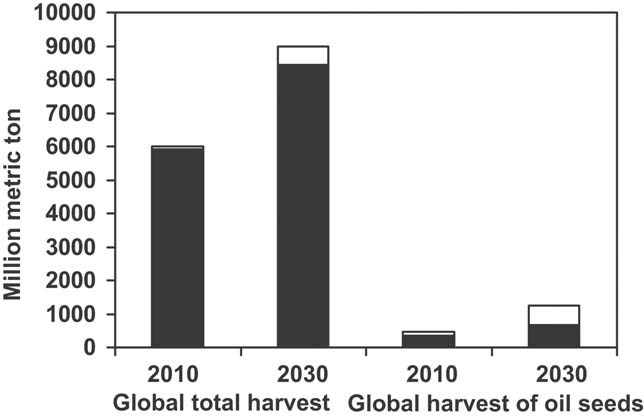
Proportion of actual and forecasted total agricultural harvest and harvest of oilseeds for chemical industry if 40% of the feedstock for chemical industry should be replaced by plant oils by 2030. Total agricultural harvest at 2030 has been forecast assuming a yearly increase of about 2%. The amount of oil seeds harvested in 2030 is derived from a forecasted global production of plant oil of 390 Mt. Values are partly based on information in the OECD/FAO Agricultural Market Outlook [140]. Open bar areas indicate oil crops harvest required for chemical industry assuming a 40% oil content of the harvest.
Figure 3
Figure 3
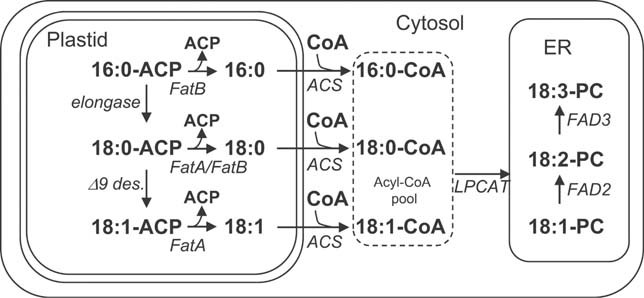
Generalised scheme of the biosynthesis of the five common fatty acids and the main enzyme steps involved. The first three fatty acids (16:0, 18:0 and 18: 1Δ9) are produced by de novo synthesis and desaturation in the plastids. Elongation and desaturation are carried out while the fatty acids are attached to acyl carrier protein (ACP). After removal of the ACP group by acyl-ACP thioesterases (FatA or FatB), the fatty acids are exported from the plastid and incorporated into the cytosolic acyl-CoA by the action of an acyl-CoA synthetase (ACS). 18:1Δ9 is then acylated onto PC, mainly by the action of the LPCAT. Further desaturations of the 18:1Δ9 to 18:2Δ9,12 and 18:3Δ9,12,15 are catalysed by FAD2 and FAD3 while the acyl substrates are acylated to PC. The further synthesis of glycerol lipids from acyl-CoA are depicted in Fig. 4
Figure 4
Figure 4
Overview of the production of storage oil in plant seeds. The acyl-CoA dependent acylation of glycerol-3-phosphate (G3P), first to lysophosphatidic acid (LPA) and then to phosphatidic acid (PA), is catalysed by the enzymes GPAT and LPAAT. Phosphatidic acid phosphatase (PAP) catalyses the dephosphorylation of PA to produce DAG and the final acylation to TAG is catalysed by DGAT. DAG can also be converted to PC by choline phosphotransferase (CPT) and/or PC/DAG cholinephosphotransferase (PDCT). TAG can also be formed by direct transfer of the acyl group from PC to DAG via the action of phospholipid/PDAT. LPCAT channels fatty acids into PC for desaturation by acylation of LPC. In the reverse reaction of LPCAT, PUFA can be transferred out to the acyl-CoA pool for utilisation in TAG synthesis.
Figure 5
Figure 5
Schematic diagram of the biosynthesis of 22:1–22:1 wax esters. The membrane bound FAE elongates the 18:1-CoA in two steps on the cytosolic side of the ER membrane, after which the 22:1 fatty acid is reduced to 22:1 alcohol in two steps catalysed by a FAR. In the final step, a WS esterifies a fatty acid to a fatty alcohol to produce the 22:1–22:1 wax ester.
Figure 6
Figure 6
Light microscopy pictures of (A) nutsedge tubers at 35 days after tuber initiation and (B) endosperm tissue from developing oat grain. In (A) oil is seen as discrete grey bodies (o), starch grains (s) are visible as white or reddish structures enclosed by amyloplast, and remaining vacuoles (v) as areas with white vesicles. In (B) the different sub-layers of the endosperm (e) are marked as aleurone (a), sub-aleurone (sa) and the starchy endosperm (se). Starch granules (s) are present in sub-aleurone layer and starchy endosperm but not in the aleurone layer. Oil is present as oil bodies (o) in the aleurone and sub-aleurone layer, either as oil bodies (o) or confluent oil masses (om) in starchy endosperm.

Similar articles

Cited by

References

    1. FAO, How to Feed the World in 2050. in: Expert Meeting on How to feed the World in 2050. FAO Headquarters, Rome, 24–26 June. 2009, 35 pp. Available at http://www.fao.org/fileadmin/templates/wsfs/docs/expert_paper/How_to_Fee... {accessed on 17 November 2010}
    1. USDA-FAS, Table 03: Major Vegetable Oils: World Supply and Distribution (Commodity View). in: Oilseeds: World Markets and Trade Monthly Circular. 2010. Acess at http://www.fas.usda.gov/oilseeds/circular/Current.asp {accessed on 16 November 2010}
    1. Janssen M, de Bresser L, Baijens T, Tramper J, et al. Scale-up aspects of photobioreactors: Effects of mixing-induced light/dark cycles. J. Appl. Phycol. 2000;12:225–237.
    1. Janssen M, Tramper J, Mur LR, Wijffels RH. Enclosed outdoor photobioreactors: Light regime, photosynthetic efficiency, scale-up, and future prospects. Biotechnol. Bioeng. 2003;81:193–210. - PubMed
    1. Rapier R. The man who wrote the book on algal biodiesel. in: The Oil Drum | Discussions about Energy and Our Future. 2007. Acess at http://www.theoildrum.com/node/2541 {accessed on 17 November 2010}