. 2011 Nov 15:2:226.
doi: 10.3389/fmicb.2011.00226. eCollection 2011.

Enhanced Actin Pedestal Formation by Enterohemorrhagic Escherichia coli O157:H7 Adapted to the Mammalian Host

Affiliations

Enhanced Actin Pedestal Formation by Enterohemorrhagic Escherichia coli O157:H7 Adapted to the Mammalian Host

Michael John Brady et al. Front Microbiol. .

Abstract

Upon intestinal colonization, enterohemorrhagic Escherichia coli (EHEC) induces epithelial cells to generate actin "pedestals" beneath bound bacteria, lesions that promote colonization. To induce pedestals, EHEC utilizes a type III secretion system to translocate into the mammalian cell bacterial effectors such as translocated intimin receptor (Tir), which localizes in the mammalian cell membrane and functions as a receptor for the bacterial outer membrane protein intimin. Whereas EHEC triggers efficient pedestal formation during mammalian infection, EHEC cultured in vitro induces pedestals on cell monolayers with relatively low efficiency. To determine whether growth within the mammalian host enhances EHEC pedestal formation, we compared in vitro-cultivated bacteria with EHEC directly isolated from infected piglets. Mammalian adaptation by EHEC was associated with a dramatic increase in the efficiency of cell attachment and pedestal formation. The amounts of intimin and Tir were significantly higher in host-adapted than in in vitro-cultivated bacteria, but increasing intimin or Tir expression, or artificially increasing the level of bacterial attachment to mammalian cells, did not enhance pedestal formation by in vitro-cultivated EHEC. Instead, a functional assay suggested that host-adapted EHEC translocate Tir much more efficiently than does in vitro-cultivated bacteria. These data suggest that adaptation of EHEC to the mammalian intestine enhances bacterial cell attachment, expression of intimin and Tir, and translocation of effectors that promote actin signaling.

Keywords: EHEC; Tir; actin assembly; host adaptation; intimin; translocation.


Figures

Figure 1
Figure 1
Enterohemorrhagic Escherichia coli actin pedestal formation and adhesion are enhanced upon host adaptation. (A) Mammalian cell monolayers were infected with host-adapted EHEC (top), in vitro-cultured EHEC (middle) or in vitro-cultured EHEC ectopically expressing the afimbrial adhesin AFA-1 (bottom). Bacteria were stained with DAPI (“EHEC”) and actin pedestals with Alexa568-phalloidin (”F-actin”). The percentage of actin pedestals (±SD) per 100 mammalian cells was determined visually (right). (B) Binding of the same three strains to mammalian cell monolayers was determined by plating for viable counts. Data represent the mean ± SD from three independent experiments. *P ≤ 0.05.
Figure 2
Figure 2
Intimin expression is increased during host adaptation but is not solely responsible for enhanced pedestal formation. (A) Equivalent numbers of bacteria were utilized to generate bacterial lysates of host-adapted or in vitro-cultivated EHEC that were subjected to immunoblotting using anti-intimin antibody. The in vitro-cultivated EHEC included wild type bacteria ±pInt, a plasmid that encodes intimin (pInt, lane 3), and EHECΔeae, which does not express intimin (lane 4). Molecular weight markers are indicated at left. (B) Equivalent numbers of the indicated strains were added to microtiter wells, fixed, and the relative number of bound bacteria was normalized by ELISA using anti-O157 antiserum. Parallel microtiter wells were subjected to anti-intimin ELISA to determine relative intimin surface expression. Shown are the mean OD600 values (±SD) of quadruplicate samples after subtraction of background (i.e., signal when the primary antibody was omitted) and normalized to bacterial number. (C) The percent of bacteria bound, determined by plating for viable counts, and the frequency of pedestal formation was determined as described in Figure 1. ND, not detected. *P ≤ 0.05.
Figure 3
Figure 3
Translocated intimin receptor expression is increased during host adaptation but is not solely responsible for enhanced pedestal formation. (A) Equivalent numbers of bacteria were utilized to generate bacterial lysates of host-adapted or in vitro-cultivated EHEC that were subjected to immunoblotting using anti-intimin antibody. The in vitro-cultivated EHEC included wild type bacteria ± pTir a plasmid that encodes Tir (pTir, lane 3), and EHECΔtir (lane 4). Molecular weight is indicated at left. (B) Percent bacteria bound and the frequency of pedestal formation was determined as described in Figure 1. ND, not detected.*P ≤ 0.05.
Figure 4
Figure 4
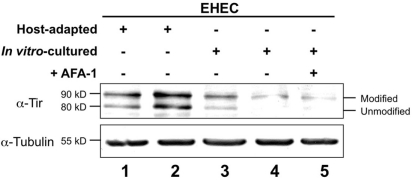
Translocated intimin receptor translocation is enhanced upon host adaptation. Mammalian cell monolayers were infected for 6 h with equivalent numbers of host-adapted EHEC isolated from the intestine of two different gnotobiotic piglets (lanes 1–2) or in vitro-cultured EHEC strains alone (lanes 3–4) or in vitro-cultured EHEC harboring a plasmid encoding AFA-1 (lane 5). Lysates of infected monolayers were resolved by SDS-PAGE and immunoblotted for Tir and tubulin. Western blots from a representative experiment are shown. The migration of unmodified and modified Tir is indicated (right), and numbers on the left indicate apparent molecular mass.

References

    1. Acheson D. W., De Breucker S. A., Jacewicz M., Lincicome L. L., Donohue-Rolfe A., Kane A. V., Keusch G. T. (1995). Expression and purification of Shiga-like toxin II B subunits. Infect. Immun. 63, 301–308 - PMC - PubMed
    1. Agin T. S., Wolf M. K. (1997). Identification of a family of intimins common to Escherichia coli causing attaching-effacing lesions in rabbits, humans, and swine. Infect. Immun. 65, 320–326 - PMC - PubMed
    1. Ando H., Abe H., Sugimoto N., Tobe T. (2007). Maturation of functional type III secretion machinery by activation of anaerobic respiration in enterohaemorrhagic Escherichia coli. Microbiology 153, 464–47310.1099/mic.0.2006/000893-0 - DOI - PubMed
    1. Antunes L. C., Ferreira R. B., Buckner M. M., Finlay B. B. (2010). Quorum sensing in bacterial virulence. Microbiology 156, 2271–228210.1099/mic.0.038794-0 - DOI - PubMed
    1. Bhatt S., Romeo T., Kalman D. (2011). Honing the message: post-transcriptional and post-translational control in attaching and effacing pathogens. Trends Microbiol. 19, 217–22410.1016/j.tim.2011.01.004 - DOI - PMC - PubMed

LinkOut - more resources