


Data partitions, Bayesian analysis and phylogeny of the zygomycetous fungal family Mortierellaceae, inferred from nuclear ribosomal DNA sequences
- PMID: 22102902
- PMCID: PMC3213126
- DOI: 10.1371/journal.pone.0027507
Data partitions, Bayesian analysis and phylogeny of the zygomycetous fungal family Mortierellaceae, inferred from nuclear ribosomal DNA sequences
Abstract
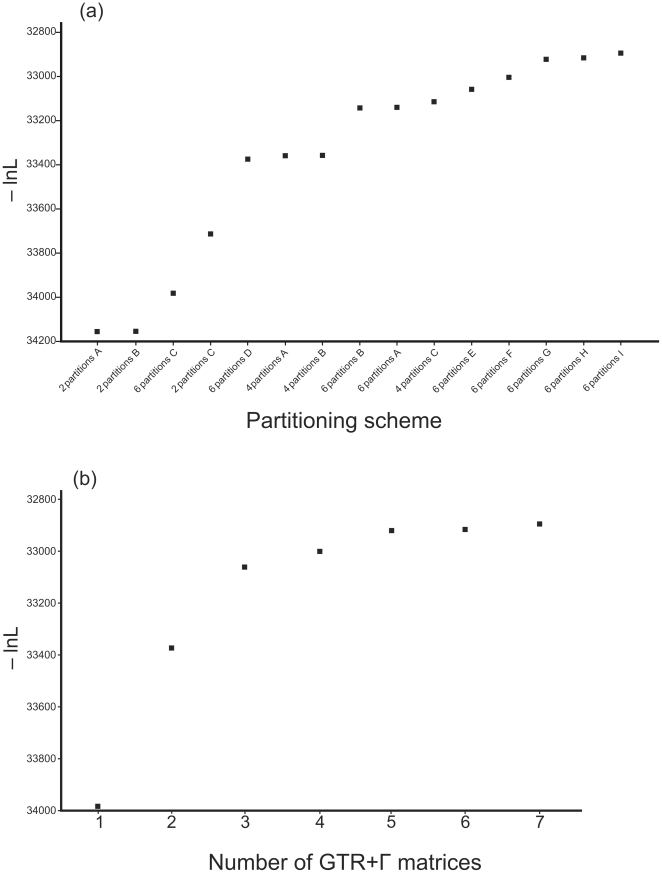
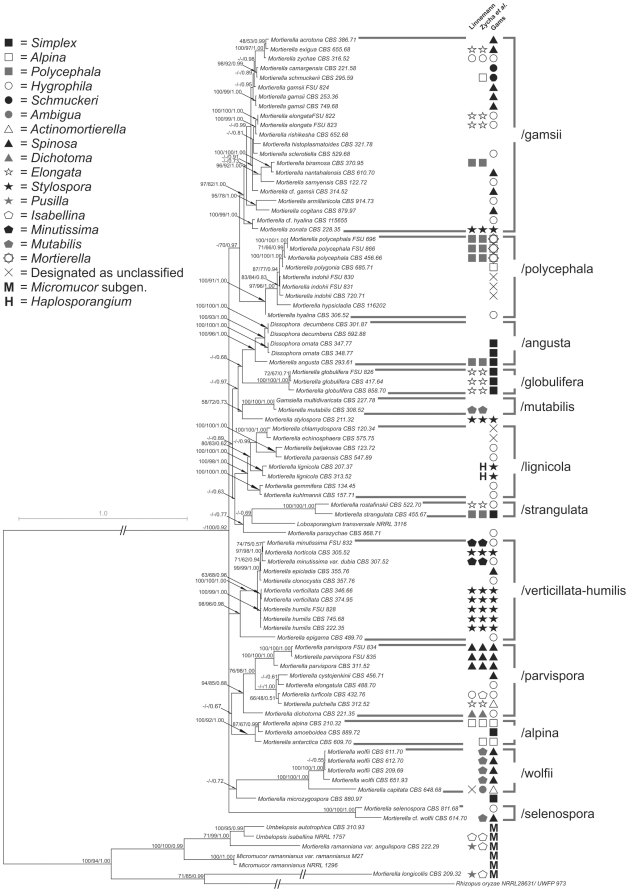
Although the fungal order Mortierellales constitutes one of the largest classical groups of Zygomycota, its phylogeny is poorly understood and no modern taxonomic revision is currently available. In the present study, 90 type and reference strains were used to infer a comprehensive phylogeny of Mortierellales from the sequence data of the complete ITS region and the LSU and SSU genes with a special attention to the monophyly of the genus Mortierella. Out of 15 alternative partitioning strategies compared on the basis of Bayes factors, the one with the highest number of partitions was found optimal (with mixture models yielding the best likelihood and tree length values), implying a higher complexity of evolutionary patterns in the ribosomal genes than generally recognized. Modeling the ITS1, 5.8S, and ITS2, loci separately improved model fit significantly as compared to treating all as one and the same partition. Further, within-partition mixture models suggests that not only the SSU, LSU and ITS regions evolve under qualitatively and/or quantitatively different constraints, but that significant heterogeneity can be found within these loci also. The phylogenetic analysis indicated that the genus Mortierella is paraphyletic with respect to the genera Dissophora, Gamsiella and Lobosporangium and the resulting phylogeny contradict previous, morphology-based sectional classification of Mortierella. Based on tree structure and phenotypic traits, we recognize 12 major clades, for which we attempt to summarize phenotypic similarities. M. longicollis is closely related to the outgroup taxon Rhizopus oryzae, suggesting that it belongs to the Mucorales. Our results demonstrate that traits used in previous classifications of the Mortierellales are highly homoplastic and that the Mortierellales is in a need of a reclassification, where new, phylogenetically informative phenotypic traits should be identified, with molecular phylogenies playing a decisive role.
Conflict of interest statement
Figures
References
-
- Shinmen Y, Shimizu S, Akimoto K, Kawashima H, Yamada H. Production of arachidonic acid by Mortierella fungi: selection of a potent producer and optimization of culture for large-scale production. Appl Microbiol Biotechnol. 1989;31:11–16.
-
- Higashiyama K, Fujikawa S, Park EY, Shimizu S. Production of arachidonic acid by Mortierella fungi. Biotechnol Bioprocess Eng. 2002;7
-
- Ratledge C. Fatty acid biosynthesis in microorganisms being used for single cell oil production. Biochimie. 2004;86:807–815. - PubMed
-
- Holland HL. Biotransformation of organic sulfides. Nat Prod Rep. 2001;18:171–181. - PubMed
-
- Trytek M, Fiedurek J. A novel psychrotrophic fungus, Mortierella minutissima, for D–limonene biotransformation. Biotechnol Lett. 2005;27:149–153. - PubMed
Publication types
MeSH terms
Substances
LinkOut - more resources
Full Text Sources
Medical
Molecular Biology Databases
