


Molecular mechanisms of maternal cannabis and cigarette use on human neurodevelopment
- PMID: 22103415
- PMCID: PMC3226730
- DOI: 10.1111/j.1460-9568.2011.07884.x
Molecular mechanisms of maternal cannabis and cigarette use on human neurodevelopment
Abstract
Prenatal development is highly sensitive to maternal drug use due to the vulnerability for disruption of the fetal brain with its ongoing neurodevelopment, resulting in lifelong consequences that can enhance risk for psychiatric disorders. Cannabis and cigarettes are the most commonly used illicit and licit substances, respectively, among pregnant women. Although the behavioral consequences of prenatal cannabis and cigarette exposure have been well-documented in epidemiological and clinical studies, only recently have investigations into the molecular mechanisms associated with the developmental impact of early drug exposure been addressed. This article reviews the literature relevant to long-term gene expression disturbances in the human fetal brain in relation to maternal cannabis and cigarette use. To provide translational insights, we discuss animal models in which protracted molecular consequences of prenatal cannabis and cigarette exposure can be better explored and which enable future evaluation of epigenetic pathways, such as DNA methylation and histone modification, that could potentially maintain abnormal gene regulation and related behavioral disturbances. Altogether, this information may help to address the current gaps of knowledge regarding the impact of early drug exposure that set in motion lifelong molecular disturbances that underlie vulnerability to psychiatric disorders.
© 2011 The Authors. European Journal of Neuroscience © 2011 Federation of European Neuroscience Societies and Blackwell Publishing Ltd.
Figures
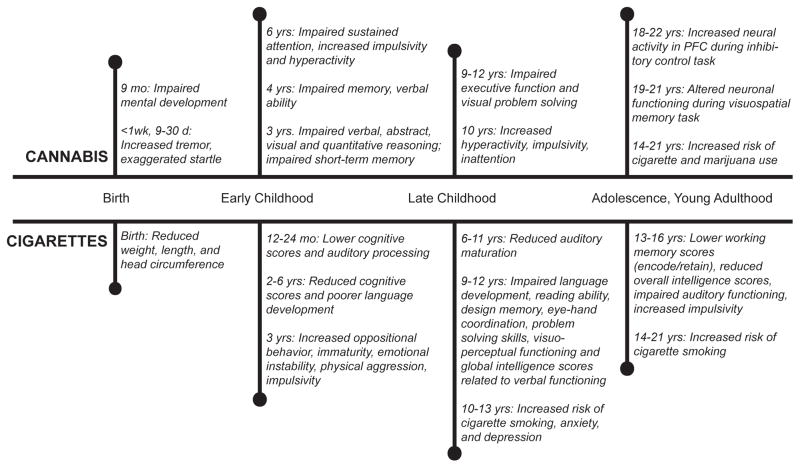
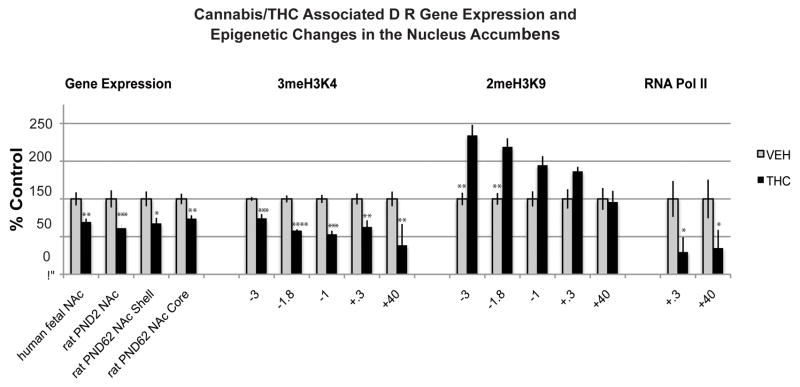
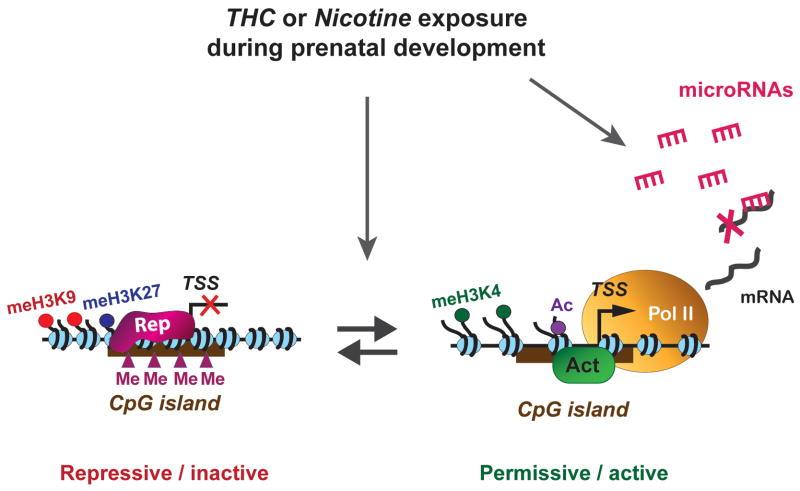
References
-
- Akil H, Watson SJ, Young E, Lewis ME, Khachaturian H, Walker JM. Endogenous opioids: biology and function. Annu Rev Neurosci. 1984;7:223. - PubMed
-
- Bals-Kubik R, Ableitner A, Herz A, Shippenberg TS. Neuroanatomical sites mediating the motivational effects of opioids as mapped by the conditioned place preference paradigm in rats. J Pharmacol Exp Ther. 1993;264:489–495. - PubMed
-
- Bannister AJ, Kouzarides T. Reversing histone methylation. Nature. 2005;436:1103–1106. - PubMed
-
- Berghuis P, Rajnicek AM, Morozov YM, Ross RA, Mulder J, Urban GM, Monory K, Marsicano G, Matteoli M, Canty A, Irving AJ, Katona I, Yanagawa Y, Rakic P, Lutz B, Mackie K, Harkany T. Hardwiring the brain: endocannabinoids shape neuronal connectivity. Science. 2007;316:1212–1216. - PubMed
-
- Brana C, Charron G, Aubert I, Carles D, Martin-Negrier ML, Trouette H, Fournier MC, Vital C, Bloch B. Ontogeny of the striatal neurons expressing neuropeptide genes in the human fetus and neonate. J Comp Neurol. 1995;360:488–505. - PubMed
Publication types
MeSH terms
Substances
Grants and funding
LinkOut - more resources
Full Text Sources
Medical
