Review
. 2011 Dec;39(6):1735-41.
doi: 10.1042/BST20110724.

Evolvement of LEM proteins as chromatin tethers at the nuclear periphery

Affiliations
Review

Evolvement of LEM proteins as chromatin tethers at the nuclear periphery

Andreas Brachner et al. Biochem Soc Trans. 2011 Dec.

Abstract

The nuclear envelope in eukaryotic cells has important roles in chromatin organization. The inner nuclear membrane contains over 60 transmembrane proteins. LEM [LAP2 (lamina-associated polypeptide 2)/emerin/MAN1] domain-containing proteins of the inner nuclear membrane are involved in tethering chromatin to the nuclear envelope and affect gene expression. They contain a common structural, bihelical motif, the so-called LEM domain, which mediates binding to a conserved chromatin protein, BAF (barrier to autointegration factor). Interestingly, this domain is highly related to other bihelical motifs, termed HeH (helix-extension-helix) and SAP {SAF (scaffold attachment factor)/acinus/PIAS [protein inhibitor of activated STAT (signal transducer and activator of transcription)]} motifs, which are directly linked to DNA. In the present paper, we summarize evidence that the LEM motif evolved from the HeH and SAP domains concomitantly with BAF. In addition, we discuss the potential evolution of HeH/SAP and LEM domain-containing proteins and their role in chromatin tethering and gene regulation from unicellular eukaryotes to mammals.


Figures
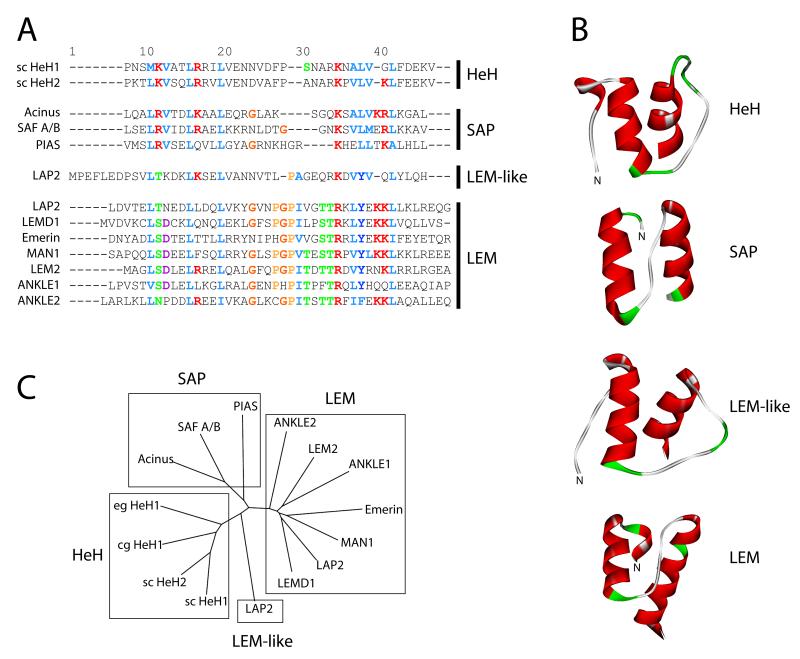
Figure 1
Figure 1. The LEM-, LEM-like, SAP and HeH motifs are conserved at sequence and structural levels
(A) Alignment of yeast HeH-, and human SAP-, LEM-like and LEM-domain sequences. Colors indicate conservation of biochemically similar residues according to the ClustalX color scheme (http://www.clustal.org/). (B) In silico secondary structure predictions (http://www.cbs.dtu.dk/services/CPHmodels/) of yeast HeH1 and the human SAP-motif of PIAS1, LEM-like motif of LAP2 and LEM-motif of emerin. (C) Phylogenetic tree calculated from sequence alignments using ClustalX.
Figure 2
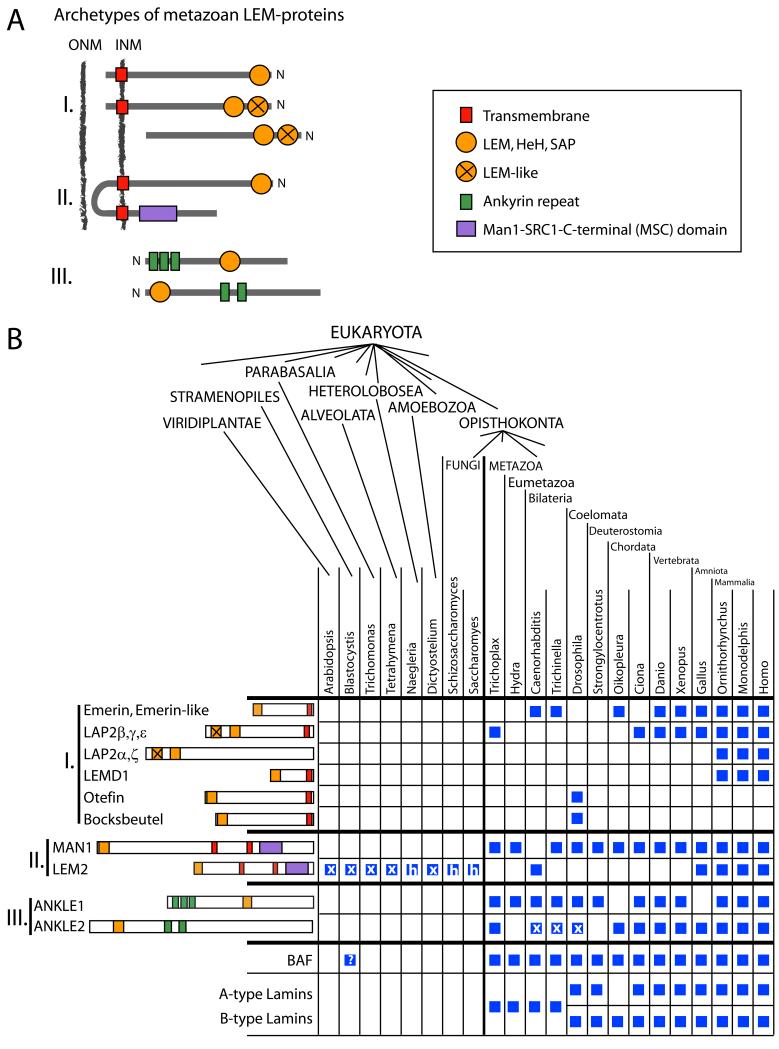
Figure 2. The evolution of the LEM domain-containing protein family
(A) Schematic drawing of the domain organization of LEM-proteins, defining three different groups. (B) Phylogenetic analysis of predicted and experimentally identified LEM-protein sequences obtained from NCBI and ENSEMBL databases. The presence of homologous LEM-proteins in selected species representing major lineages of the eukaryotic evolution are indicated by a blue square, “h” indicates the presence of a predicted HeH/SAP motif instead of a canonical LEM-motif. Squares are marked with “X” if the bi-helical motif was not detectable in an otherwise homologous sequence. Note that incomplete genomic sequence information may account for the absence of LEM-proteins in the scheme (e.g. Oikopleura Ankle1). Accession numbers can be found in supplemental table 1. Polypeptides predicted from genomic sequence using Genscan software (http://genes.mit.edu/GENSCAN.html) are marked with a “*”.

References

    1. D’Angelo MA, Hetzer MW. The role of the nuclear envelope in cellular organization. Cell Mol Life Sci. 2006;63:316–332. - PMC - PubMed
    1. Hetzer MW, Walther TC, Mattaj IW. Pushing the envelope: structure, function, and dynamics of the nuclear periphery. Annu Rev Cell Dev Biol. 2005;21:347–380. - PubMed
    1. Wilson KL, Foisner R. Lamin-binding Proteins. Cold Spring Harbor perspectives in biology. 2010;2:a000554. - PMC - PubMed
    1. Schirmer EC, Florens L, Guan T, Yates JR, 3rd, Gerace L. Nuclear membrane proteins with potential disease links found by subtractive proteomics. Science. 2003;301:1380–1382. - PubMed
    1. Dechat T, Pfleghaar K, Sengupta K, Shimi T, Shumaker DK, Solimando L, Goldman RD. Nuclear lamins: major factors in the structural organization and function of the nucleus and chromatin. Genes Dev. 2008;22:832–853. - PMC - PubMed

Publication types