


Review
doi: 10.2217/bmm.11.94.
From pharmacogenomic knowledge acquisition to clinical applications: the PharmGKB as a clinical pharmacogenomic biomarker resource
Affiliations
- PMID: 22103613
- PMCID: PMC3339046
- DOI: 10.2217/bmm.11.94
Item in Clipboard
Review
From pharmacogenomic knowledge acquisition to clinical applications: the PharmGKB as a clinical pharmacogenomic biomarker resource
Biomark Med.
2011 Dec.
Abstract
The mission of the Pharmacogenomics Knowledge Base (PharmGKB; www.pharmgkb.org ) is to collect, encode and disseminate knowledge about the impact of human genetic variations on drug responses. It is an important worldwide resource of clinical pharmacogenomic biomarkers available to all. The PharmGKB website has evolved to highlight our knowledge curation and aggregation over our previous emphasis on collecting primary data. This review summarizes the methods we use to drive this expanded scope of 'Knowledge Acquisition to Clinical Applications', the new features available on our website and our future goals.
Figures
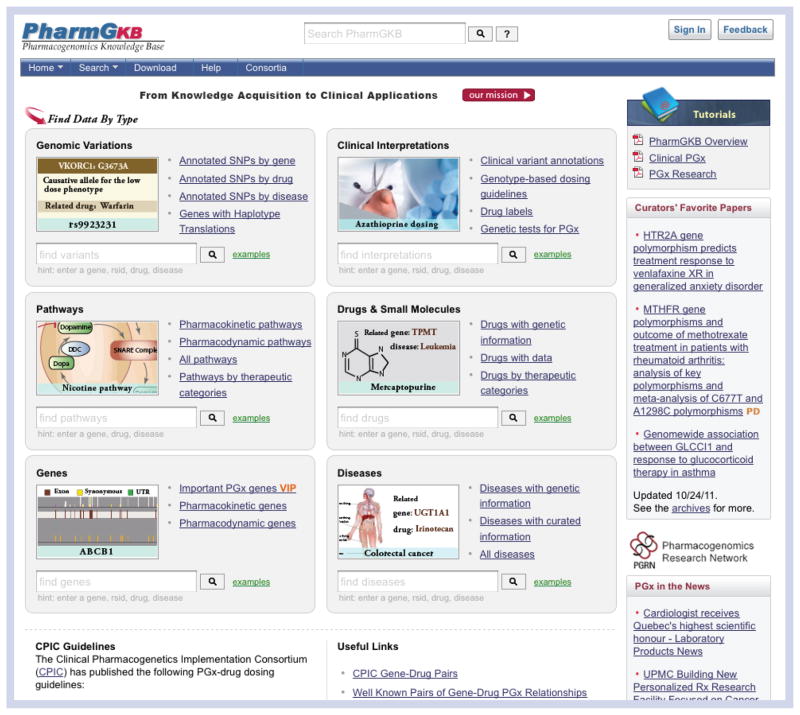
The Pharmacogenomics Knowledge Base (PharmGKB) homepage is found at [101]. The ‘Clinical Interpretations’ box (top middle) contains links to genotype-based dosing guidelines, drug label information, Clinical Annotations and genetic test information. The search box can also be used to find clinically related information for a drug, gene or variant. The search boxes for ‘Genomic Variations’, ‘Pathways’, ‘Drugs & Small Molecules’, ‘Genes’ and ‘Diseases’ have been rearranged to increase ease of usability. Top center: more information regarding the mission of PharmGKB “From Knowledge Acquisition to Clinical Applications” can be found by clicking on ‘our mission’. Top right: users can learn more about how to utilize the PharmGKB website through our tutorials. Right side panel: the curator’s favorite papers and pharmacogenomics news are constantly updated to keep users up to date with the most recent pharmacogenomic research and policies. Reprinted with permission from PharmGKB.
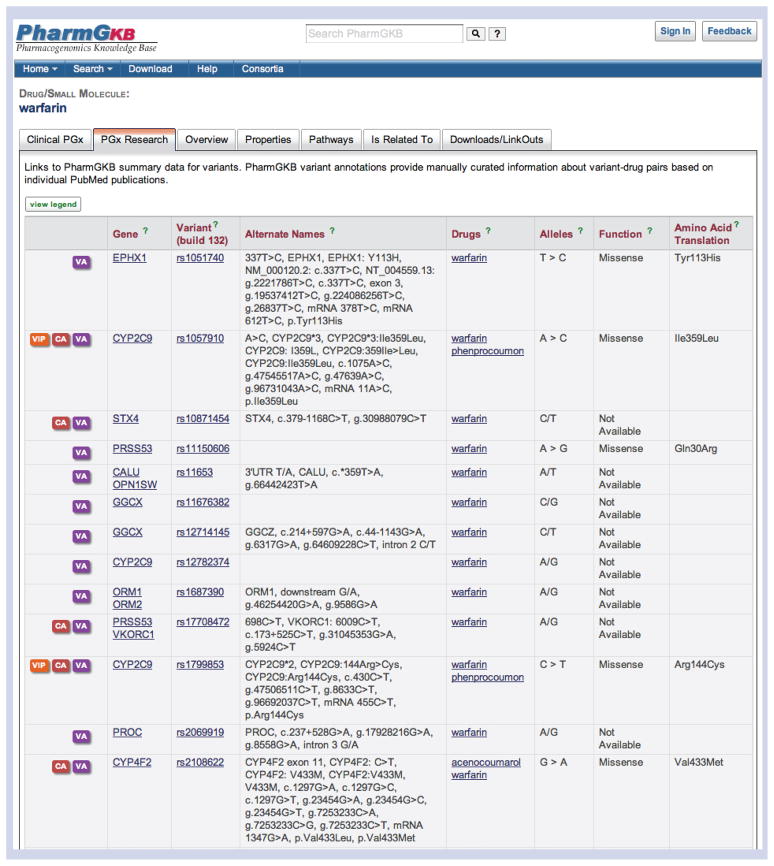
Under the ‘Pharmacogenomics (PGx) Research’ tab on a drug page, a list of variants with associations with the drug can be found. On gene pages, a similar format is found, with a list of variants within that gene and the drugs they have been associated with. If curated Variant Annotations and Clinical Annotations are available for the variant, this is represented by an icon in the first column of the table (Table 1). If the variant is described in a Very Important Pharmacogene (VIP) summary of the gene, this symbol is also provided (Table 1). As well as the reference single nucleotide polymorphisms identification (rsID), alternative names for the variant are provided. Useful information includes the variant alleles, the amino acid change (if applicable) and the features of the variant (e.g., a missense amino acid change). Alleles, Function and Amino Acid Translation are all sourced from single nucleotide polymorphisms database build 132 [103]. Reprinted with permission from PharmGKB.
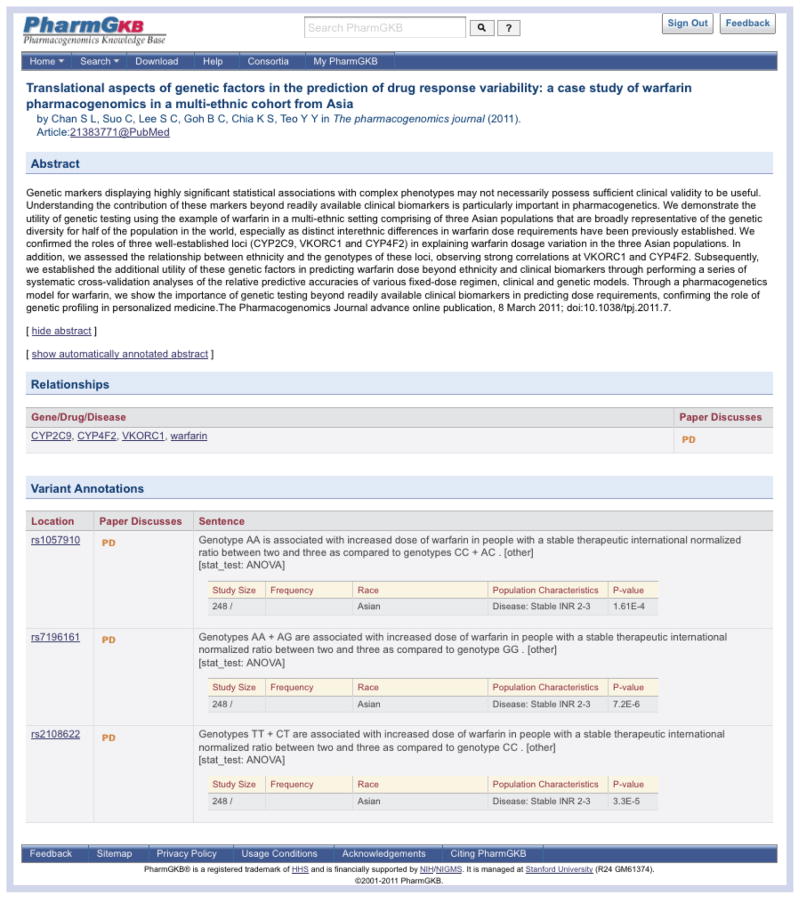
The title and reference of the journal are found at the top of the page, along with a link to the journal within PubMed® [102] (reference [1] is shown as an example). If available, the abstract is also provided. The Pharmacogenomics Knowledge Base (PharmGKB) curated sections are ‘Relationships’ and ‘Variant Annotations’. The genes, drugs and diseases discussed in the journal are provided in the ‘Relationships’ section, and link to each feature page in the database. Where possible, associations between a drug and a genetic variant reported in the journal are represented in the form of Variant Annotations in the table below. The variant reference single nucleotide polymorphism identification (rsID) is used as an identifier and whether the association was related to pharmacokinetics or pharmacodynamics is given in the ‘Paper discusses’ column (Table 1). Study parameters relevant to the association are also provided for each Variant Annotation in the sub-table. Reprinted with permission from PharmGKB.
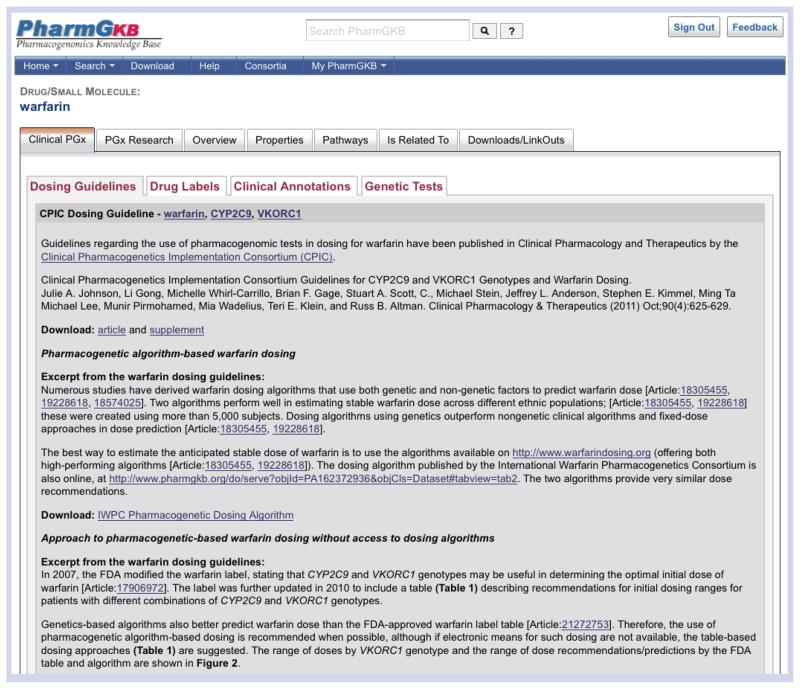
Clinical interpretation information can be found on every drug or gene page of the Pharmacogenomics Knowledge Base (PharmGKB) website. This is exemplified here with the drug warfarin. A drug page can be found in a number of ways, for example using the search boxes on the homepage or by simply searching for ‘warfarin’ in the search box at the top of the PharmGKB website. More information about our searches can be found in our tutorials (Figure 1). Under the ‘Clinical PGx’ tab is information related to genotype-based warfarin dosing guidelines (as shown here [8]), warfarin drug labeling information, curated PharmGKB Clinical Annotations for genetic variants involved in warfarin response, and genetic tests available for warfarin-related genotyping. Reprinted with permission from PharmGKB and Clinical Pharmacology & Therapeutics.
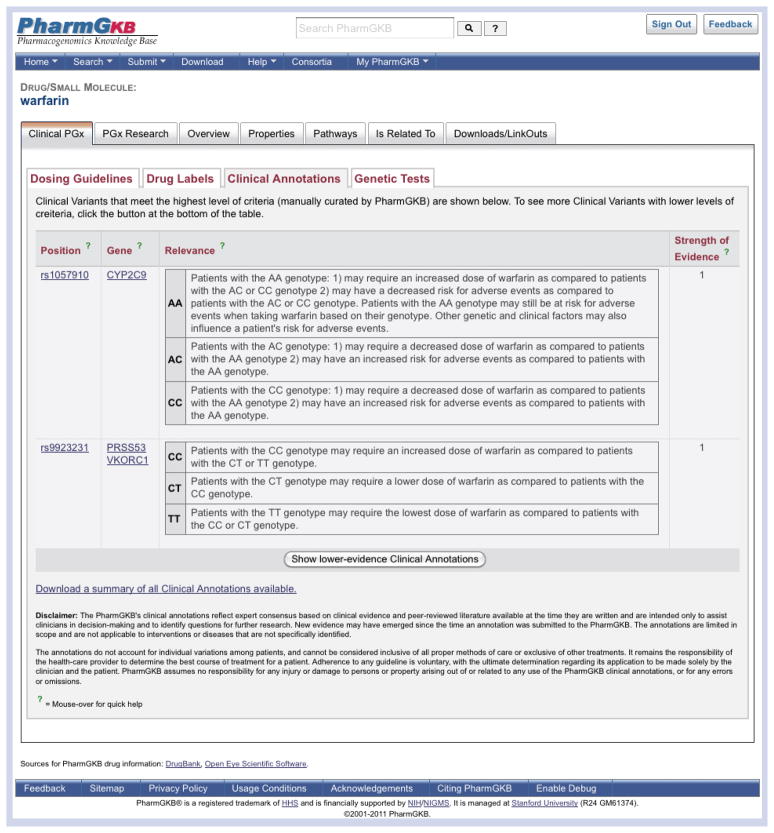
Clinical Annotations are created by the Pharmacogenomics Knowledge Base (PharmGKB) curators, weighing levels of evidence to provide an association between the drug and each genotype (Table 2). They are found on drug and gene pages under the ‘Clinical Pharmacogenomics (PGx)’ tab, as shown here for the drug warfarin. Reprinted with permission from PharmGKB.
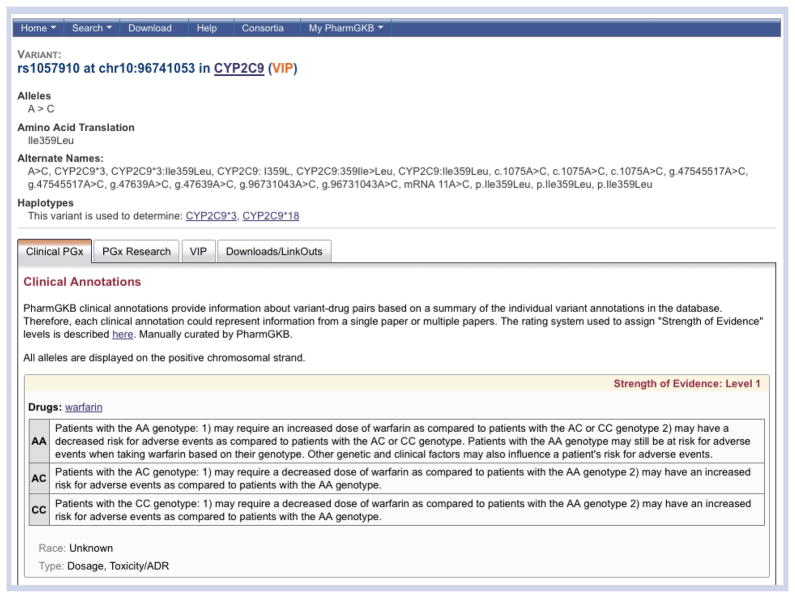
Each variant annotated on the Pharmacogenomics Knowledge Base (PharmGKB) has a page that includes information regarding the alleles, amino acid change (if relevant), alternative names that have been used to describe the variant and links to haplotypes that include the variant (if available). The ‘Clinical Pharmacogenomics (PGx)’ tab includes Clinical Annotations involving the variant and the ‘PGx Research’ tab lists Variant Annotations involving the variant. The ‘VIP’ tab is shown if Very Important Pharmacogene (VIP) summary information is available for the variant, and the ‘Downloads/Linkouts’ tab includes links to resources of further information. Reprinted with permission from PharmGKB.
References
-
- Chan SL, Suo C, Lee SC, Goh BC, Chia KS, Teo YY. Translational aspects of genetic factors in the prediction of drug response variability: a case study of warfarin pharmacogenomics in a multiethnic cohort from Asia. Pharmacogenomics J. 2011 doi: 10.1038/tpj.2011.7. (Epub ahead of print) - DOI - PubMed
-
- Bolton E, Wang Y, Thiessen PA, Bryant SH. PubChem: integrated platform of small molecules and biological activities. In: Bolton E, Wang Y, Thiessen PA, Bryant SH, editors. Annual Reports in Computational Chemistry. American Chemical Society; Washington, DC, USA: 2008.
Websites
-
- PharmGKB. www.pharmgkb.org.
-
- PubMed®. National Center for Biotechnology Information, US National Library of Medicine; www.ncbi.nlm.nih.gov/
-
- dbSNP. National Center for Biotechnology Information, US National Library of Medicine; www.ncbi.nlm.nih.gov/snp/
-
- National Library of Medicine’s Medical Subject Headings (MeSH browser) www.nlm.nih.gov/mesh/2011/mesh_browser/MBrowser.html.
-
- DrugBank. www.drugbank.ca.
Publication types
MeSH terms
Substances
Grants and funding
LinkOut - more resources
Full Text Sources
Other Literature Sources
