


Procoagulant activity in hemostasis and thrombosis: Virchow's triad revisited
- PMID: 22104070
- PMCID: PMC3264782
- DOI: 10.1213/ANE.0b013e31823a088c
Procoagulant activity in hemostasis and thrombosis: Virchow's triad revisited
Abstract
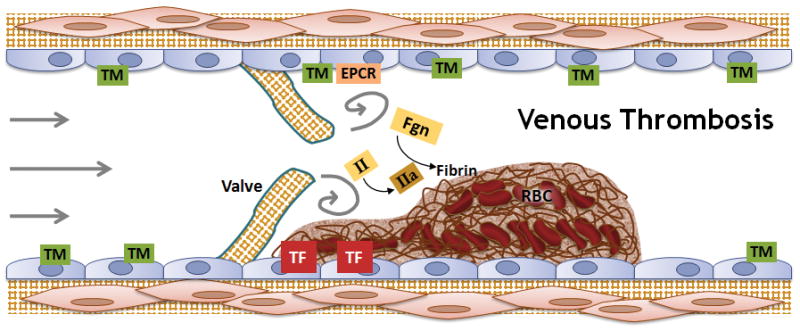
Virchow's triad is traditionally invoked to explain pathophysiologic mechanisms leading to thrombosis, alleging concerted roles for abnormalities in blood composition, vessel wall components, and blood flow in the development of arterial and venous thrombosis. Given the tissue-specific bleeding observed in hemophilia patients, it may be instructive to consider the principles of Virchow's triad when investigating mechanisms operant in hemostatic disorders as well. Blood composition (the function of circulating blood cells and plasma proteins) is the most well studied component of the triad. For example, increased levels of plasma procoagulant proteins such as prothrombin and fibrinogen are established risk factors for thrombosis, whereas deficiencies in plasma factors VIII and IX result in bleeding (hemophilia A and B, respectively). Vessel wall (cellular) components contribute adhesion molecules that recruit circulating leukocytes and platelets to sites of vascular damage, tissue factor, which provides a procoagulant signal of vascular breach, and a surface upon which coagulation complexes are assembled. Blood flow is often characterized by 2 key variables: shear rate and shear stress. Shear rate affects several aspects of coagulation, including transport rates of platelets and plasma proteins to and from the injury site, platelet activation, and the kinetics of fibrin monomer formation and polymerization. Shear stress modulates adhesion rates of platelets and expression of adhesion molecules and procoagulant activity on endothelial cells lining the blood vessels. That no one abnormality in any component of Virchow's triad fully predicts coagulopathy a priori suggests coagulopathies are complex, multifactorial, and interactive. In this review, we focus on contributions of blood composition, vascular cells, and blood flow to hemostasis and thrombosis, and suggest that cross-talk among the 3 components of Virchow's triad is necessary for hemostasis and determines propensity for thrombosis or bleeding. Investigative models that permit interplay among these components are necessary to understand the operant pathophysiology, and effectively treat and prevent thrombotic and bleeding disorders.
Conflict of interest statement
The authors declare no conflicts of interest.
Figures



References
-
- Heidenreich PA, Trogdon JG, Khavjou OA, Butler J, Dracup K, Ezekowitz MD, Finkelstein EA, Hong Y, Johnston SC, Khera A, Lloyd-Jones DM, Nelson SA, Nichol G, Orenstein D, Wilson PW, Woo YJ. Forecasting the future of cardiovascular disease in the United States: a policy statement from the American Heart Association. Circulation. 2011;123:933–44. - PubMed
-
- Schwartz NE, Albers GW. Dabigatran challenges warfarin's superiority for stroke prevention in atrial fibrillation. Stroke. 2010;41:1307–9. - PubMed
-
- Gailani D, Broze GJ., Jr Factor XI activation in a revised model of blood coagulation. Science. 1991;253:909–12. - PubMed
-
- Lord ST. Fibrinogen and fibrin: scaffold proteins in hemostasis. Curr Opin Hematol. 2007;14:236–41. - PubMed
Publication types
MeSH terms
Substances
Grants and funding
LinkOut - more resources
Full Text Sources
Medical
